Pick the unit your lengths are in. Areas are then labelled in square units and volumes in cubic units; nothing is converted.
What cosine is
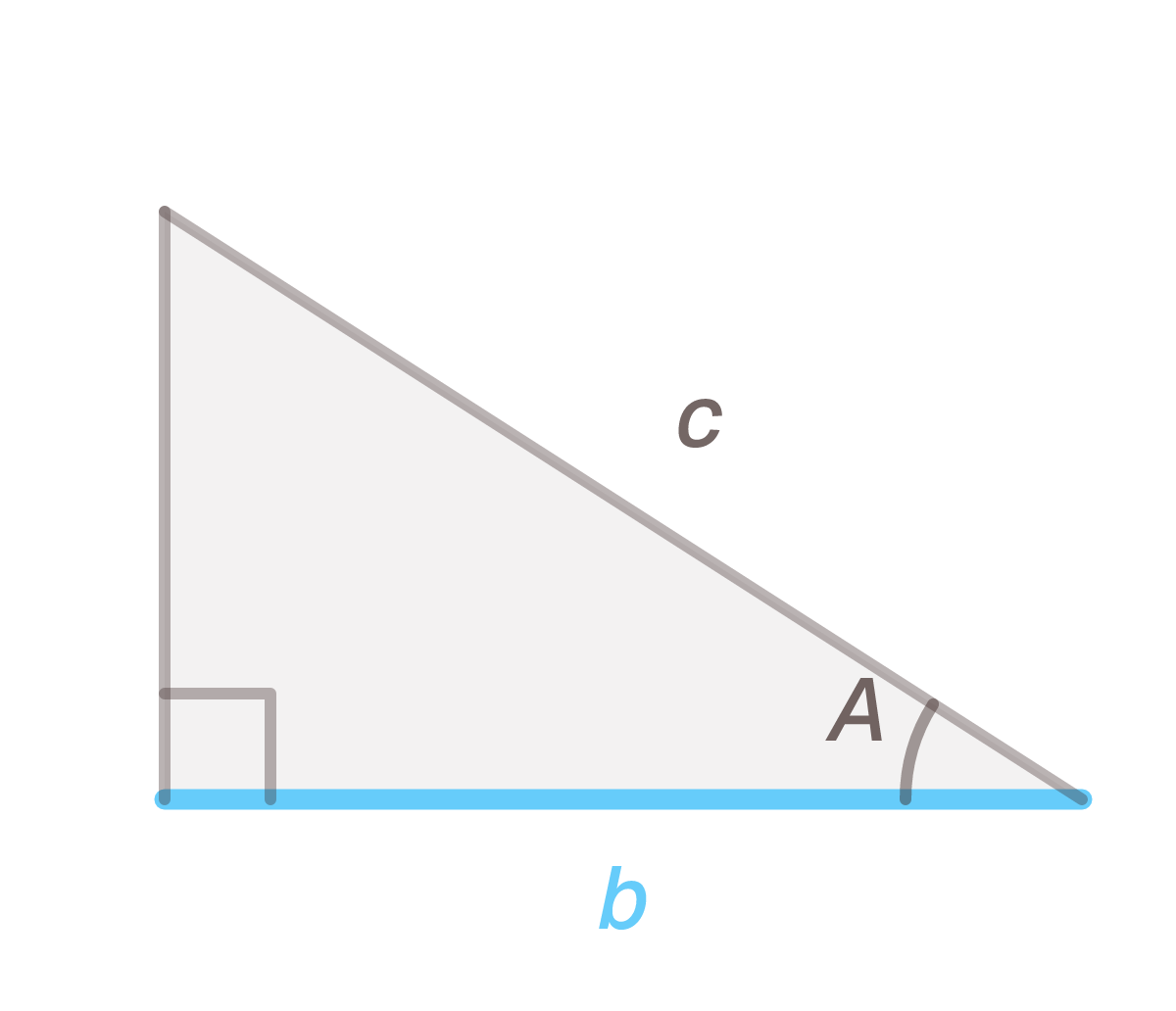
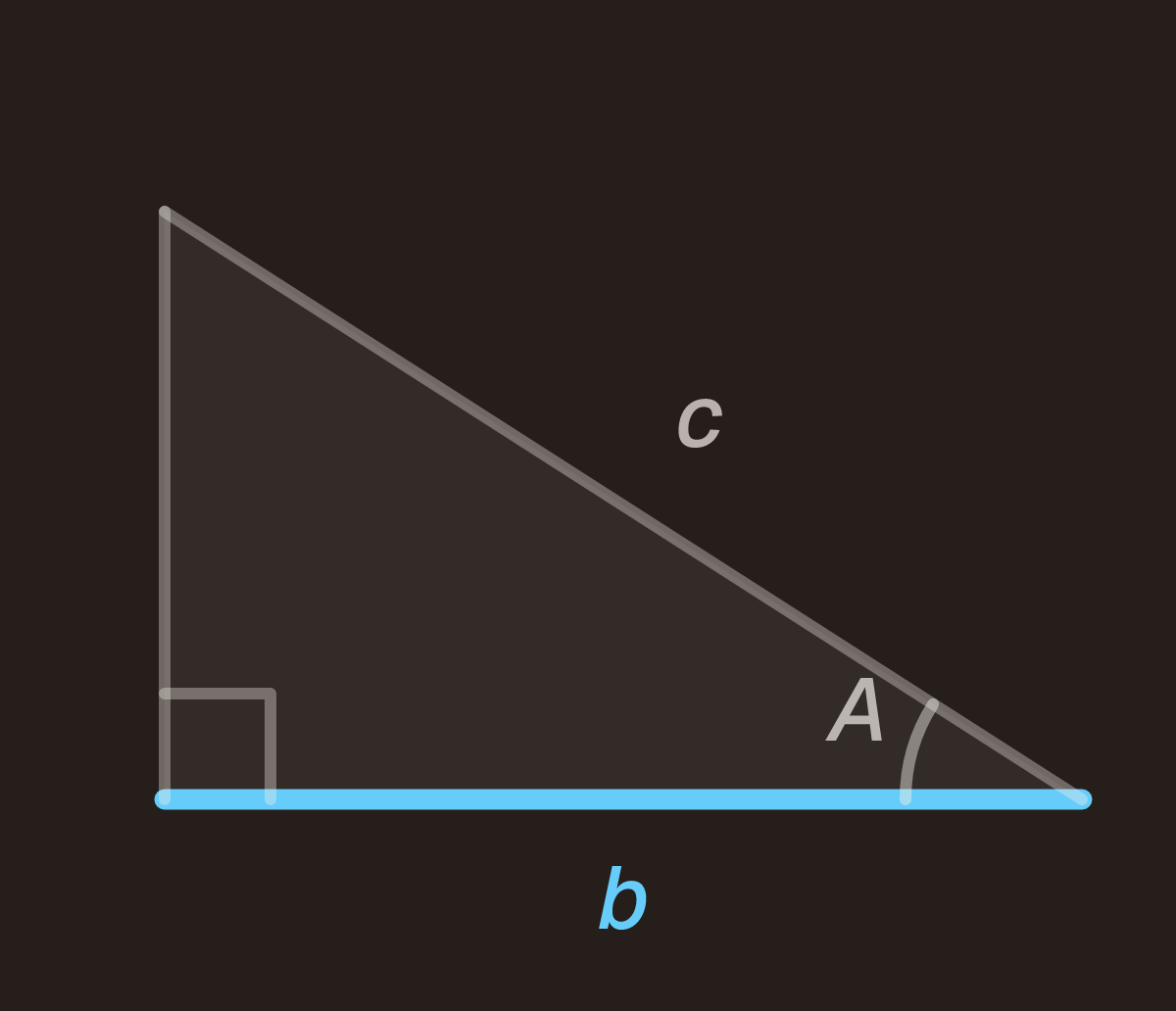
Pick one of the two angles in a right-angled triangle that is not the right angle. Two sides touch it:
the hypotenuse, and one of the other two. That one is the adjacent side, and the cosine of the angle
is the adjacent side divided by the hypotenuse.
As with sine, the ratio depends only on the angle. Two triangles with the same acute angle have the same
cosine however different their sizes.
Cosine is the sine of the other angle
The two acute angles in a right-angled triangle add to 90°, because all three add to 180° and one of
them has already taken 90. Switch angles and the two short sides swap roles: what was adjacent becomes
opposite. So
cos A = sin (90° − A)
It is the same triangle read from the other end, and often the quickest way to check an answer: cos 60° has to come out the same as sin 30°, which is 0.5.
Worked examples
A ladder. A 6.0 m ladder stands with its foot 2.0 m from the wall. What angle does it make with the
ground?
The distance to the wall is the adjacent side and the ladder is the hypotenuse:
- cos A = 2.0 / 6.0 = 0.3333
- A = arccos 0.3333 = 70.5°
A side from an angle. The same ladder leans at 75° to the ground. How far out is its foot?
- b = c · cos A = 6.0 · cos 75°
- b = 6.0 · 0.2588 = 1.6 m
The key for the first question is labelled cos⁻¹ or acos. It answers with an angle between 0° and
180°, though in a right-angled triangle only answers below 90° can occur.
Common mistakes
- The calculator in radian mode. cos 60° is 0.5, while cos 60 in radians is −0.952. Check that the
display says DEG.
- Confusing adjacent with opposite. The adjacent side touches the angle but is not the hypotenuse.
If the side you have is across from the angle, you want
sine instead.
- A cosine above 1. Same as with sine: the hypotenuse is the longest side, so the ratio cannot
exceed 1.
- Expecting cosine to grow with the angle. It does the opposite. At 0° the cosine is 1 and at 90° it
is 0 — the bigger the angle, the shorter the adjacent side is compared with the hypotenuse.
Frequently asked questions
When do you use cosine rather than sine?
When the side you know or want lies beside the angle rather than across from it. Hypotenuse and
adjacent side means cosine; hypotenuse and opposite side means sine. Two short sides and no
hypotenuse means neither — that is
tangent.
Which cosines are exact?
The same three angles as for sine, the other way round: cos 30° is √3/2, cos 45° is √2/2 and cos 60°
is 0.5. Those are the ones a textbook expects you to know. A few others have exact
forms too (cos 36° is (1 + √5)/4), but most angles give a value that has to be rounded.
What happens at 0° and 90°?
At 0° the cosine is 1 and the triangle is flat — the adjacent side has become the hypotenuse. At 90°
the cosine is 0. Neither is a real triangle, which is why the card above asks for an angle strictly
between them.