Pick the unit your lengths are in. Areas are then labelled in square units and volumes in cubic units; nothing is converted.
What sine is
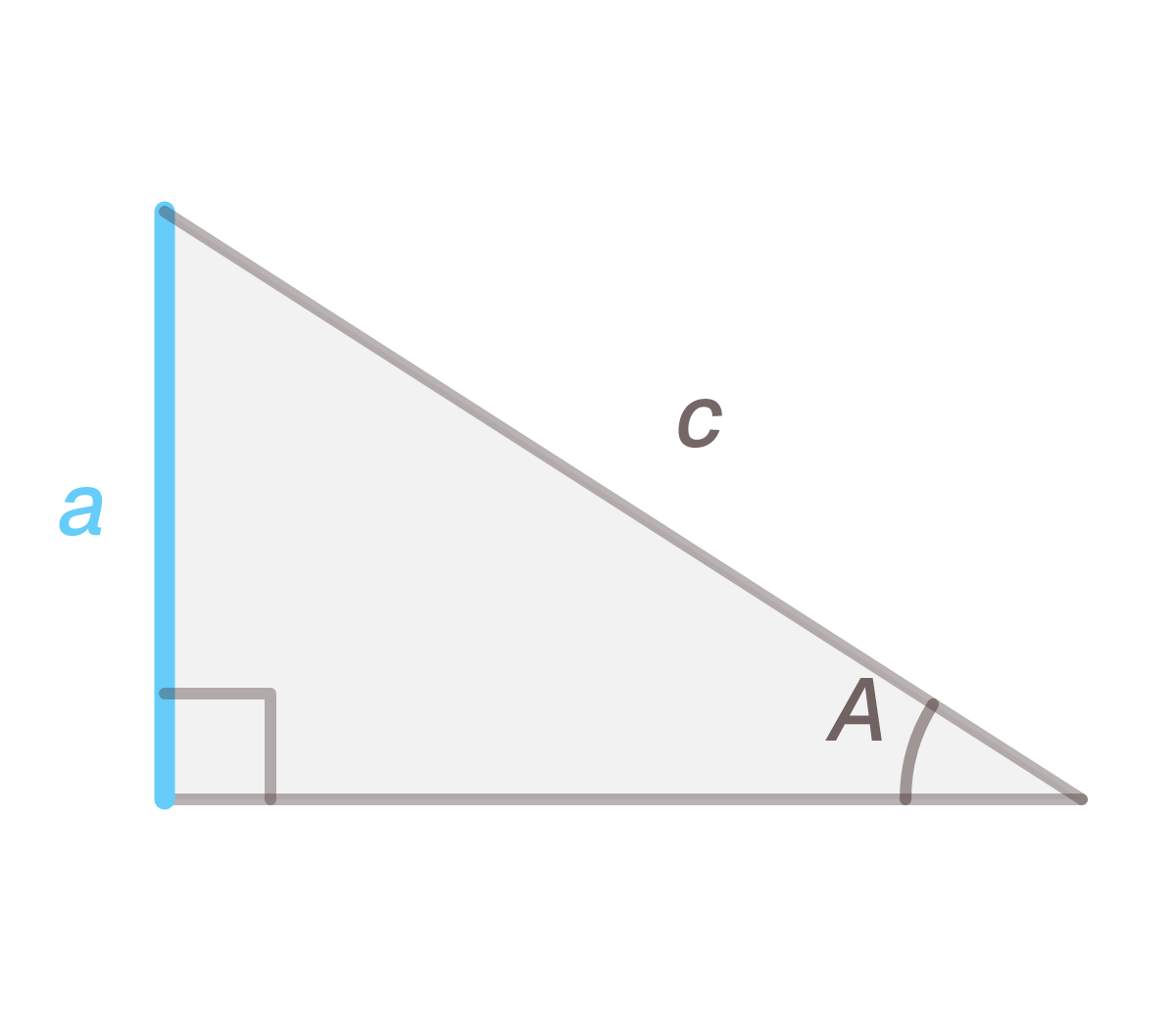
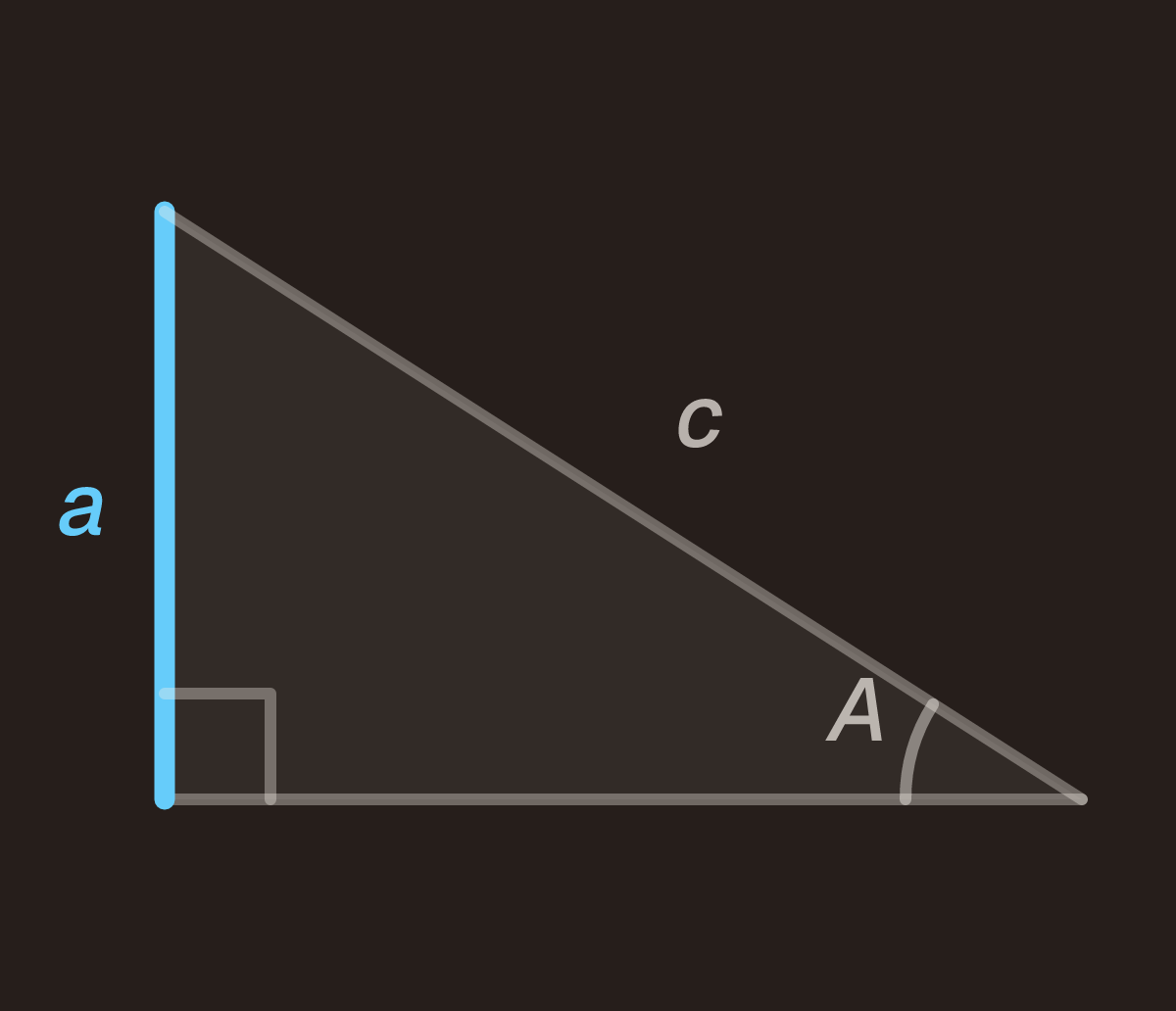
Draw a right-angled triangle and pick one of the two angles that is not the right angle. The sine of
that angle is the side opposite it divided by the hypotenuse.
Side a is the one facing the angle A across the triangle. The hypotenuse c is always the side opposite
the right angle, and always the longest. Which of the two acute angles you start from decides which side
counts as opposite — that is a property of the choice, not of the side.
The useful part is that the ratio ignores size. Double the whole triangle and both a and c double, so
a/c is unchanged. One angle therefore tells you the proportions of every right triangle with that angle in
it, and trigonometry is built on that.
Degrees, not radians
A common mistake with sine is a practical one: the calculator is in the wrong mode.
sin 30° is 0.5, but sin 30 read as radians is −0.988. Both are numbers, nothing looks broken, and the
answer is wrong without any sign of it.
Look for DEG on the display before you start. RAD or GRAD means it is measuring something else. The
card above always works in degrees, and prints the degree sign, so you can see what it assumed.
Worked examples
A ramp. A ramp is 4.0 m long and rises at 12° to the ground. How high does it reach?
The ramp is the hypotenuse and the height is the opposite side:
- a = c · sin A = 4.0 · sin 12°
- a = 4.0 · 0.2079 = 0.83 m
An angle from two sides. A 5.0 m ladder reaches 4.0 m up a wall. What angle does it make with the
ground?
Here the angle is the unknown, and it comes out by undoing the sine:
- sin A = 4.0 / 5.0 = 0.80
- A = arcsin 0.80 = 53°
The key is labelled sin⁻¹ or asin on most calculators. It always answers with an angle between −90°
and 90°, which is all a right-angled triangle needs — neither of its other two angles can be larger.
Common mistakes
- The calculator in radian mode. See above. A sine that looks plausible but gives the wrong answer
often comes from here.
- Taking the wrong side as opposite. The opposite side is the one that does not touch the angle at
all. If the side touches the angle it is either the hypotenuse or the adjacent side, and then you want
cosine instead.
- A sine above 1. No triangle has one. The hypotenuse is the longest side, so a/c can never exceed
1 — if it does, the values are in the wrong places.
- Using sine in a triangle with no right angle. The formula on this page holds for right-angled
triangles only.
Frequently asked questions
What is the difference between sine and cosine?
Sine uses the opposite side, cosine the adjacent one. They are the same thing seen from the other
acute angle: since those two angles add to 90°, the sine of one is always the cosine of the other.
Why is the answer a long decimal?
Because a sine is almost never a round number. Only a few angles give exact values — sin 30° is
exactly 0.5, sin 45° is √2/2 and sin 60° is √3/2. A few others have exact forms, but most angles
give a value that has to be rounded, and the rounding belongs in the last step, not along the way.
How does sine relate to Pythagoras?
They describe the same triangle from different starting points. Pythagoras’
theorem gives you the third side from two sides, with no angle
involved. Sine gives you a side from one side and an angle. Knowing two sides, you can take either
route.