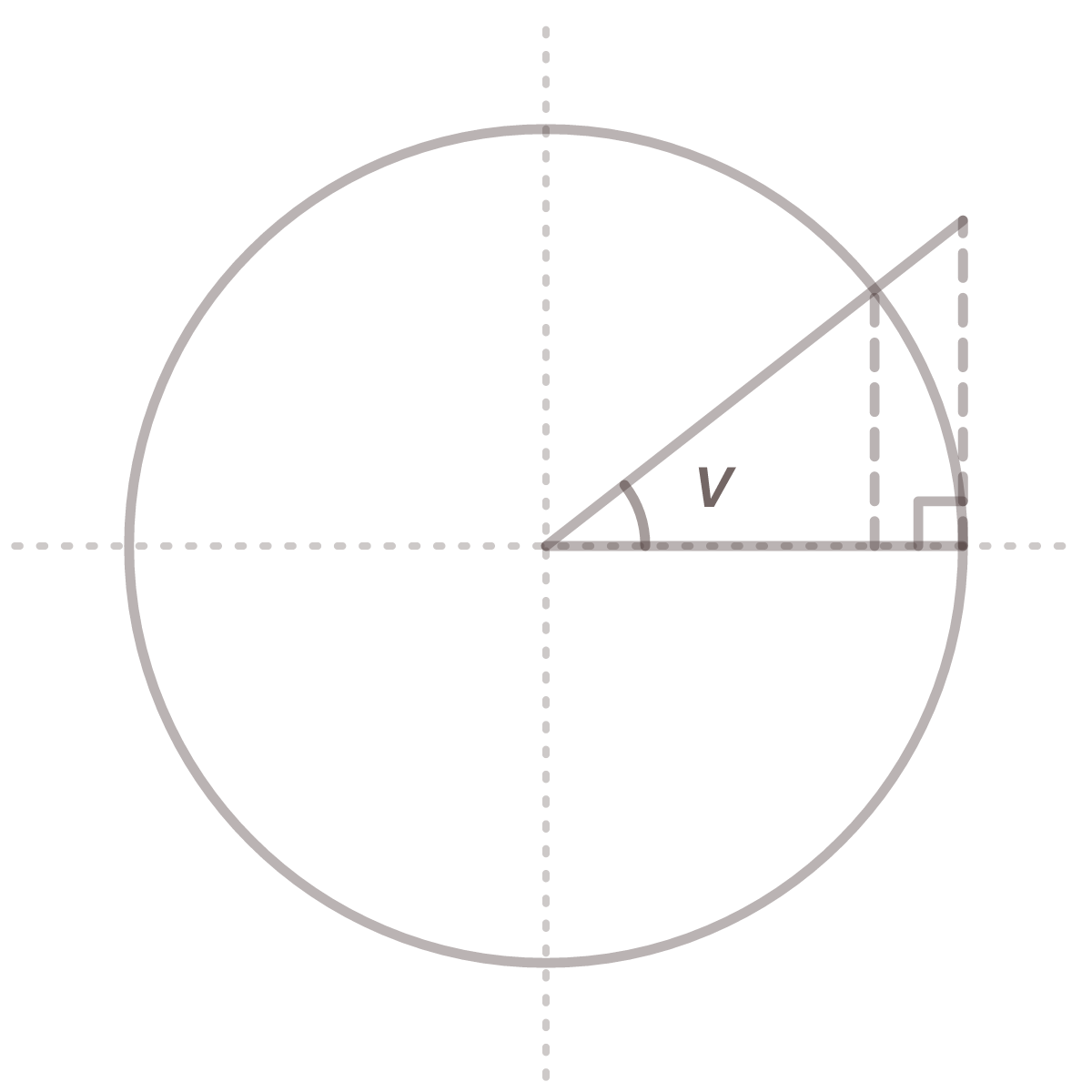
What the theorem says
- tan v = sin v / cos v
Holds when cos v ≠ 0, that is for every angle except 90° + n · 180°.
The three functions are not three separate things to learn. If you know sine and cosine, you know tangent, because the tangent is the quotient of the other two.
Why it is true
In a right-angled triangle with hypotenuse c, opposite side a and adjacent side b,
- sin v = a/c and cos v = b/c
Dividing one by the other cancels the c:
- sin v / cos v = (a/c) / (b/c) = a/b
and a/b — opposite over adjacent — is the definition of the tangent. The hypotenuse drops out.
The rule is not a new fact about angles; it is the same three sides read
in a different order.
Worked examples
A check. At 30°, sin 30° = 0.5 and cos 30° ≈ 0.866. The quotient 0.5 / 0.866 ≈ 0.577, which is tan 30°. Exactly, it is 1/√3.
When the quotient simplifies an equation. An equation like 3 sin v = 2 cos v is solved by dividing both
sides by cos v: 3 tan v = 2, so tan v = 2/3 and v ≈ 33.7°. Without the quotient rule you are stuck with
two different functions in one equation.
Where the tangent runs out. At 90°, cos 90° = 0, so the quotient is a division by zero. So a calculator returns an error: tan 90° does not exist, unlike sin 90°, which is 1.
Common mistakes
- Flipping the quotient. The tangent is the sine divided by the cosine, not the other way round. cos v / sin v is the cotangent, a different function. The check: the tangent grows as the angle approaches 90°, and only the quotient with the cosine underneath does that.
- Treating tan 90° as infinity. It is undefined. The value grows without bound as you approach 90°, but at the point itself there is no number.
- Assuming it only holds in right-angled triangles. The argument comes from the triangle, but the rule holds for every angle, obtuse and negative ones included, because the unit circle defines sine and cosine there too.
- Cancelling wrongly. sin v / cos v does not reduce to sin/cos as if
vwere a factor.vis the function’s argument, not something being multiplied.
Common questions
Do you need to know this rule by heart?
Yes, and it is easy to remember because it follows in one line from the definitions. It turns up in
many trigonometric equations where both a sine and a cosine are left standing.
Is there a matching rule for the cotangent?
Yes: cot v = cos v / sin v, the quotient upside down. It is undefined where the sine is 0, that is at
0°, 180° and every 180° from there.
What is the other rule linking sine and cosine?
The Pythagorean identity: sin²v +
cos²v = 1. Between them, the two rules get you from any one of the three functions to any other.