Pick the unit your lengths are in. Areas are then labelled in square units and volumes in cubic units; nothing is converted.
What the law of sines says
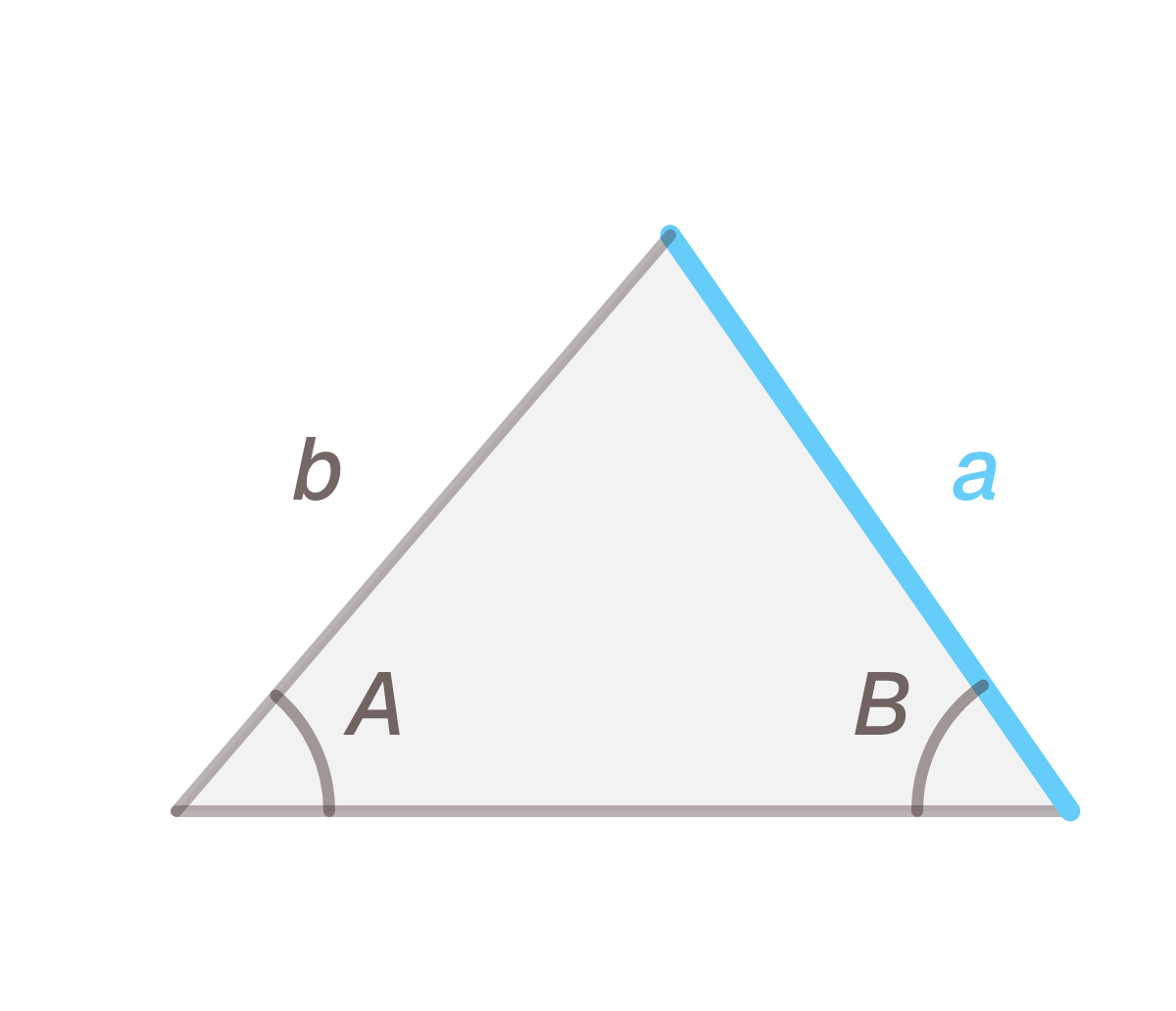
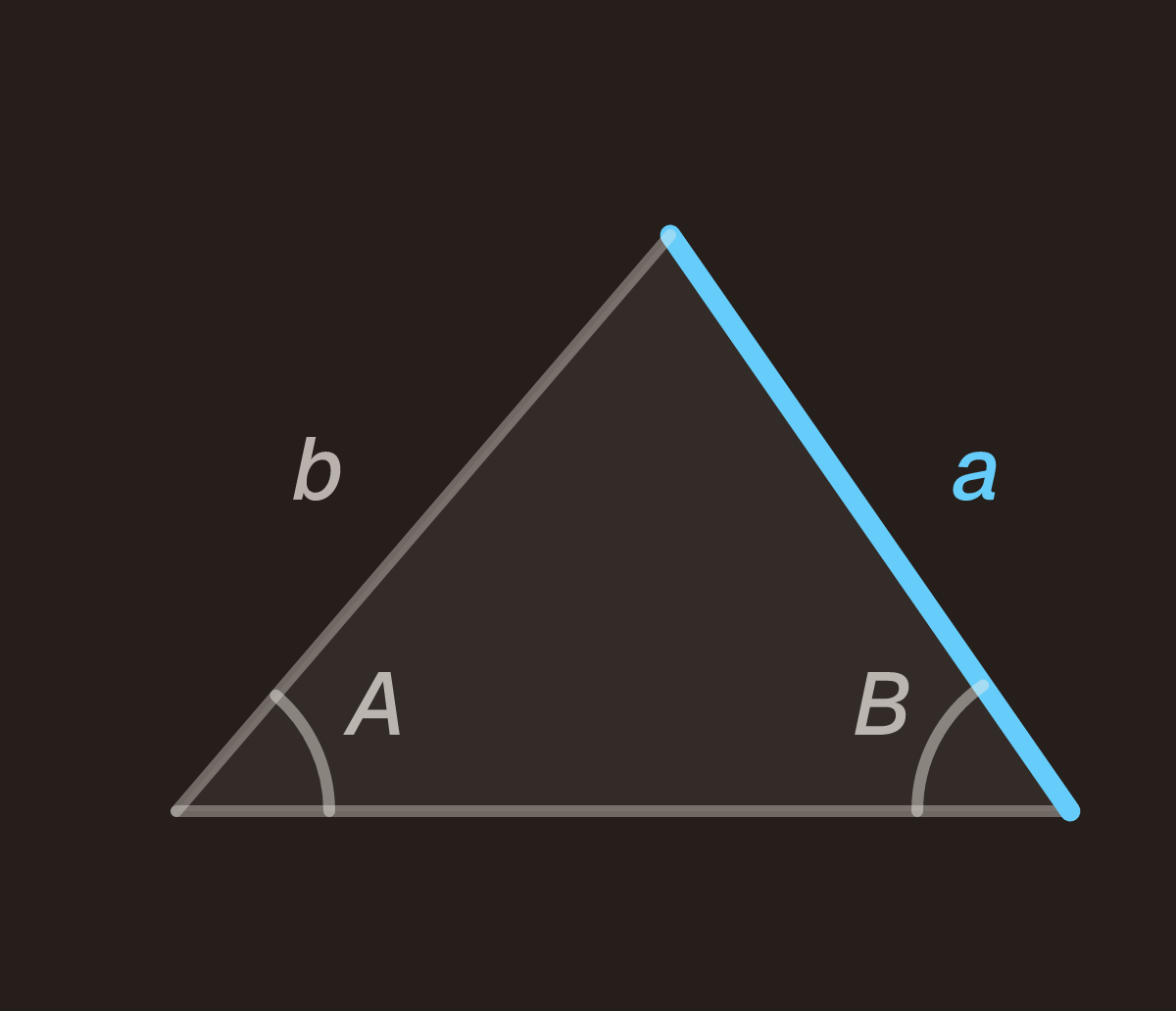
Draw any triangle and name its corners A, B and C. The side opposite angle A is called a, the side
opposite B is b, and the side opposite C is c. The law of sines says the three ratios are equal:
a / sin A = b / sin B = c / sin C
That is three statements in one, but you never use more than two ratios at a time — the one you know and
the one you want. That is the form the card above calculates with.
Why is it true? Drop the altitude from corner C down to side c. It splits the triangle into two
right-angled ones, and its length is b · sin A seen from the left and a · sin B seen from the right. One
altitude, two expressions, so b · sin A = a · sin B — the law of sines rearranged. The proof needs the
figure, so it is written here rather than in the card.
What matters about the law is that it asks for no right angle. Sine, cosine and
tangent as ratios of sides hold only in a right-angled
triangle; this works in all of them.
Worked examples
How far away is the buoy? Two people stand 40 m apart along a shoreline and both sight the same
buoy. One measures 65° between the shoreline and the buoy, the other 48°.
The third angle, at the buoy, comes first: 180° − 65° − 48° = 67°.
The distance from the first person to the buoy lies opposite the 48° angle, and the known 40 m lies
opposite the 67° one:
- a = b · sin A / sin B = 40 · sin 48° / sin 67°
- a = 40 · 0.7431 / 0.9205 = 29.73 / 0.9205 = 32.3 m
This is the idea behind triangulation: two angles and one distance you can walk are enough to measure
a distance you cannot.
When the answer is not one answer. In a triangle, a = 9 cm, b = 6 cm and angle B = 25°. How large is
A?
- sin A = a · sin B / b = 9 · 0.4226 / 6 = 0.6339
- A = arcsin 0.6339 = 39.3°
But 180° − 39.3° = 140.7° has the same sine. And that angle fits: 25° + 140.7° = 165.7°,
leaving 14.3° for the third. Both triangles exist. The card above works out the acute one and names the
obtuse one beside it, because it is the figure — not the formula — that decides which you meant.
Common mistakes
- Pairing the wrong side with the wrong angle. a belongs to A, never to B. The side and the angle in
one ratio must sit opposite each other in the triangle. Swap them and you get a number that looks
reasonable.
- Forgetting the third angle. If you know two angles and the side between them, work out the third
angle first — that is the one lying opposite the side you know.
- Trusting arcsine to give the whole answer. Arcsine replies with an angle of at most 90°. When the
side opposite the unknown angle is the longer of the two, there can be an obtuse solution as well.
- Using the law of sines with two sides and the angle between them. There is no complete side-angle
pair to start from, and the law of cosines is what that case needs.
- Working in radians. The fields above are labelled °. A calculator in radian mode gives a wrong
answer without complaining.
Frequently asked questions
When do I use the law of sines and when the law of cosines?
The law of sines when you have a complete pair — a side and the angle opposite it — plus one more
piece. The law of cosines when you have no such pair: two sides and the angle between them, or all
three sides. If you do have a pair, the law of sines is both shorter and easier to compute with.
Why are there sometimes two answers?
Because a sine is the same for an angle and its supplement: sin 40° and sin 140° are the same number.
So when you recover an angle from a sine, both can fit, and if both leave room for a third angle then
both triangles are real. It only happens when the side opposite the unknown angle is longer than the
other known side — if it is shorter there is exactly one answer.
Does the law of sines hold in a right-angled triangle?
Yes, and there it turns into something you already know. Put C = 90°. Since sin 90° = 1, c / sin C is
just c, and a / sin A = c gives sin A = a / c — the definition of sine in a right-angled triangle. The
right-angled triangle is a special case of the law.