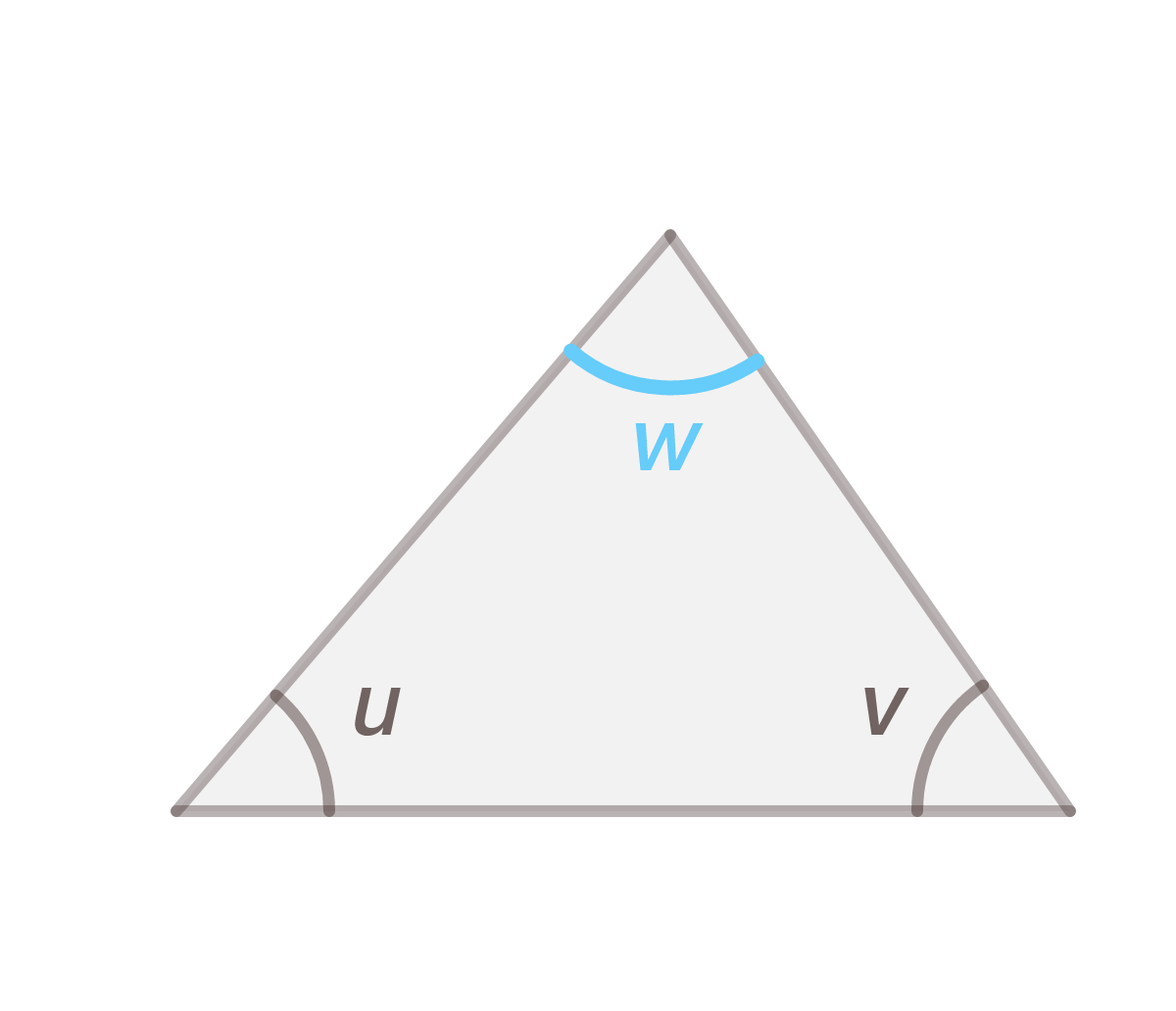
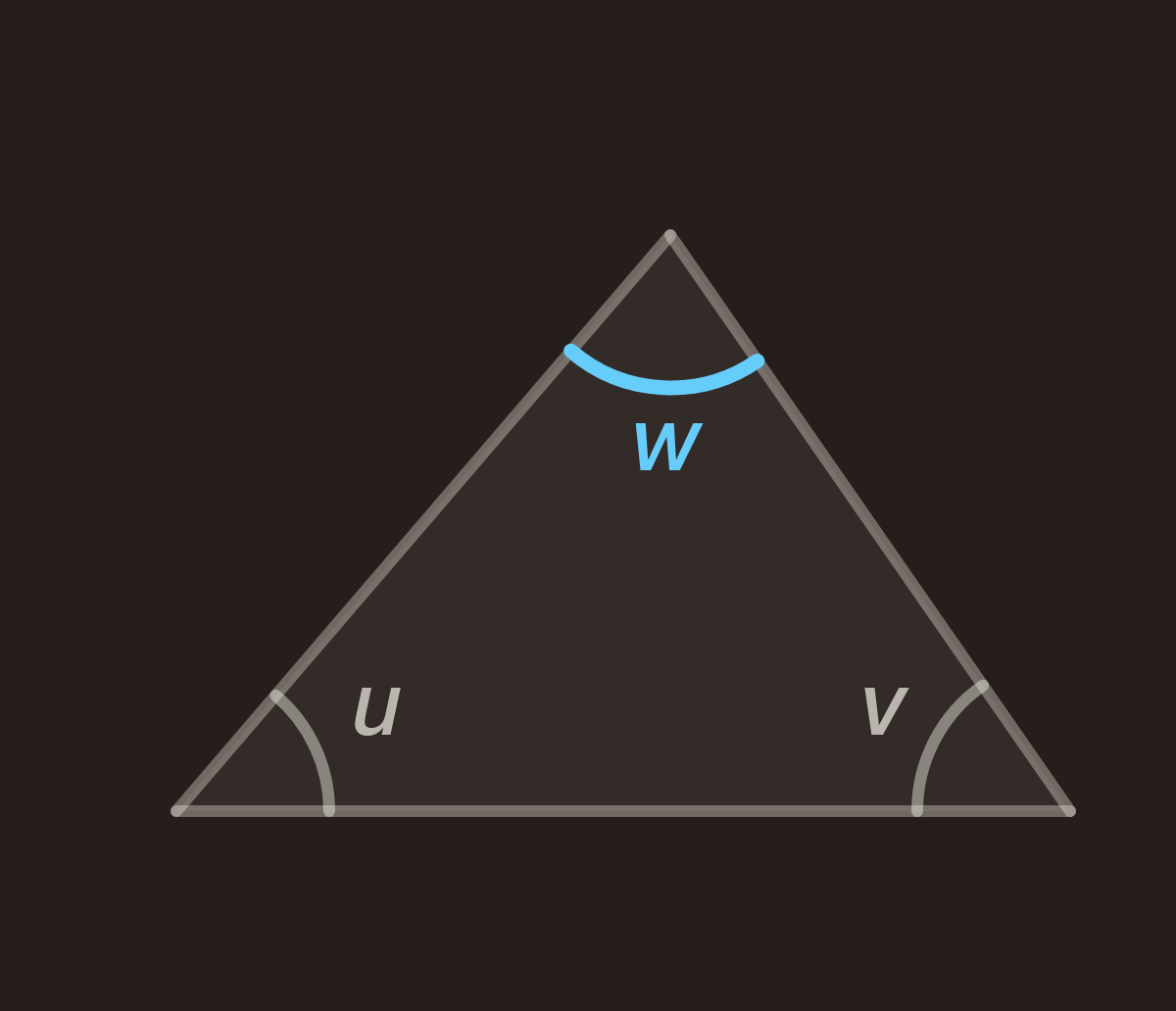
What the theorem says
It holds for every triangle in the plane: acute, obtuse, right-angled, large, small. Given two angles you
get the third by subtracting them from 180°.
It is also called the angle sum theorem.
If two angles are 30° and 60°, the third is 180 − 30 − 60 = 90° — the triangle is right-angled.
The proof with a parallel line
Draw a line through the apex parallel to the base. Three angles now sit along that line, and together they
make a half turn, 180°.
The two outer ones are alternate angles to the base angles of the triangle — parallel lines cut by a
third give equal alternate angles — and the middle one is the triangle’s apex angle. So the three angles
of the triangle add up to 180°.
It is one of the shortest proofs in geometry, and it rests entirely on that parallel line existing and
being unique. On a sphere it does not, and there the theorem fails.
Consequences used all the time
- In a right-angled triangle the two acute angles add up to 90°.
- In an equilateral triangle every angle is 60°.
- In an isosceles triangle the base angles are equal, so the apex angle is 180° minus twice a base
angle.
- An exterior angle equals the sum of the two interior angles it is not next to.
Worked examples
The third angle. Two angles are 47° and 68°. The third is 180 − 47 − 68 = 65°.
Isosceles. The base angles of an isosceles triangle are 70° each. The apex angle is 180 − 140 =
40°.
Backwards. A triangle has an angle of 90° and one of 35°. The third is 180 − 90 − 35 = 55°, and
sure enough the two acute angles come to 90°.
An impossible case. Angles of 100° and 95° cannot both be there: they already make 195°, more than a
half turn. One of the measurements is wrong.
Common mistakes
- Using 360°. That is the quadrilateral’s
sum, not the triangle’s.
- Thinking a bigger triangle has a bigger angle sum. Neither size nor shape makes any
difference.
- Treating an exterior angle as an interior one. The exterior angle and the interior angle at the same
corner add up to 180°.
Common questions
Does it really hold for every triangle?
For every triangle in the plane, yes. Draw on a sphere — the Earth, say — and the sum comes out greater
than 180°, and a triangle with three right angles is perfectly possible. That geometry has rules of its
own.
Why 180?
Because a half turn is 180° in a system that splits the full turn into 360 parts. In radians the sum is
π instead, and the theorem is the same one.
How does it connect to polygons?
A convex polygon can be cut into triangles from one corner. An n-gon gives n − 2 triangles, so its angle
sum is (n − 2) · 180°.