Pick the unit your lengths are in. Areas are then labelled in square units and volumes in cubic units; nothing is converted.
Cut a paper cone open along its side and lay it flat. It does not become a rectangle the way a cylinder’s
wall does, but a sector of a circle — a slice out of a circle of radius l. How big a slice is decided
by the base circle’s circumference, and the sector’s area comes to:
A = π · r · l
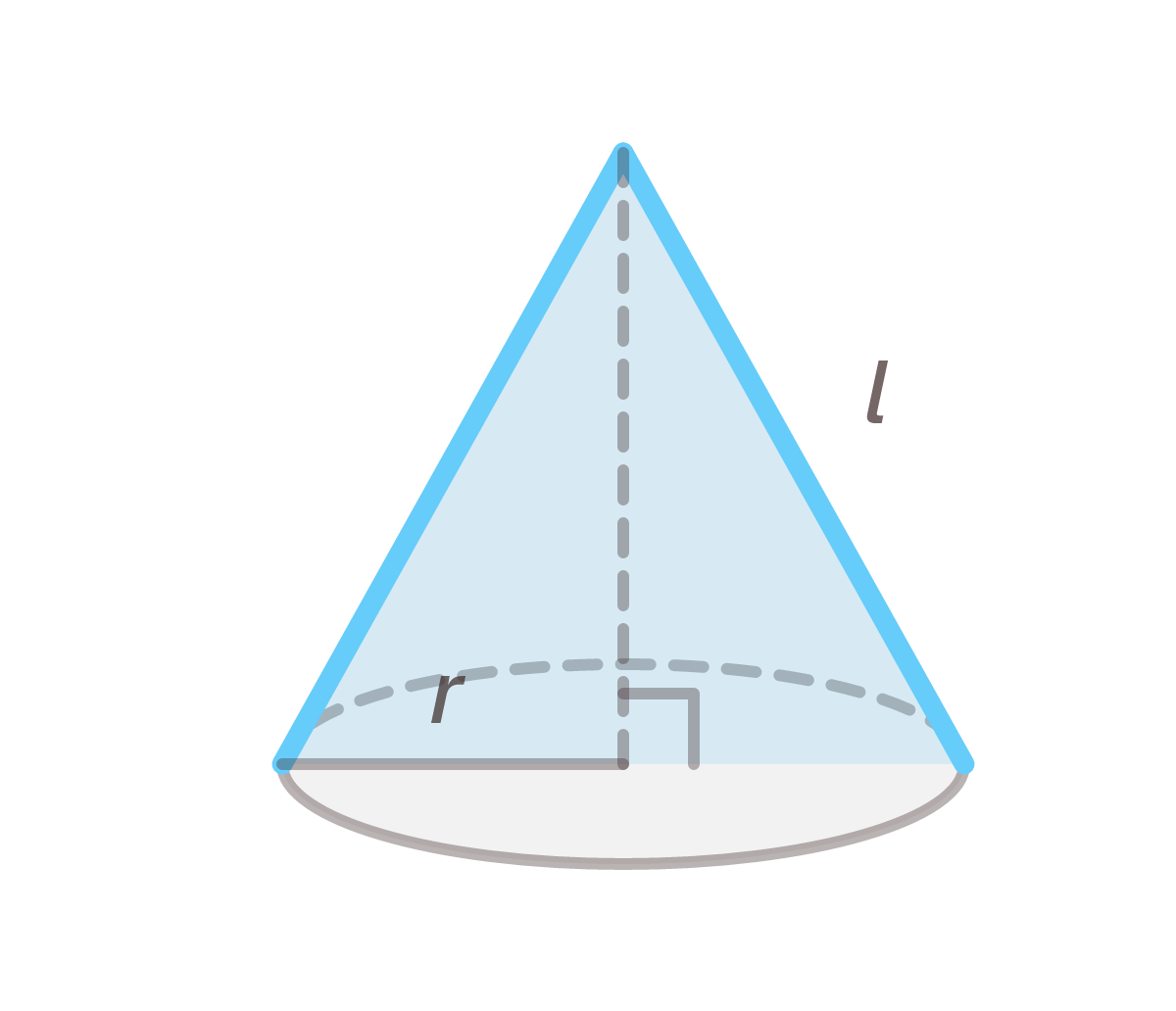
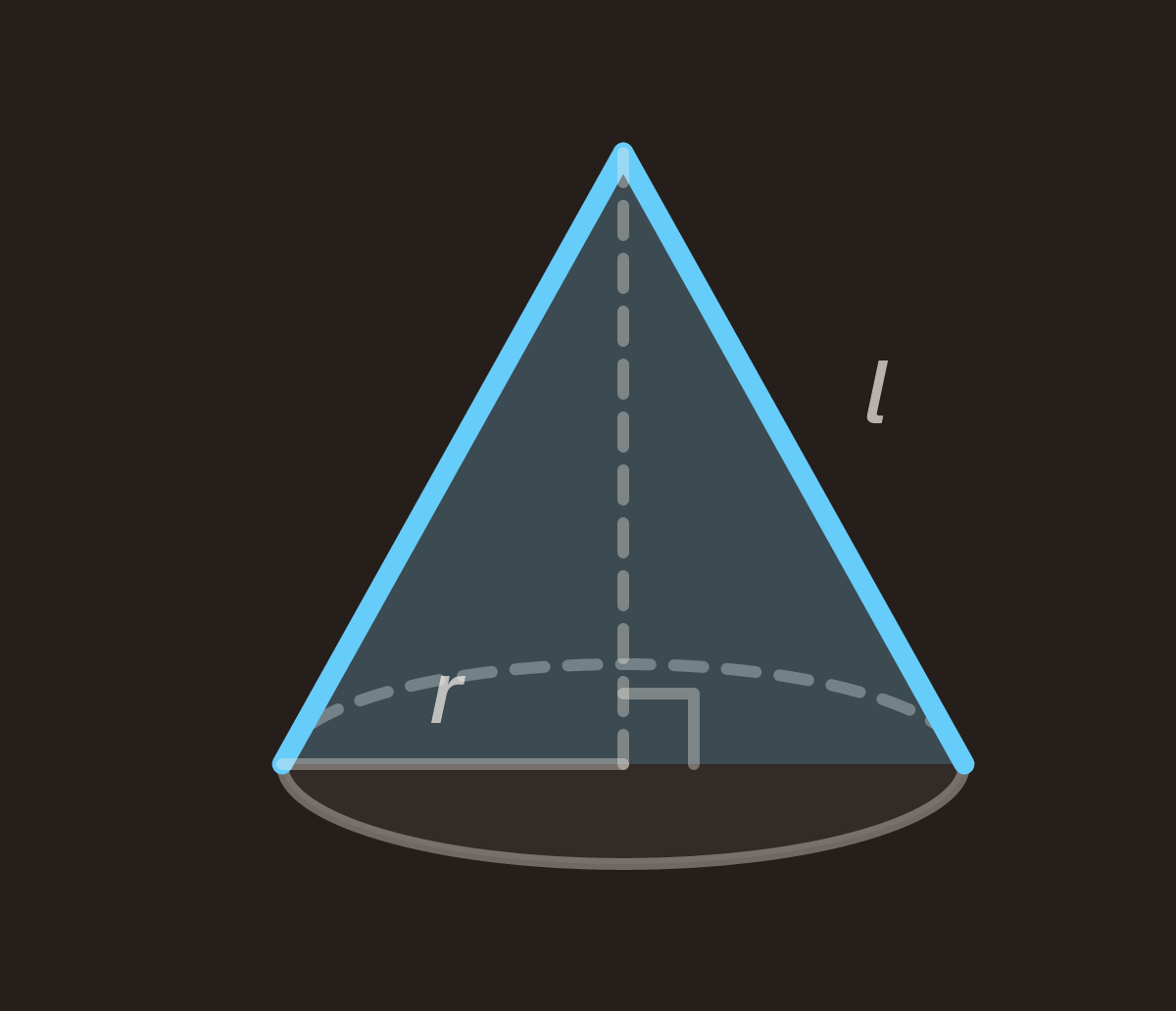
r is the base circle’s radius and l is the slant height, the distance from the rim of the base up to
the apex along the sloping side. The base circle is not included — it belongs to the
surface area.
The slant height is not the cone’s height
The pyramid has the same pair:
- The height h runs straight up through the middle, from the centre of the base to the apex.
- The slant height l runs up the surface at an angle, from the rim of the base to the apex.
Inside the cone the two form a right-angled triangle with the radius as the third side, so
Pythagoras’ theorem ties them together:
l² = r² + h²
If the question gives you the height, the first step is to work out the slant height.
Worked examples
A cone with a radius of 3 cm and a height of 4 cm. The slant height is √(3² + 4²) = √25 = 5 cm, and
the lateral area is π · 3 · 5 = 15π ≈ 47.1 cm².
Given the slant height directly. A cone has a radius of 6 cm and a slant height of 10 cm. The lateral
area is π · 6 · 10 = 60π ≈ 188.5 cm².
Working backwards. A cone has a lateral area of 15π cm² and a radius of 3 cm. The slant height is
15π / (π · 3) = 5 cm — the π cancels and the answer is exact.
A paper cone 12 cm across with a slant height of 15 cm. The radius is 6 cm, so the paper it takes is
π · 6 · 15 = 90π ≈ 282.7 cm², with no overlap.
Common mistakes
- Substituting the height where the slant height belongs. The answer comes out too small, and the unit
does not give the mistake away. Convert with Pythagoras first.
- Using the diameter as the radius. Halve it first.
- Including the base circle. It belongs to the surface area, not the lateral one.
- Rounding π along the way. Keep π as a symbol and round once, at the end.
- Confusing it with the volume. The volume is
πr²h / 3, with the height and a squared radius, measured in cubic units.
Common questions
Why is the formula so short when the side is curved?
Because the unrolled sector has area (arc length · l) / 2, and the arc length is the base circle’s
circumference 2πr. Substitute: (2πr · l) / 2 = πrl. The twos cancel.
Can I find the radius from the lateral area and the slant height?
Yes, directly: r = A / (πl). It is the surface area that needs more than a division, because the radius
appears twice there.
What if the cone is oblique?
Then there is no single slant height — the distance from the apex to the rim differs around the cone —
and the formula does not hold. πrl assumes a right cone.