Pick the unit your lengths are in. Areas are then labelled in square units and volumes in cubic units; nothing is converted.
What the theorem says
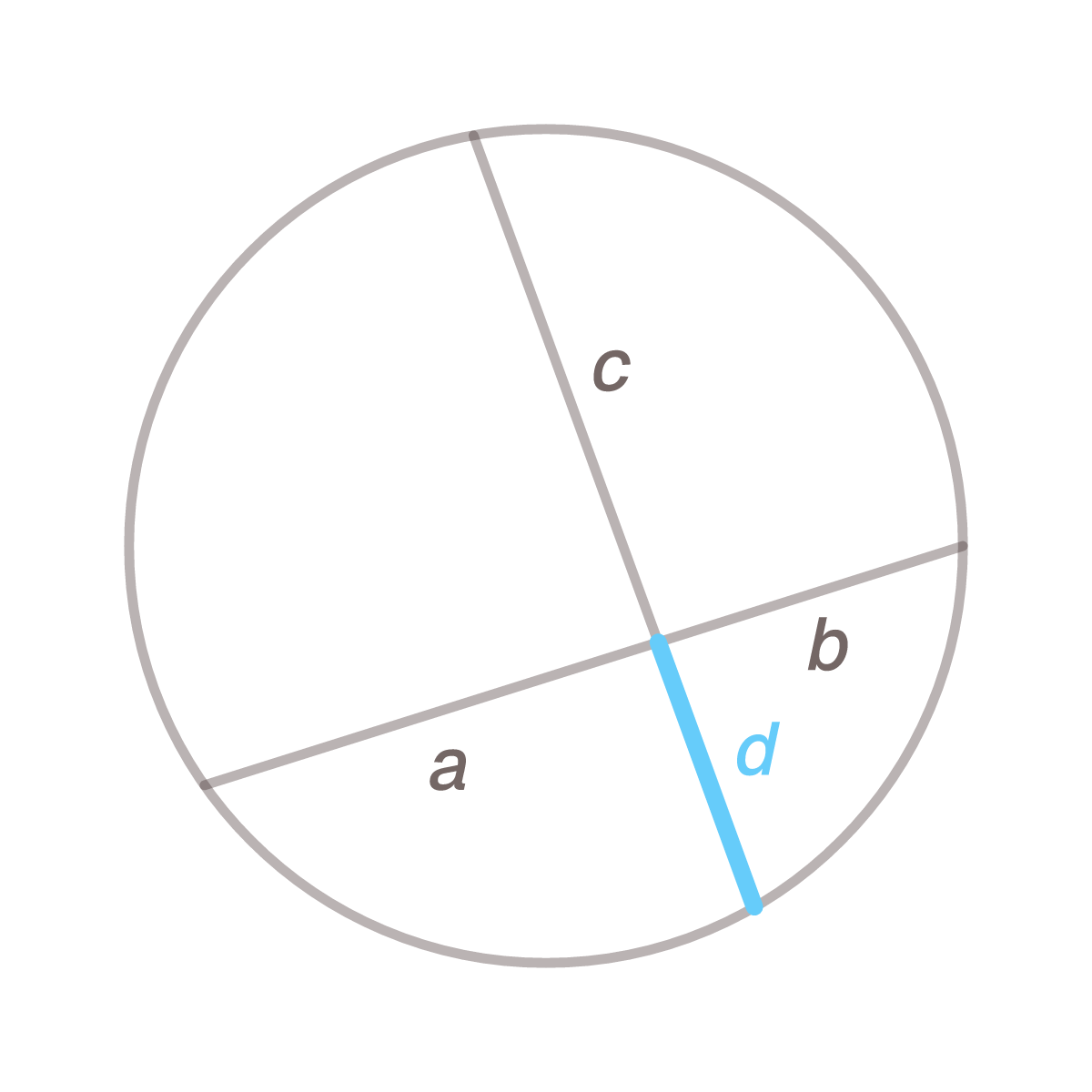
A chord is a line segment between two points on a circle. When two chords cross, each is cut in two: one
into a and b, the other into c and d. The theorem says that a times b equals c times d, wherever inside
the circle the chords cross.
One chord is cut into 4 cm and 6 cm, and one piece of the other is 3 cm. Then
4 · 6 = 3 · d, so d = 24 / 3 = 8 cm.
Pairing the pieces correctly
A common mistake is the pairing. a and b are the two pieces of the same chord. Multiply one piece from
each chord and you still get a number, and it still looks like a length:
| Set-up |
d |
| 4 · 6 = 3 · d (right: one chord on each side) |
8 cm |
| 4 · 3 = 6 · d (wrong: a piece from each chord) |
2 cm |
Draw the figure and mark which pieces belong to the same chord before setting up the equation. Each side
of the equals sign holds one chord.
Why it is true
Join the chords’ endpoints so that two triangles form, sharing the crossing point as a corner. The angles
at the crossing are vertically opposite and so equal. The angles at the rim stand on the same arc and are
equal by the inscribed angle theorem. The
triangles are therefore similar, and the ratio
a / c = d / b becomes a · b = c · d when you cross-multiply.
An example with a diameter
A circle has radius 5 cm. A chord crosses a diameter at right angles, 2 cm from the centre. The diameter
is cut into 5 + 2 = 7 cm and 5 − 2 = 3 cm. A diameter that meets a chord at right angles bisects it, so
the chord’s two pieces are equal, x and x:
x · x = 7 · 3 = 21, so x = √21 ≈ 4.58 cm, and the whole chord is about 9.17 cm.
Here there is no single unknown piece but two equal ones, and the answer is a root.
Common mistakes
- Pairing pieces from different chords. a and b belong to one chord, c and d to the other.
- Using the whole chord. The theorem is about the pieces on either side of the crossing, not the
chords’ full lengths.
- Using it when the lines meet outside the circle. Then a relative applies, the secant theorem, where
you measure from the meeting point to both places each line cuts the circle.
Common questions
Does it work for any two chords?
For any pair that crosses inside the circle, wherever the crossing is. If one chord passes through the
centre it is a diameter, and the theorem still holds.
How is it proved?
With two similar triangles. The vertically opposite angles at the crossing are equal, and the inscribed
angle theorem makes the angles at the rim equal. Similarity gives a / c = d / b, so a · b = c · d.