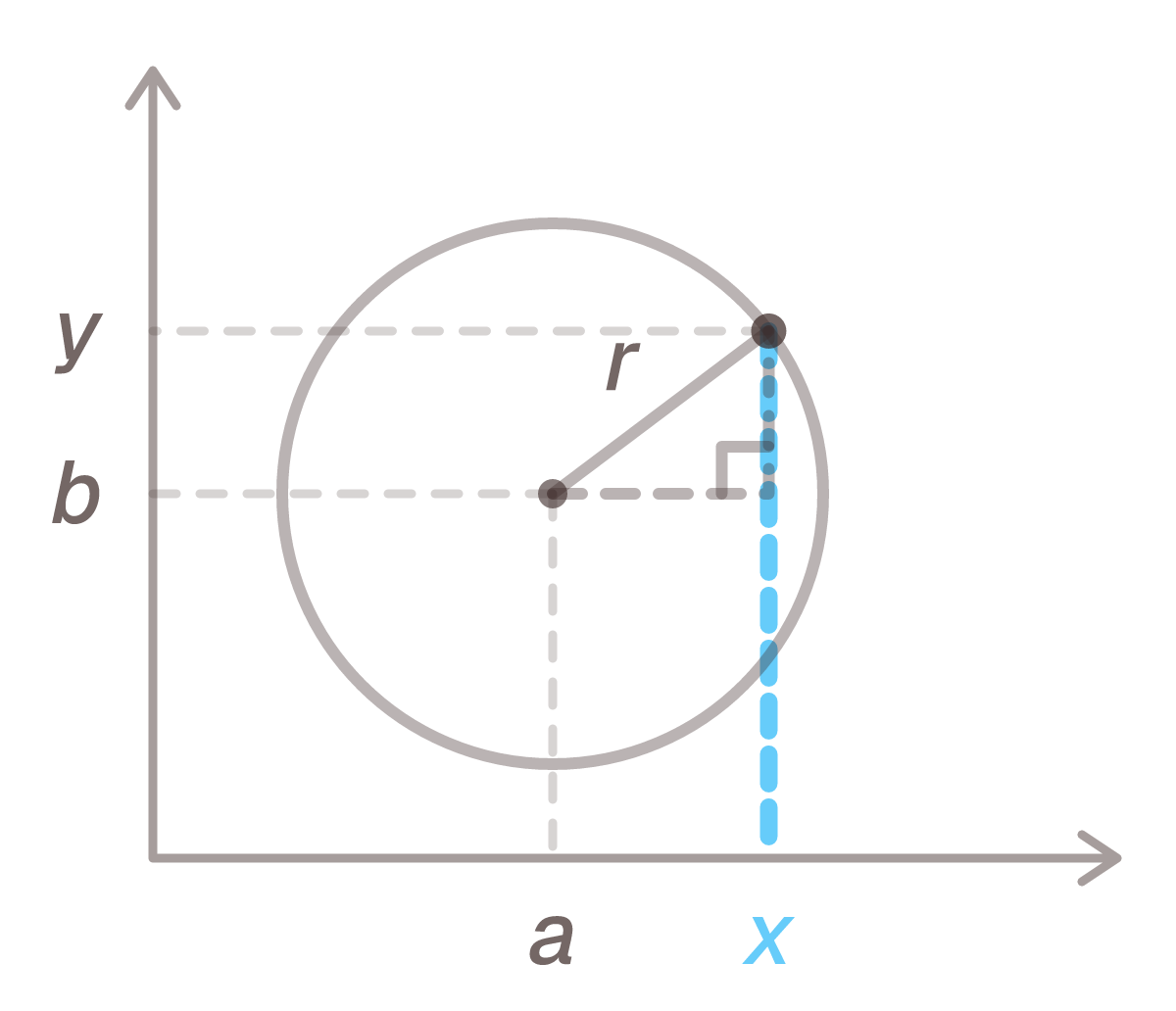
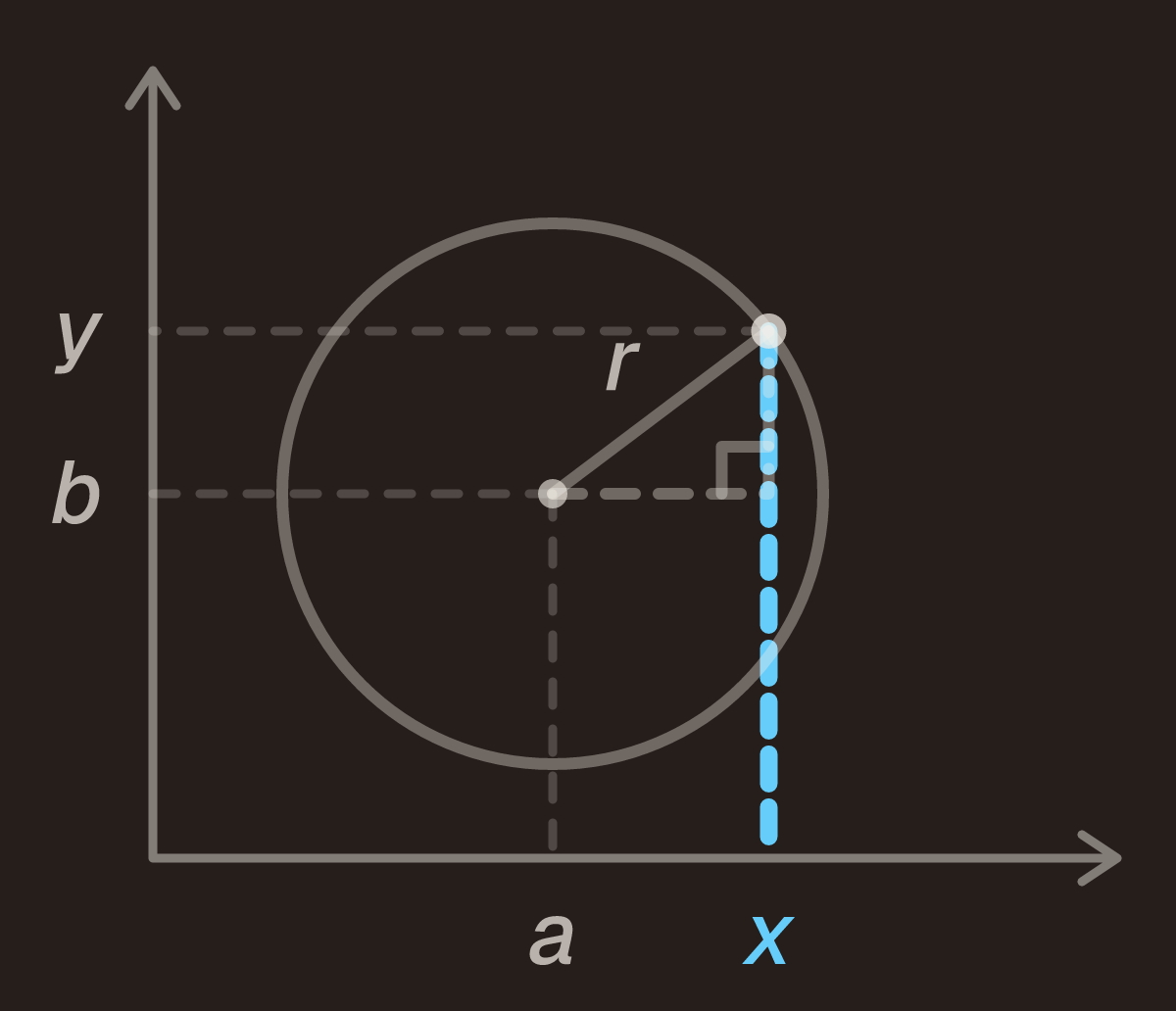
- (x, y) = (a + r cos t, b + r sin t)
- (x, y) = (a, b) + r(cos t, sin t)
Holds when r > 0.
(a, b) is the centre, r the radius and t the angle from the positive x-axis, measured anticlockwise. As
t runs from 0° to 360°, the point goes once round the circle.
With centre (1, 2), radius 4 and t = 60°:
- x = 1 + 4 · cos 60° = 1 + 4 · 0.5 = 3
- y = 2 + 4 · sin 60° = 2 + 4 · √3/2 = 2 + 2√3 ≈ 5.46
The point is (3, 5.46), rounded.
Why the point is on the circle
Put the point into the equation of a circle:
(x − a)² + (y − b)² = r² cos² t + r² sin² t = r²(cos² t + sin² t) = r²
The last step is the Pythagorean identity,
cos² t + sin² t = 1. So every angle gives a point on the circle, and every point on the circle is
reached by some angle.
The unit circle
With the centre at the origin and radius 1, the formula becomes (x, y) = (cos t, sin t). That is how
cosine and sine are defined for angles beyond 90°: as the coordinates of the point on the unit circle.
The angle of a point
Backwards, the formula gives cos t = (x − a)/r and sin t = (y − b)/r. Both are needed, because the
cosine alone gives two angles between 0° and 360°.
The point (−1, −√3) lies on the circle with centre at the origin and radius 2. Then cos t = −1/2, which
gives t = 120° or t = 240°. sin t = −√3/2 is negative, so t = 240°.
The card takes r and t as given. A point fixes them only when it lies exactly on the circle at exactly
that angle, which a point typed with rounded decimals rarely does.
In radians
The formula is the same with t in radians, but the calculator has to be in radian mode, and one turn is
2π. In physics, uniform circular motion is often written x = r cos ωt and y = r sin ωt, where ω is the
angular velocity and t the time.
Common mistakes
- Swapping cos and sin. (a + r sin t, b + r cos t) is on the circle too, but at the angle 90° − t,
and the point goes round clockwise. With the example above you land on (4.46, 4) instead of
(3, 5.46).
- Forgetting the centre. r cos t and r sin t are measured from the centre, not from the origin.
- Degrees and radians mixed. cos 60 with the calculator in radians is the cosine of 60 radians.
Common questions
How is this different from the equation of a circle?
The equation (x − a)² + (y − b)² = r² says which points are on the circle. The parametric form also
says where on the circle each angle lands, which is what drawing it or moving along it needs.
How is an ellipse written the same way?
With two different semi-axes: (x, y) = (a + p cos t, b + q sin t). With p = q it is the circle.