The four pairs
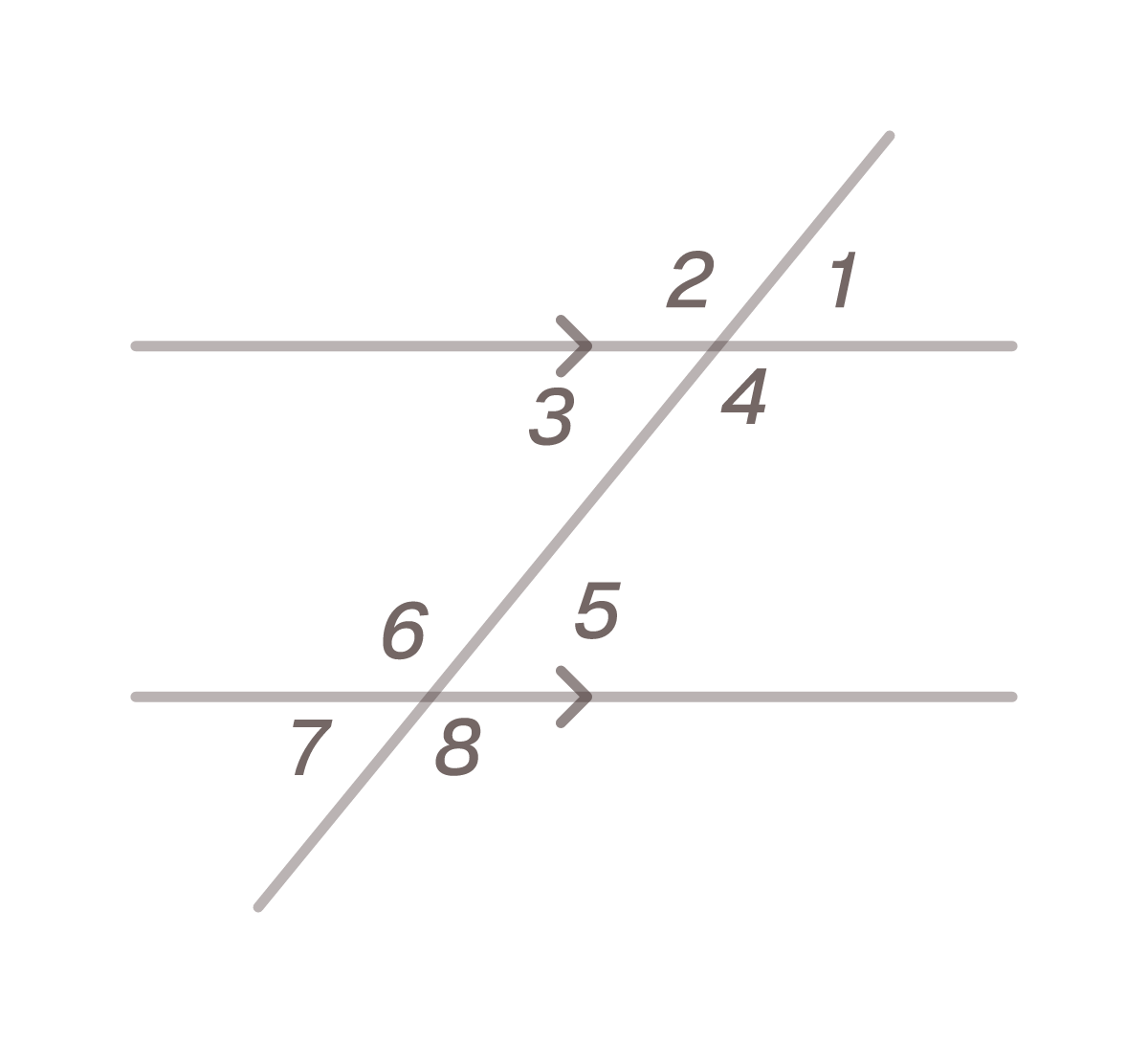
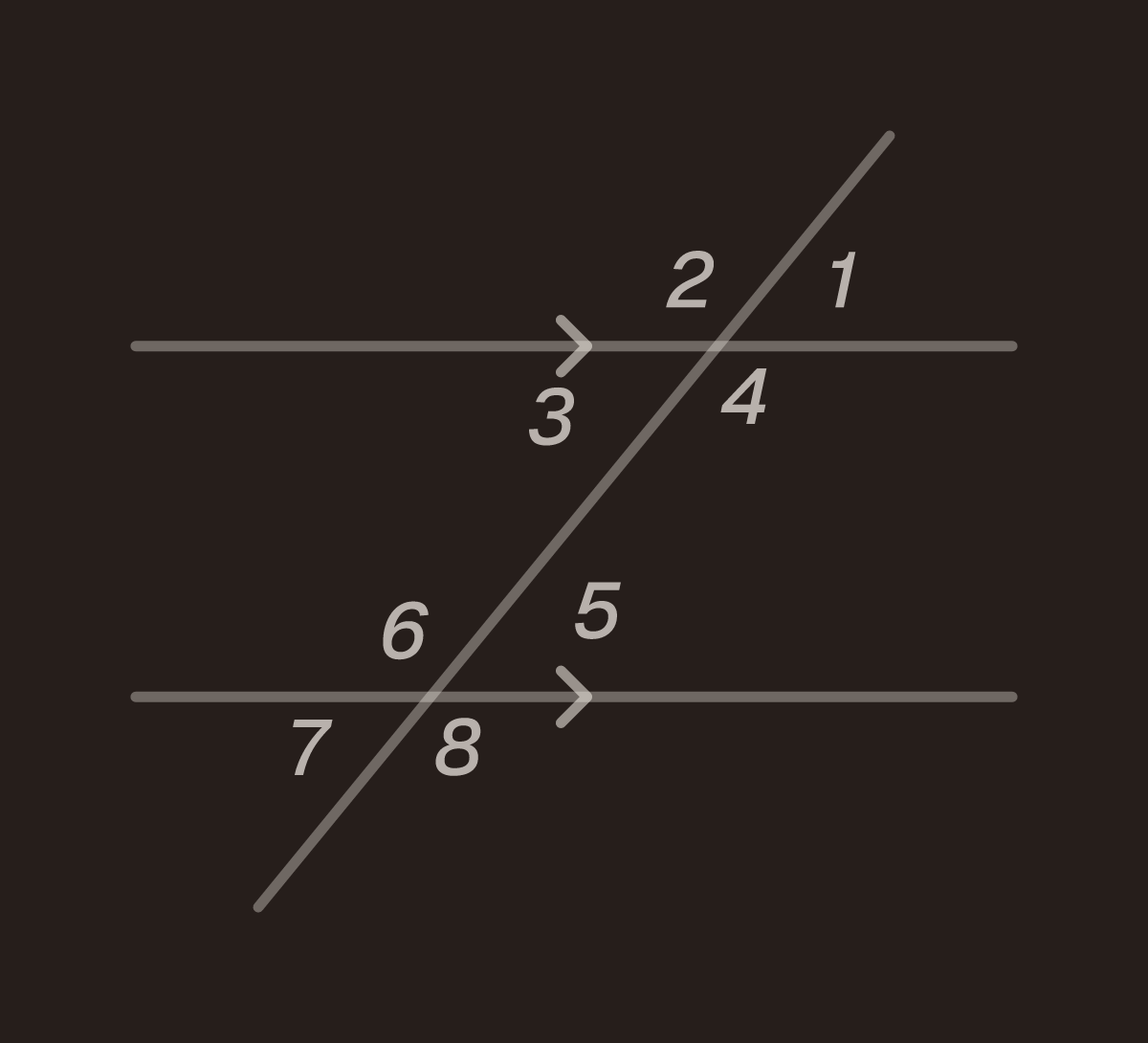
Where one line crosses another, four angles form around the crossing. If the same line crosses a second line, four more form. Among the eight there are four kinds of pair:
| Pair | Where they sit | Relation | Holds |
|---|---|---|---|
| Angles on a straight line | next to each other on one line | add up to 180° | always |
| Vertically opposite angles | across from each other at one crossing | equal | always |
| Corresponding angles | in the same position at each crossing | equal | at parallel lines |
| Alternate angles | on opposite sides of the transversal, between the lines | equal | at parallel lines |
A transversal crosses two parallel lines and makes an angle of 65°. The angle beside it on the line is 180° − 65° = 115°, the vertically opposite angle is 65°, and at the other crossing the corresponding and alternate angles are 65° too. Every one of the eight is either 65° or 115°.
Swedish books call them sidovinklar, vertikalvinklar, likbelägna vinklar and alternatvinklar, in the same order.
The lines have to be parallel
Angles on a line and vertically opposite angles concern a single crossing, and always hold. Corresponding and alternate angles compare two different crossings, and they are equal only if the two lines are parallel.
This is where mistakes happen. Two lines that are nearly parallel in a figure look parallel, and anyone who uses alternate angles on them gets an answer that looks reasonable and is wrong. If the question does not say the lines are parallel — or mark them with arrows — the last two rows of the table are off limits.
It works the other way round as well: if two alternate angles are equal, the lines are parallel. That is how two lines are shown to be parallel.
An example: why a triangle’s angles make 180°
Draw a line through the top of a triangle, parallel to its base. At the top there are now three angles in a row along the new line, and they make 180° because they fill a straight line. The left one is an alternate angle to the triangle’s left base angle, and the right one to the right base angle. So the triangle’s three angles make 180° — which is the proof of the angle sum of a triangle.
Common mistakes
- Using alternate angles on lines that are not parallel. It gives a number, but not a true one.
- Mixing up the two that always hold. Angles on a line sit side by side and make 180°; vertically opposite angles sit across from each other and are equal.
- Pairing angles on the same side. Two angles between the lines on the same side of the transversal are in general not equal — at parallel lines they add up to 180°.
Common questions
How do I know the lines are parallel?
The question says so, or the lines are marked with small arrows. Looking parallel is not enough.
Why are vertically opposite angles equal?
Both sit on a straight line with the same third angle. So both are 180° minus the same number.