What the condition says
Two straight lines are parallel exactly when they have the same slope:
m₁ = m₂
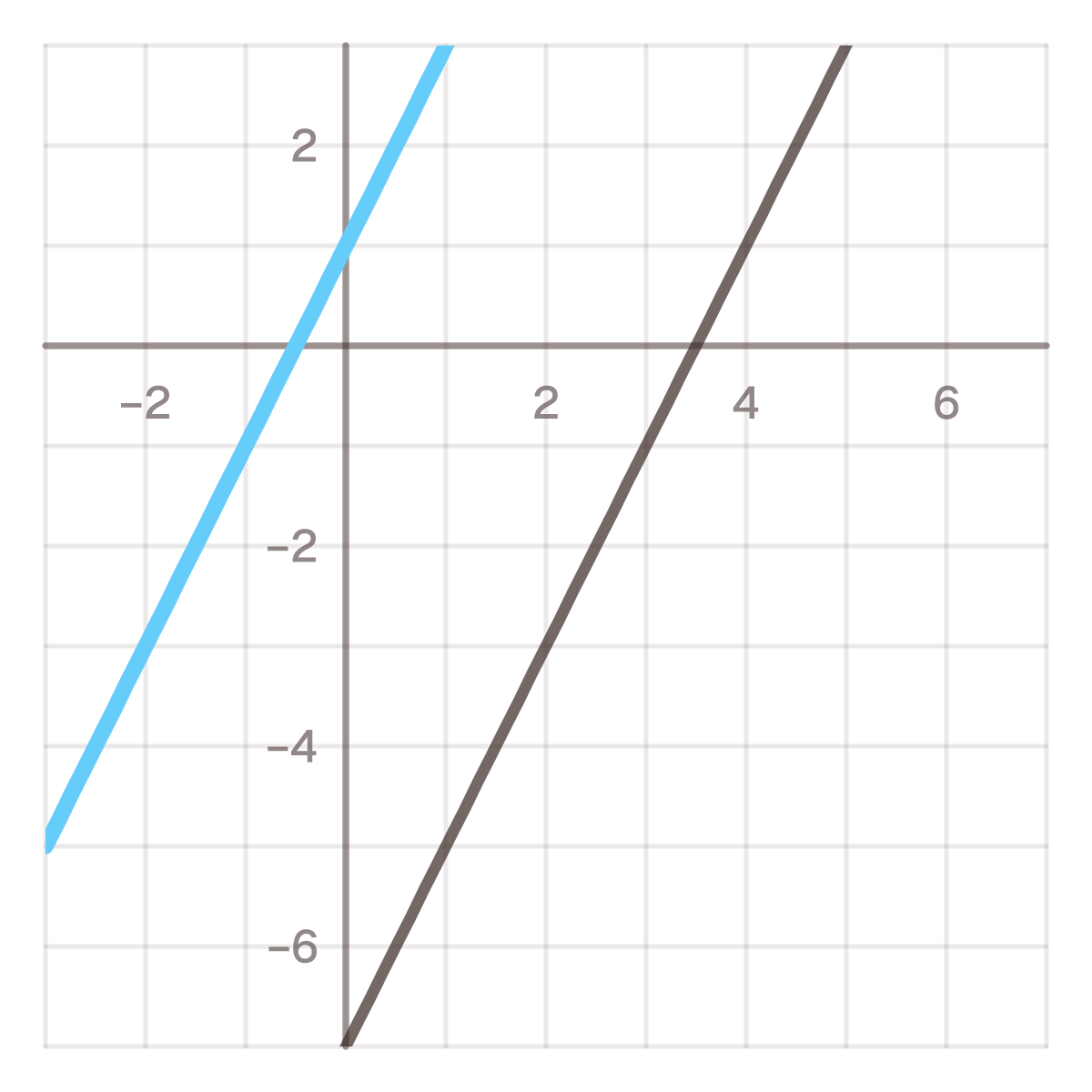
y = 2x + 1 and y = 2x − 7 are parallel. y = 2x + 1 and y = 3x + 1 are not, even though they share an intercept and pass through the same point on the y-axis.
Why the intercept plays no part
The slope says how steeply the line climbs: one step right, m steps up. Two lines with the same slope therefore climb equally everywhere, and the vertical gap between them — the difference of the intercepts — is the same at every x. A gap that never changes is a gap that never closes, and lines that never meet are parallel.
So the condition is a claim about the figure: “the same slope” and “they never meet” are two different things that turn out to mean the same.
The edge case is when the intercepts are equal too. Then it is not two parallel lines but one line, written twice. A system of equations with two such rows has infinitely many solutions, while one with the same slope and different intercepts has none at all — parallel lines do not cross.
Vertical lines have no slope and the condition says nothing about them. Two vertical lines, x = 2 and x = 5, are of course parallel all the same.
What you actually compute
The question often reads: write the line through (3, 9) parallel to y = 2x + 1.
- Parallel means the same slope, so m = 2.
- Substitute the point into y = mx + c: 9 = 2 · 3 + c, so c = 3.
- The answer is y = 2x + 3.
With point-slope form steps 2 and 3 collapse into one: y − 9 = 2(x − 3).
Common mistakes
- Comparing intercepts instead of slopes. The same intercept only means the lines cross the y-axis at the same place — that is, that they cross each other, not that they are parallel.
- Not rearranging first. 4x − 2y = 6 has slope 2, which only shows once it is solved for y: y = 2x − 3.
- Calling identical lines parallel. The same slope and the same intercept is one line, not two.
- Confusing it with perpendicular. Parallel is m₁ = m₂; perpendicular is m₁ · m₂ = −1.
Common questions
How do I tell whether two lines are parallel when they are not in y = mx + c form?
Solve both for y and compare the coefficient of x. The form ax + by = c has slope −a/b.
Is a line parallel to itself?
It depends who you ask. In school mathematics two coincident lines are usually counted as the same line
rather than as parallel. The condition m₁ = m₂ does not separate the cases, so the intercepts are what
you have to look at.
What is the distance between two parallel lines?
Measured vertically it is |c₁ − c₂|. Measured perpendicular to the lines it is |c₁ − c₂| / √(1 + m²),
which is shorter — the vertical segment cuts across at an angle.
Do parallel lines have an intersection point?
No. A system of equations shows it by having no solution: the rows cancel and leave
something impossible like 0 = 4.