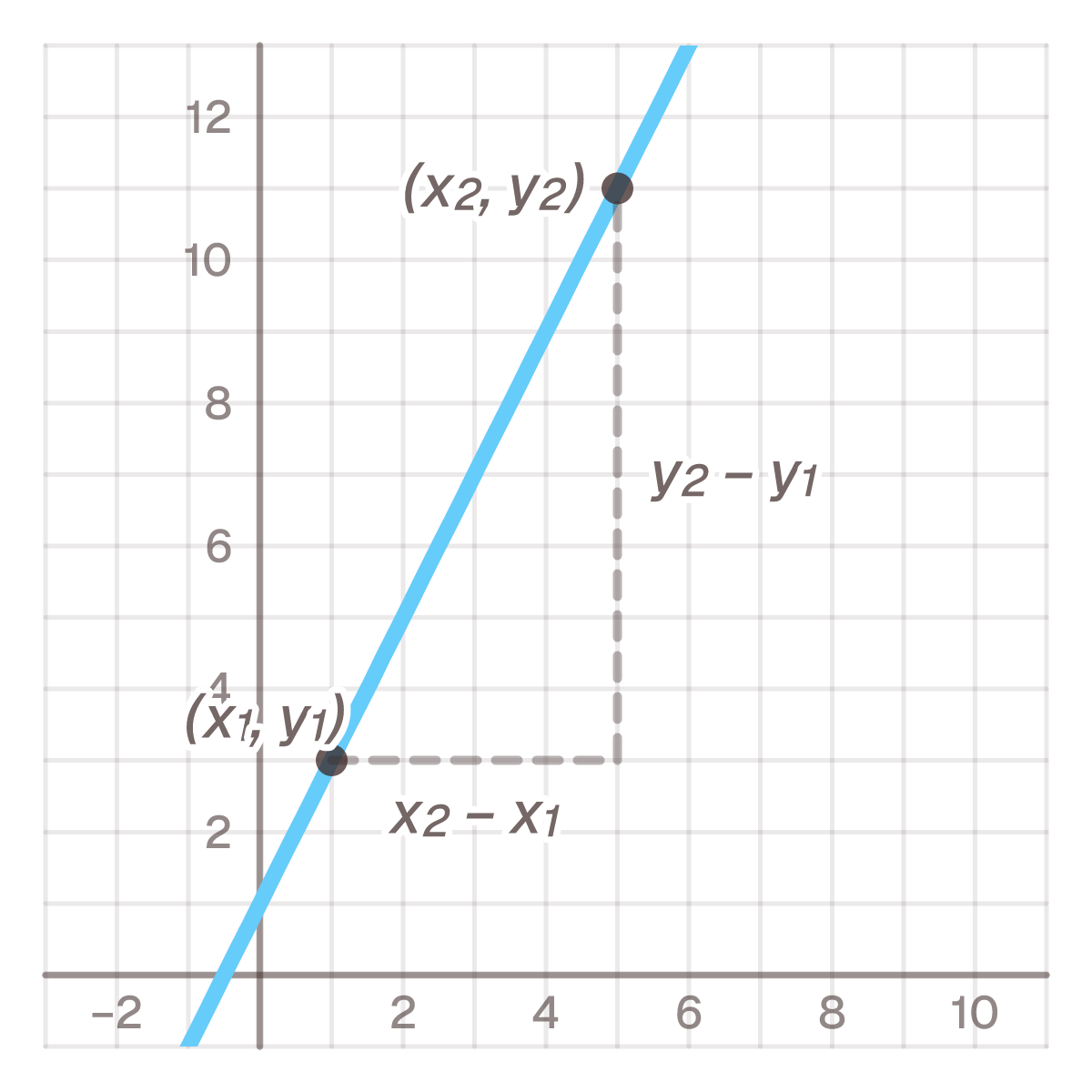
- m = (y₂ − y₁) / (x₂ − x₁)
The line through (1, 3) and (5, 11): the top is 11 − 3 = 8, the bottom is 5 − 1 = 4, and m = 8 / 4 = 2.
The line rises two in y for every one across.
Both differences, the same way round
Take the points in the other order and the top and the bottom both change sign, so the answer is the
same. The error comes from reversing only one:
- From (1, 3) to (5, 11): 8 / 4 = 2
- From (5, 11) to (1, 3): −8 / −4 = 2
Reverse one of them and you get −2, and a line that rises appears to fall. The answer is still a
number and still a plausible line, and nothing in the working shows the error. Decide which point is the first
one and keep it that way through the whole calculation.
An example that falls
The line through (1, 7) and (3, 1): (1 − 7) / (3 − 1) = −6 / 2 = −3. A negative slope means the line
falls — three down in y for every one to the right.
On to the equation of the line
With m in hand, the equation of a straight line is one step
away: put one of the points into y = mx + c and solve for c.
With m = 2 and the point (1, 3): 3 = 2 · 1 + c, so c = 1, and the line is y = 2x + 1.
Vertical and horizontal
| The line |
x₂ − x₁ |
y₂ − y₁ |
m |
| Rising |
> 0 |
> 0 |
positive |
| Falling |
> 0 |
< 0 |
negative |
| Horizontal |
> 0 |
0 |
0 |
| Vertical |
0 |
≠ 0 |
none |
A horizontal line has m = 0, which is a perfectly good value. A vertical line has no slope at all: the
bottom of the fraction is 0, and no number describes how steep it is. The card above says so rather than
answering.
Common mistakes
- Pairing the coordinates wrongly. (x₁, y₁) and (x₂, y₂) — not x₁ with y₂. Write the two points one
above the other before you start.
- Taking the bottom difference the other way round. See above; it gives the right size and the wrong
sign.
- Calling a vertical line “infinite slope”. It has none. The quotient is undefined, which is not the
same as a large number.
- Reading m as an angle. It is a ratio, not degrees. A slope of 1 is 45°, but what connects them is a
tangent, not a proportion.
Common questions
Is it m or k?
Both. English-language textbooks write m for the slope and c or b for the intercept; Swedish
and German textbooks write k and m, so m means the slope in one convention and the intercept in
the other. The letters differ; the formula does not.
Does it matter which point is first?
No, as long as you are consistent. Both orders give the same m, because both differences change sign
together.
Can I use this on a curve?
You get the slope of the straight line between the two points, not the slope of the curve. That number
is the average rate of change. The derivative is the limit of that number as the points close
together.