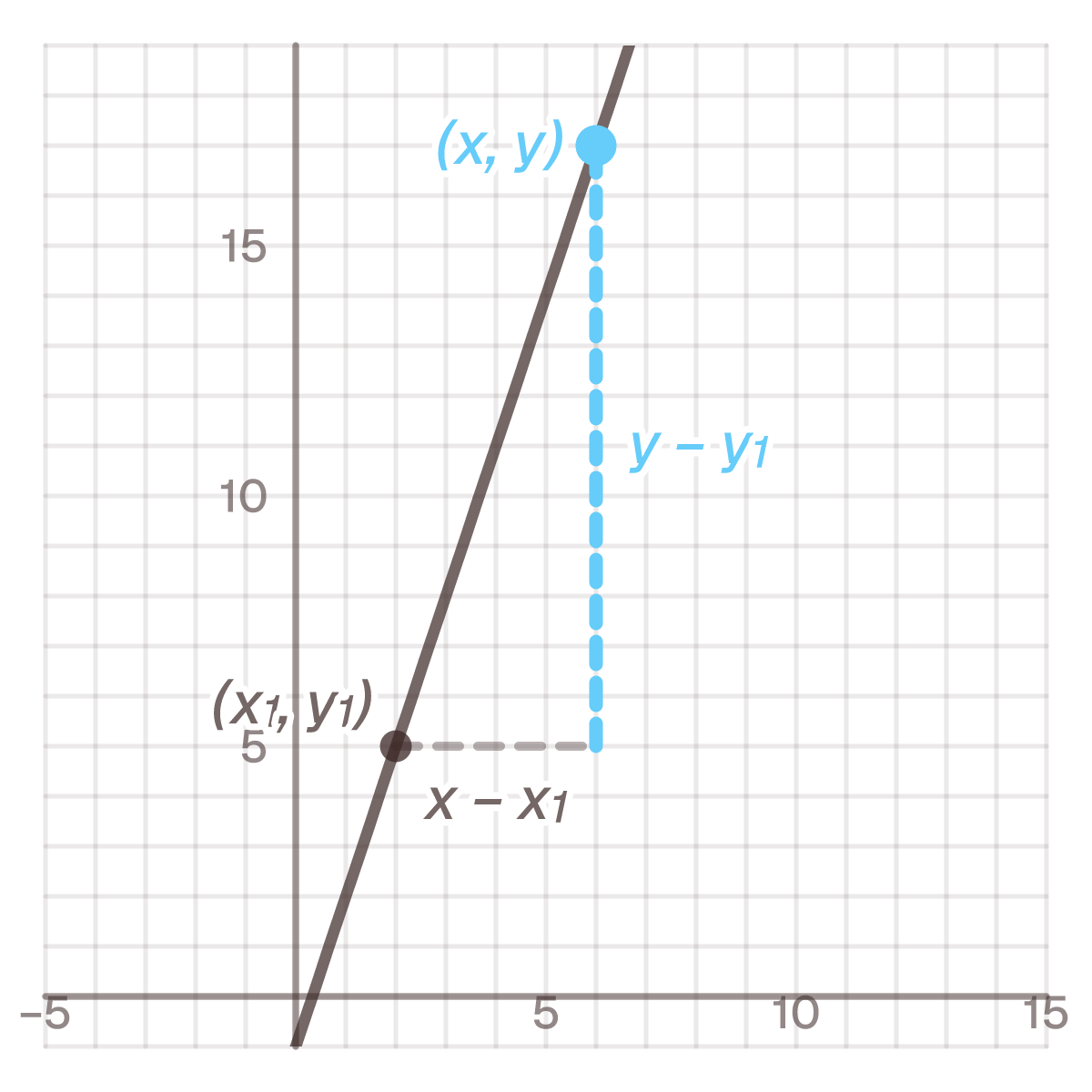
You know one point on the line, (x₁, y₁), and you know the slope m. Then the line is
y − y₁ = m(x − x₁)
The formula says nothing more than that the slope is the same everywhere on the line. Take any point
(x, y) on it and the known point (x₁, y₁), and the
slope between them is
m = (y − y₁) / (x − x₁)
Multiply both sides by (x − x₁) and you have point-slope form. The derivation also shows why the formula
is true: a straight line is the curve on which that quotient is the same number wherever you put the
second point.
When it is shorter than y = mx + c
The problem “write the line through (2, 5) with slope 3” can be done two ways.
With y = mx + c: substitute the
point, 5 = 3 · 2 + c, solve for c = −1, write y = 3x − 1. Two steps, and the first one is an equation.
With point-slope form: y − 5 = 3(x − 2). One substitution, no working. If you want slope-intercept
form from there, multiply out and move across: y = 3x − 6 + 5 = 3x − 1.
The same line, and the second route has no equation to solve. The difference shows most when the numbers
are not round: through (0.7, −1.4) with slope 2.5, point-slope form is still one line of writing.
Worked examples
Forwards. The line through (2, 5) with m = 3. What y goes with x = 6? y − 5 = 3(6 − 2) = 12, so
y = 17.
A negative point. Through (−2, −5) with m = 3: y + 5 = 3(x + 2). Both signs turned into plus, because
minus a negative is plus. This is where a sign is easily lost.
Backwards, the slope. The points (2, 5) and (6, 17) are on the line. Then
m = (17 − 5) / (6 − 2) = 12/4 = 3.
Common mistakes
- The sign in front of a negative coordinate. x₁ = −2 gives (x − (−2)) = (x + 2). Write the bracket
out first and simplify afterwards.
- Mixing the point’s coordinates with the variables. x₁ and y₁ are two numbers; x and y are variables
that stay in the answer.
- Multiplying out only one term. m(x − x₁) is mx − mx₁, not mx − x₁.
- Thinking the answer has to be rewritten. y − 5 = 3(x − 2) is an equation of a line. Convert to
slope-intercept form only if the question asks for it.
Common questions
Which form should I leave the answer in?
Whichever the question asks for. If it does not say, slope-intercept form y = mx + c is the usual
expectation, because it shows the slope and the y-intercept directly.
Does it work for vertical lines?
No. A vertical line has no slope to substitute, and is written x = x₁ instead. That is the same
limitation y = mx + c has.
Does it matter which of two known points I use?
No. Both give the same line, only written differently on the way. Work out m from the two points and
substitute whichever gives the simpler arithmetic.
Is it the same as the two-point form?
Almost. The two-point form is this one with m already replaced by (y₂ − y₁)/(x₂ − x₁), so it is one
formula rather than two steps, and harder to read because of it.