The form
- ax + by + c = 0
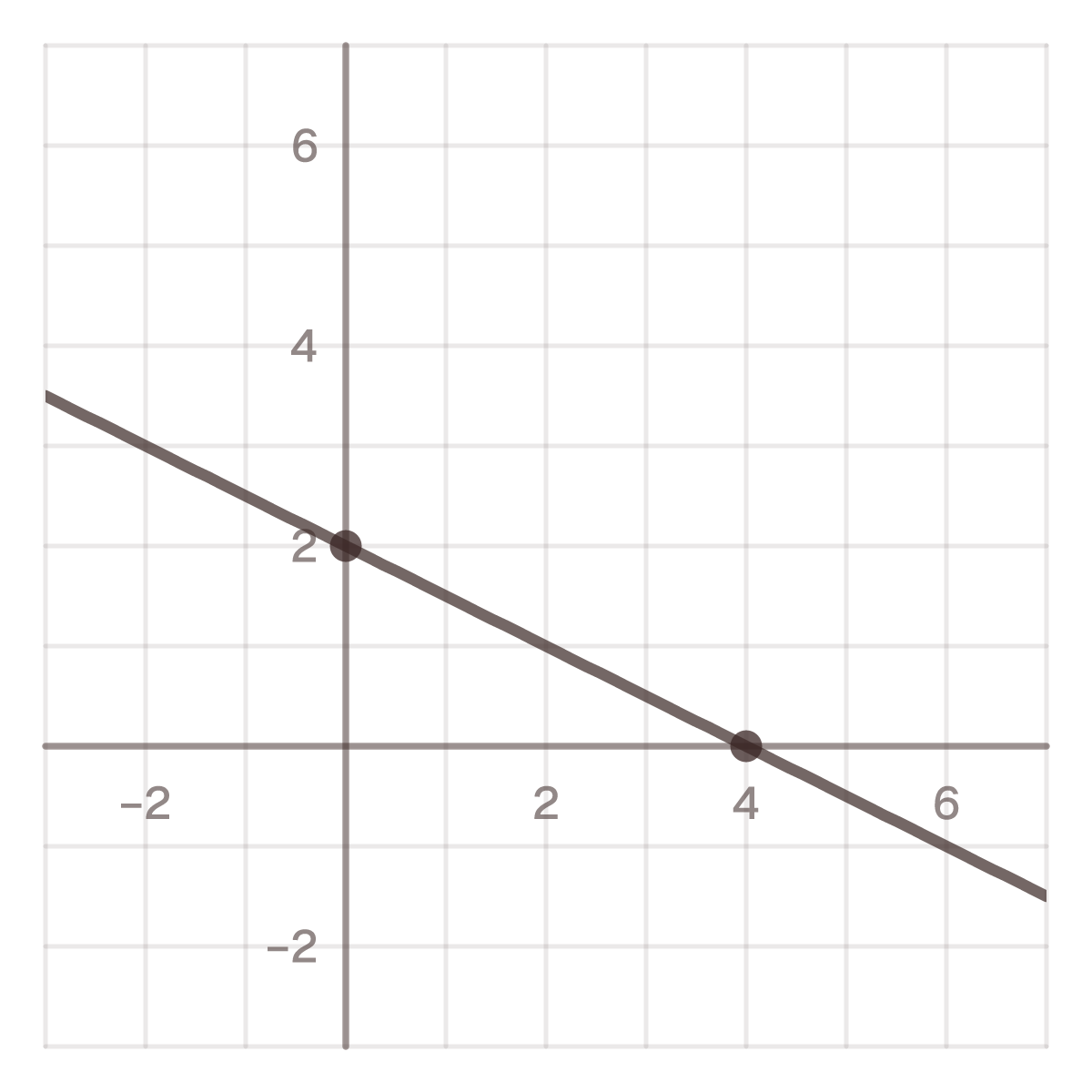
Here a and b are not both 0. A point (x, y) lies on the line exactly when its coordinates make the left side 0.
Converting to y = mx + c
When b ≠ 0, solve for y: by = −ax − c, so
- y = −(a/b)x − c/b
The slope is m = −a/b and the y-intercept is c/b with the sign changed, −c/b. When b = 0 the line is vertical, x = −c/a, and has no slope.
Example
3x + 2y − 6 = 0. Solving for y: 2y = −3x + 6, so y = −1.5x + 3. The slope is −1.5 and the line crosses the y-axis at 3.
Going the other way. Take y = 2x + 1. Move everything to the left: 2x − y + 1 = 0, with a = 2, b = −1, c = 1. Multiplying by any non-zero number gives the same line: 4x − 2y + 2 = 0.
What it is good for
- Vertical lines: x − 4 = 0 is the line x = 4.
- The distance from a point to a line uses exactly these coefficients (distance from a point to a line).
- Parallel lines have proportional a and b.
Common mistakes
- Forgetting the sign when solving for y. The slope is −a/b, not a/b.
- Thinking the form is unique. Multiplying the whole equation by a non-zero number changes a, b and c but not the line.
- Leaving the equation unbalanced. All three terms must be on the same side.