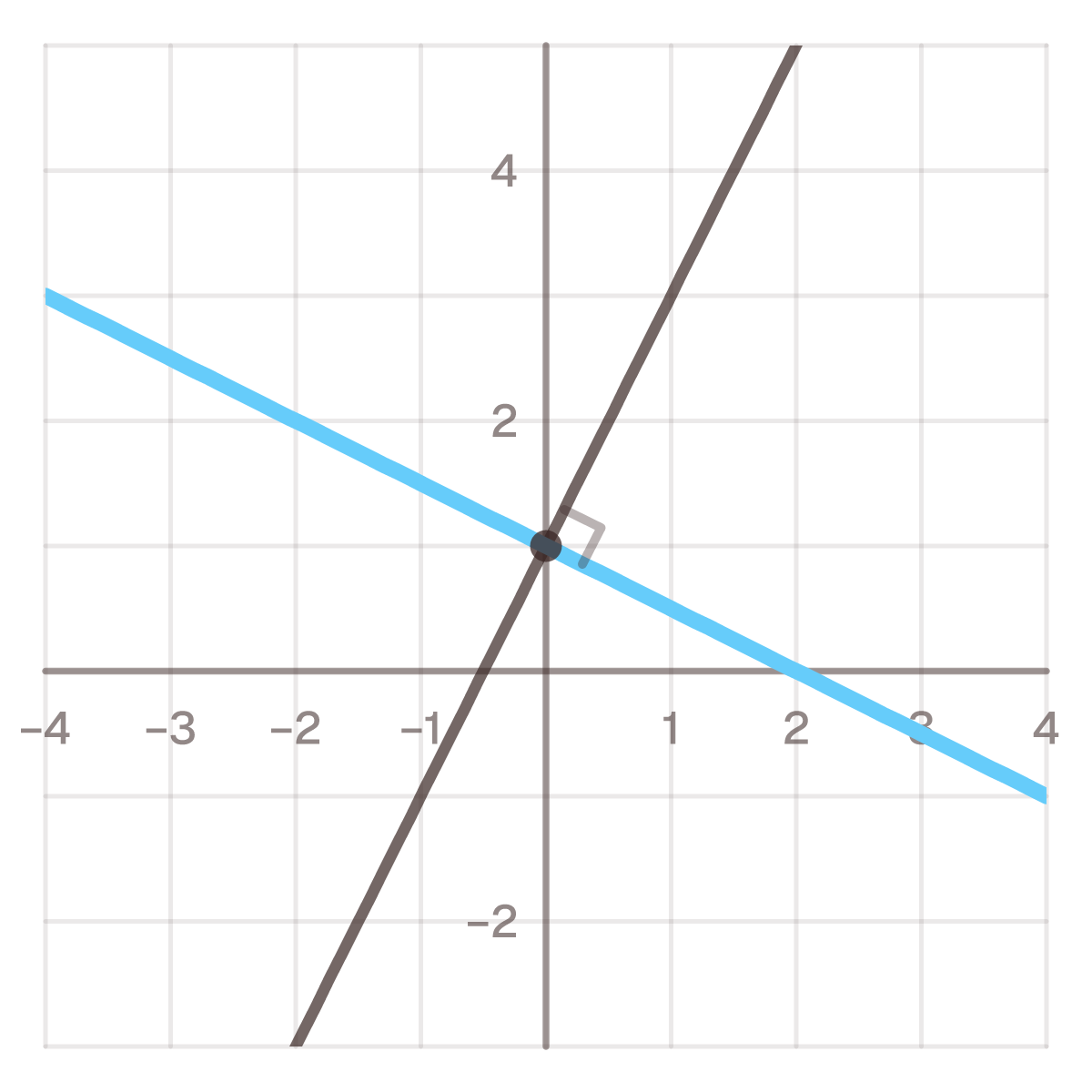
What the condition says
Two straight lines meet at a right angle exactly when
m₁ · m₂ = −1
Holds when neither line is vertical or horizontal.
Solved for the second slope: m₂ = −1/m₁. If one line has slope 2, the other has −0.5. If it is 3, the
other is −1/3. If it is −4, the other is 0.25.
Two things happen at once, and both are needed: the fraction is turned over and the sign is
changed. Slope 2 becomes neither 0.5 nor −2, but −0.5.
Why it comes out to −1
A slope m means “m steps up per step to the right” — a direction arrow (1, m).
Turn that arrow a quarter turn anticlockwise. The step to the right becomes a step up, and the step up
becomes a step to the left: the arrow (1, m) becomes (−m, 1). The new line’s slope is the rise over the
run, that is 1 / (−m) = −1/m.
Multiply the two slopes and you get m · (−1/m) = −1. The argument also explains why the number is −1: the minus comes from the turn sending one step backwards, and the one
comes from the step being the same length before and after.
Worked examples
Forwards. A line has m = 2. The perpendicular line has m = −1/2 = −0.5.
A negative slope. m₁ = −4 gives m₂ = −1/(−4) = 0.25. If one line is steeply down, the other is
gently up.
Through a point. The line perpendicular to y = 2x + 1 through (4, 3): the slope is −0.5, and with
point-slope form that is
y − 3 = −0.5(x − 4), so y = −0.5x + 5.
Checking. Do three points make two segments that meet at a right angle? Work out the two
slopes and multiply. If the product is
−1, the angle is right.
The exception: horizontal and vertical
A horizontal line has slope 0, and the line perpendicular to it is vertical. A vertical line has no slope
at all — the run is zero, and the rise divided by zero is not a number. So the condition cannot be
written for that pair: 0 · m₂ is 0 whatever m₂ is, never −1.
It is the same limitation y = mx + c has. Horizontal and vertical are
perpendicular all the same; they are just described with x = a instead.
Common mistakes
- Forgetting the sign. The perpendicular of slope 2 is −0.5, not 0.5. Always check by multiplying: if
you get +1, the minus went missing.
- Forgetting to flip. −2 is not perpendicular to 2. The product is −4.
- Flipping a fraction wrongly. If m = 2/3 the perpendicular slope is −3/2, not −2/3.
- Applying the condition to a horizontal line. m = 0 has no partner in this formula.
Common questions
How do I flip a decimal?
Write it as a fraction first. 0.4 is 2/5, so the perpendicular slope is −5/2 = −2.5.
Does it only hold for straight lines?
For curves it holds for the tangents. Two curves cross at a right angle if their tangents at the
crossing point do, and then the condition is the same one applied to the derivatives.
Why does the angle not look right in my graph?
Because the axes are scaled differently. The condition m₁ · m₂ = −1 assumes equal units on both axes; if
the y-axis is squashed, right angles look skewed.
What are the slopes called?
Negative reciprocals: each is the reciprocal of the other, with the opposite sign.