Midpoint
The relation
xₘ
The point halfway between two others: average the x-values, then average the y-values.
Solve for
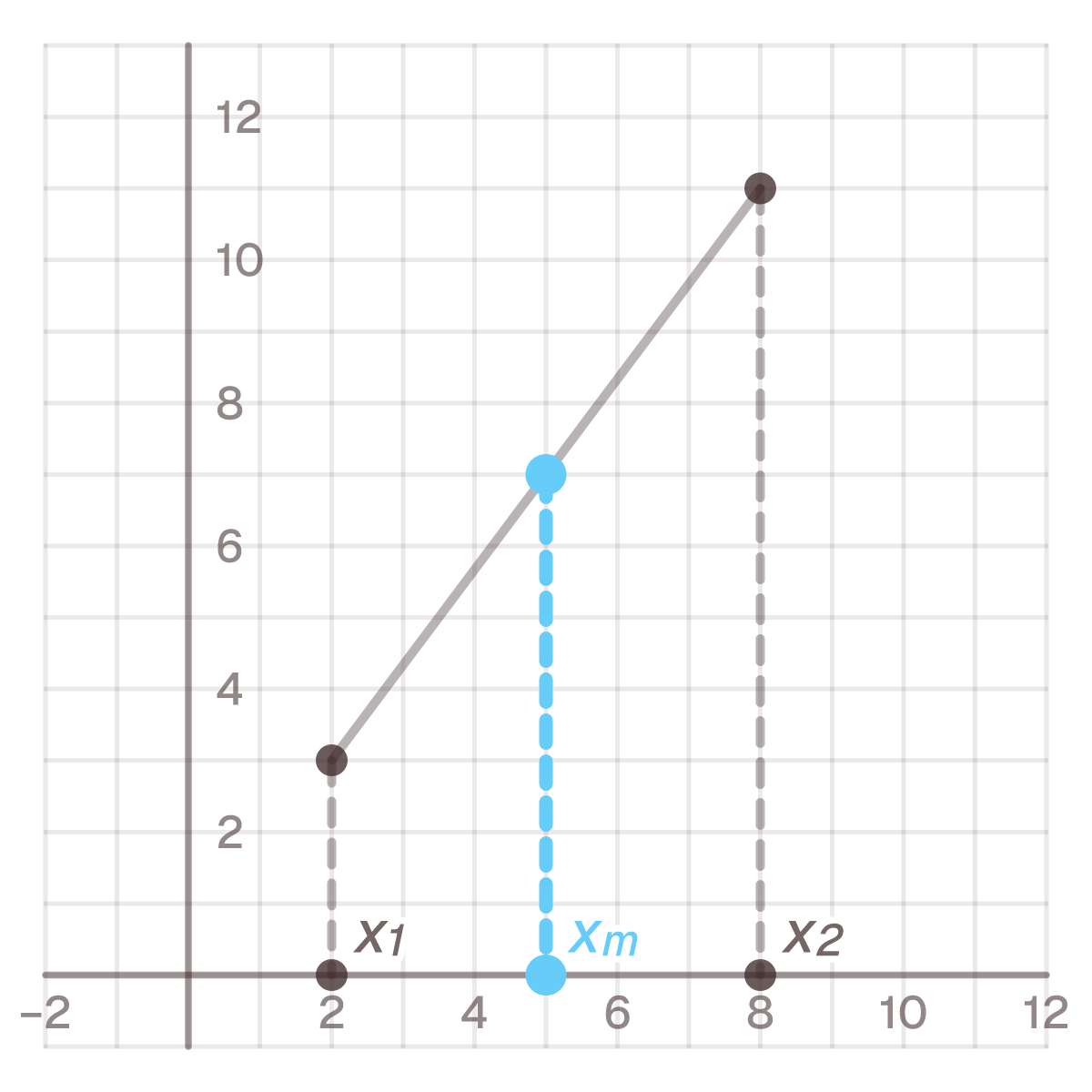
xₘ=5
xₘ equals (2 plus 8) divided by 2, equals 10 divided by 2, equals 5
Den här sidan finns på svenska. Byt till svenska
Theorem — what does that mean?
The point halfway between two others. Average the x-values, then average the y-values, and you are there.
In Swedish: Mittpunkt
xₘ
The point halfway between two others: average the x-values, then average the y-values.
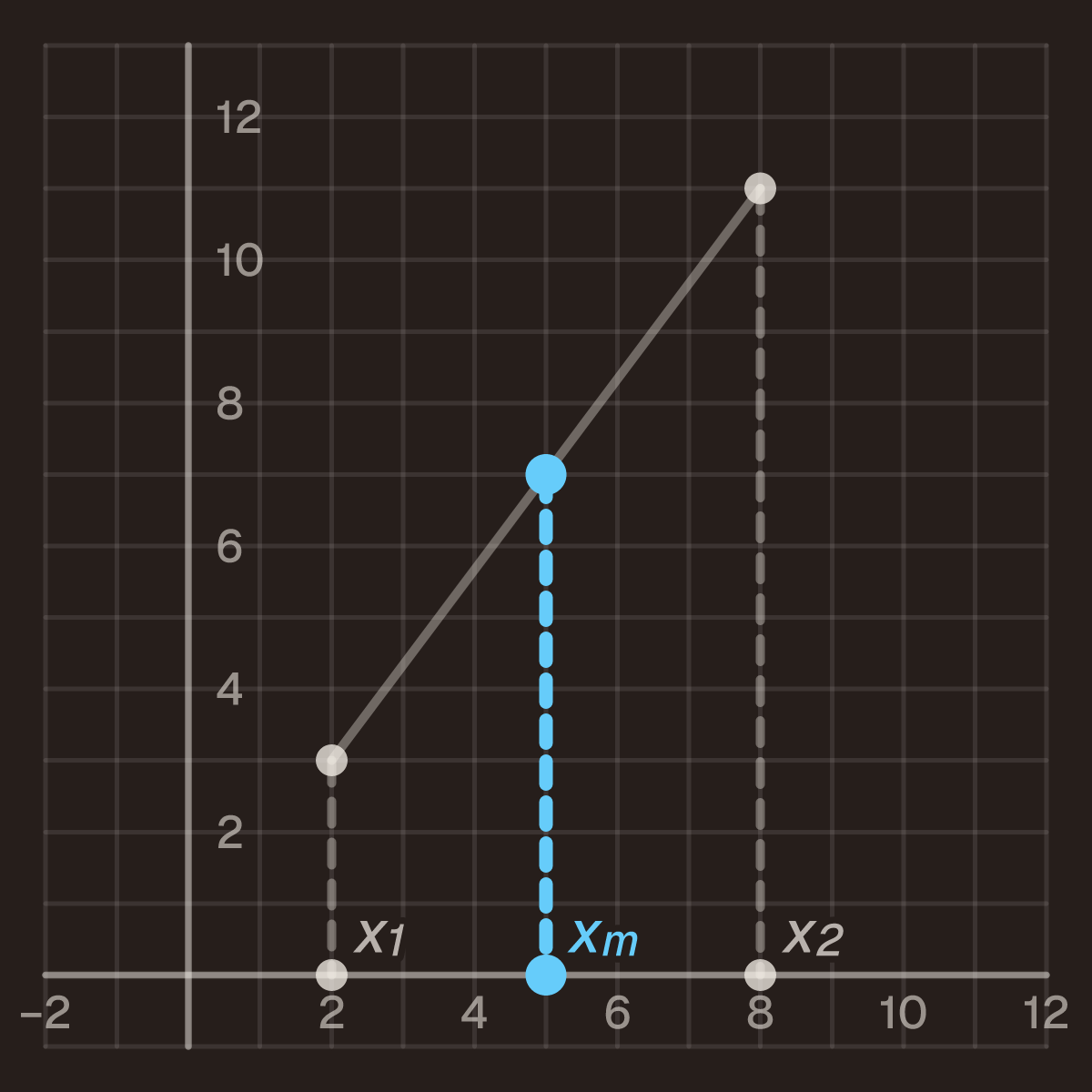
xₘ=5
xₘ equals (2 plus 8) divided by 2, equals 10 divided by 2, equals 5
You are given
The points in the coordinate plane are A = (x₁, y₁) and B = (x₂, y₂), and M is the midpoint of the segment between them. The formula is two averages side by side: one for x and one for y.
Why an average? Because halfway between two numbers is their average — halfway between 4 and 10 is 7. A segment moves at a steady rate in x all the way along and at a steady rate in y, so half the way in one direction happens at the same moment as half the way in the other.
A midpoint is a pair of numbers, and a formula here is one line. So the card on this page does one coordinate at a time: put in x₁ and x₂ to get xₘ, then put in y₁ and y₂ to get yₘ.
The midpoint’s x-coordinate does not depend on the y-values, and the other way round. Once you see that, there is no bracket with two fractions to memorise — it is the same average done twice.
The midpoint. A = (2, 3) and B = (8, 11) give xₘ = (2 + 8)/2 = 5 and yₘ = (3 + 11)/2 = 7. The midpoint is (5, 7).
With negatives. A = (−7, 4) and B = (3, −4) give xₘ = (−7 + 3)/2 = −2 and yₘ = (4 − 4)/2 = 0. The midpoint is (−2, 0), sitting on the x-axis.
The other end. A = (1, 2) and the midpoint is (4, 6). Where is B? From xₘ = (x₁ + x₂)/2 we get x₂ = 2 · xₘ − x₁ = 2 · 4 − 1 = 7, and in the same way y₂ = 2 · 6 − 2 = 10. So B = (7, 10). That is the question the bracket notation hides and the one-line version makes obvious.
How do I check that the point really is halfway?
Work out the distance from M to A and from M to B with the
distance formula. They should
come out equal, and add up to the distance from A to B. Equal distances alone are not enough: every
point on the perpendicular bisector is as far from A as from B.
Does it work in three dimensions?
Yes, unchanged: add (z₁ + z₂)/2. Every coordinate is handled on its own, which is what the
card does one at a time.
How do I divide a segment into three instead?
Then an average is not enough. The point a third of the way along is x₁ + (x₂ − x₁)/3, and the
midpoint is the same expression with a 2 underneath — so the midpoint formula is the special case
usually learned first.
| Solve for | Rearranged | With the numbers | Comes to |
|---|---|---|---|
| x₁ | 2xₘ | 2·5 | 2 |
| x₂ | 2xₘ | 2·5 | 8 |
| xₘ | x₁ | 2 | 5 |
Last reviewed October 6, 2026 ·How pages are reviewed
Sheets that ask this formula, with their answer keys. Open one to see the questions or print it.
Six questions on the distance between two points, six on the midpoint and four on the slopes of perpendicular lines.
Copy the code into your page where the formula card should appear. It loads from lovetocalc.com, so it stays current on its own — all we ask is that the credit line comes with it.