Pick the unit your lengths are in. Areas are then labelled in square units and volumes in cubic units; nothing is converted.
What the theorem says
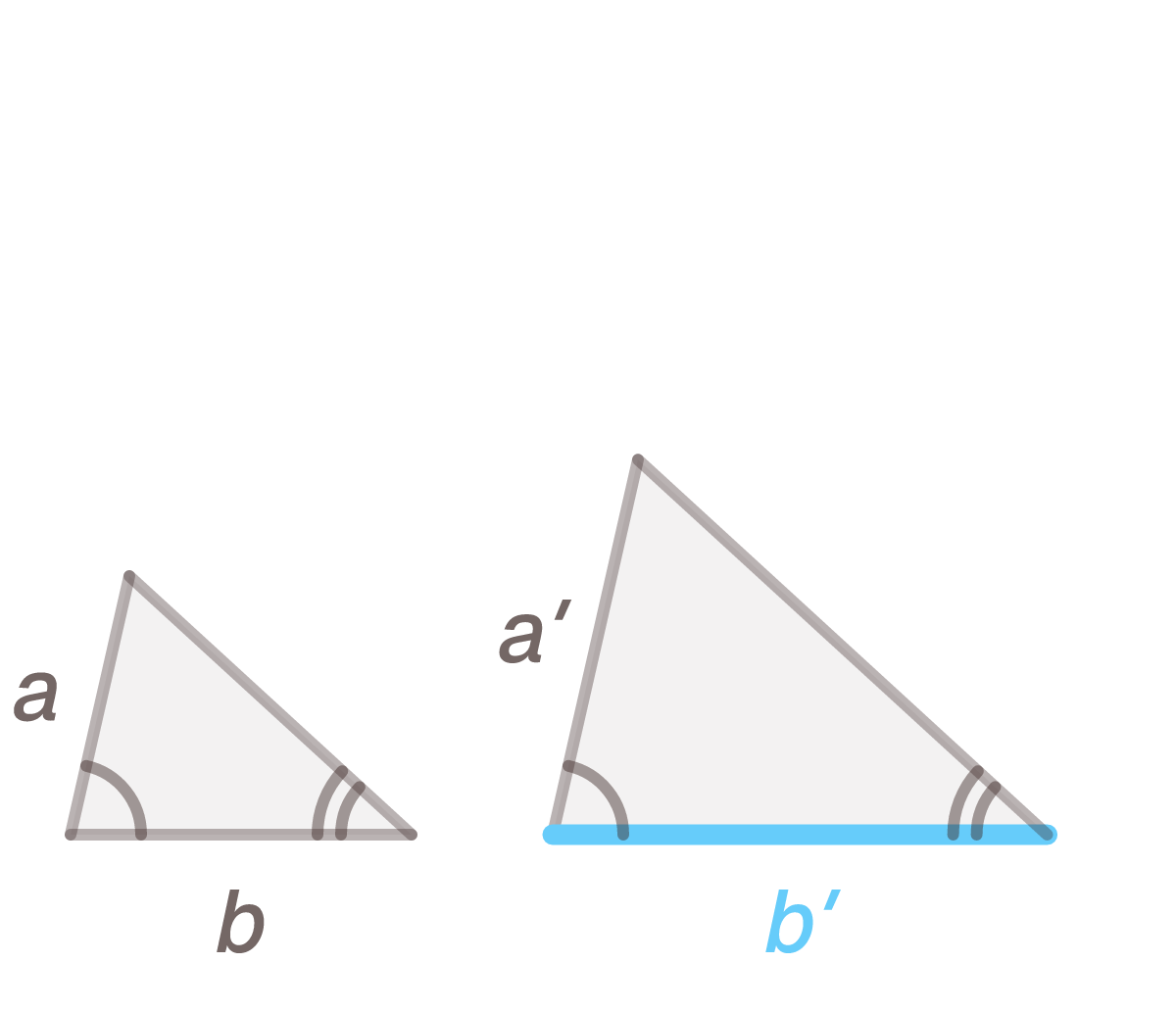
Two triangles are similar when they have the same angles. One is then an enlargement of the other,
and every side of the large one is the same number of times longer than the matching side of the small
one. That number is the scale factor.
If the small triangle has sides of 4 cm and 6 cm, and the matching side of the large one is 6 cm,
the scale factor is 6/4 = 1.5 and the other side of the large triangle is 6 · 1.5 = 9 cm.
Setting up the proportion
The arithmetic is easy; the hard part is the pairing: which side goes with which? The rule is that sides
opposite equal angles belong together.
- Draw both triangles with the same angle at the lower left.
- Pair the sides: shortest with shortest, longest with longest.
- Set the ratio of two sides in one triangle equal to the ratio of the other two.
- Cross-multiply and solve.
A proportion set up the wrong way round usually shows at once: the answer comes out smaller than the
side it was supposed to exceed.
How to know the triangles are similar
Three checks, and you only need one of them:
- Two angles equal. The third then is too, since the
angle sum is 180°.
- All three pairs of sides in the same ratio.
- Two pairs of sides in the same ratio with equal angles between them.
A common case is a line drawn parallel to one side, which produces similarity for free — see the
parallel cut.
Worked examples
The shadow. A person 1.8 m tall casts a shadow 1.2 m long. A flagpole casts an 8 m shadow at the same
moment. The pole is 1.8 · 8 / 1.2 = 12 m.
The map. Two sides of the small triangle are 5 and 8. The matching side of the large one is 10, so
the scale factor is 2 and the other side is 16.
Backwards. The large triangle has sides 21 and 15; the small one has 14 in the first position. Its
other side is 15 · 14 / 21 = 10.
Check. 6/4 = 1.5 and 9/6 = 1.5 — the same quotient, so similar.
Common mistakes
- Pairing the wrong sides. Sides have to correspond, not merely sit in the same place on the page.
Turn one triangle until the angles line up.
- Confusing the scale factor with a difference. Similarity is about multiplying, not about adding the
same amount to every side.
- Expecting the area to grow the same way. Double the sides and the area quadruples — see
area scale factor.
- Assuming similarity without checking. Two triangles with two equal sides need not have the same
shape.
Common questions
How does this differ from congruence?
Congruent figures are similar with scale factor 1 — same shape and same size. Similarity allows
enlargement.
Does similarity apply only to triangles?
No, but triangles are the easy case: equal angles are enough. For quadrilaterals both the angles and
the side ratios have to match.
What happens to the perimeter?
It grows by the same scale factor as the sides. The area grows by the factor squared.