Volume of a prism
The relation
V
The base area times the height. It is the box formula with the base left open: whatever the end face is, the volume is that face carried along.
Solve for
V=60cm³
V equals 12 times 5, equals 60 cm³
Den här sidan finns på svenska. Byt till svenska
Theorem — what does that mean?
Base area times height — the box formula with the base left open, so it holds for any end face at all.
In Swedish: Prismats volym
V
The base area times the height. It is the box formula with the base left open: whatever the end face is, the volume is that face carried along.
V=60cm³
V equals 12 times 5, equals 60 cm³
You are given
V = 16 cm³
Pick the unit your lengths are in. Areas are then labelled in square units and volumes in cubic units; nothing is converted.
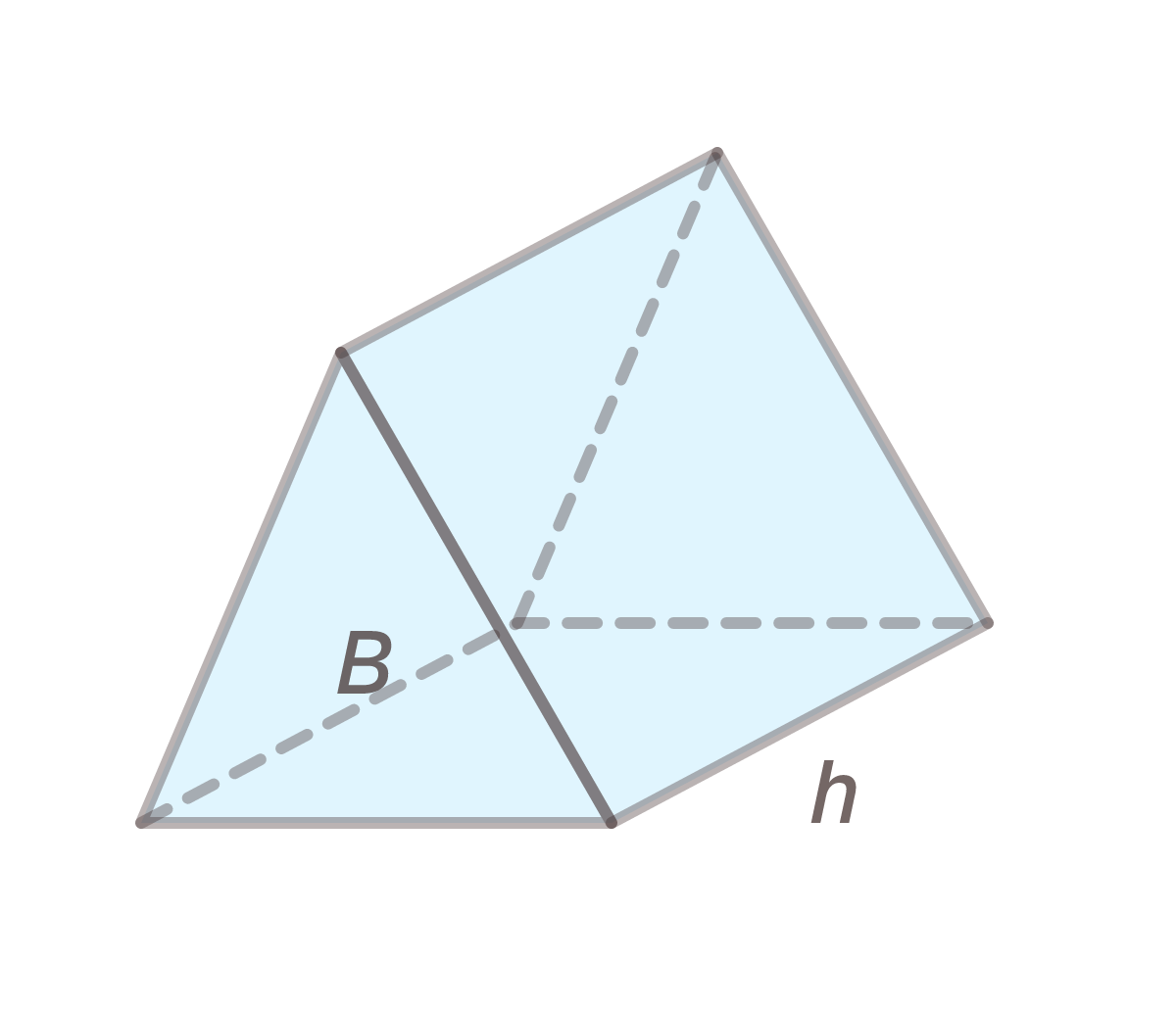
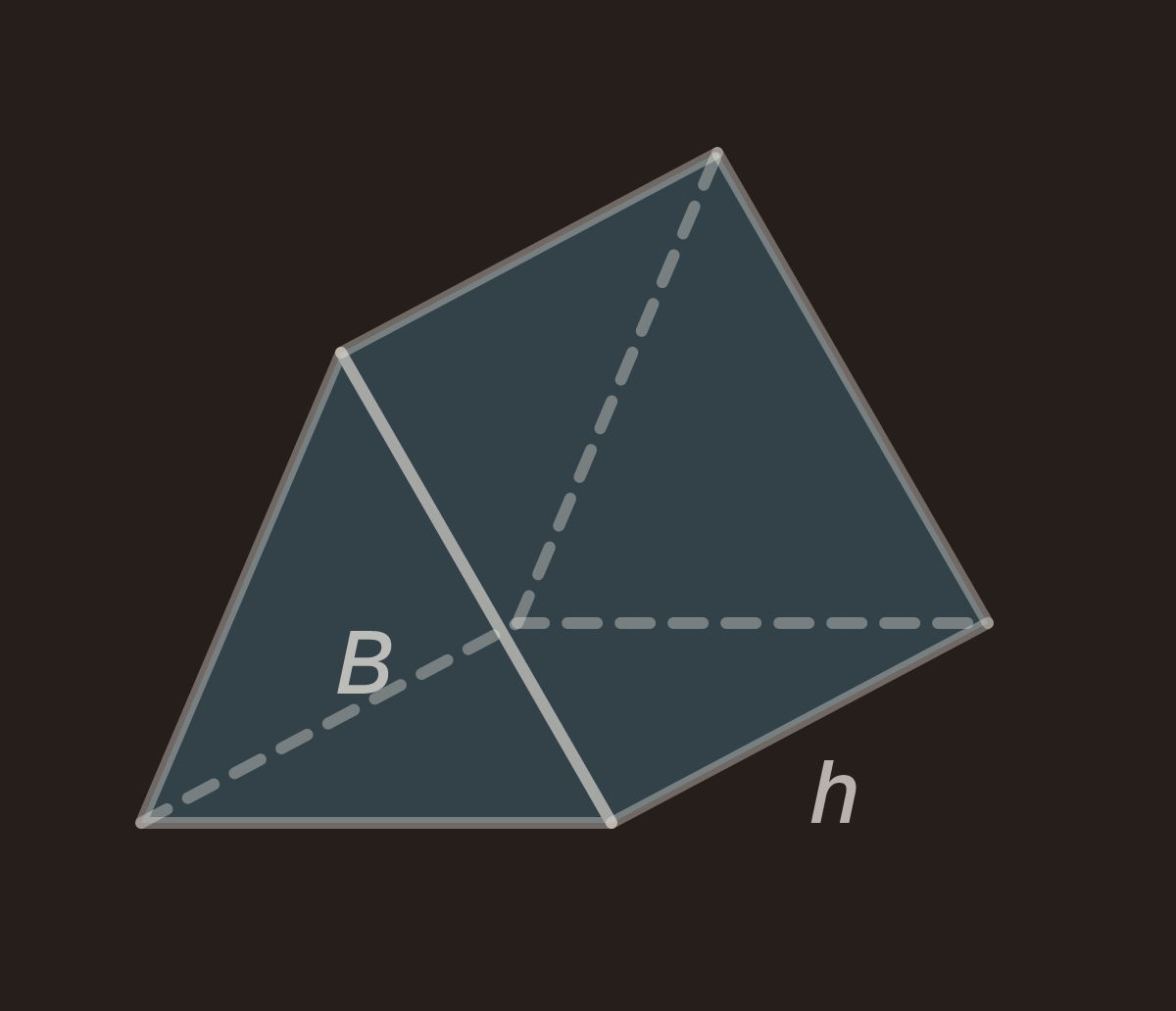
A prism has two identical, parallel end faces and straight sides between them. The end face can be a triangle, a hexagon or any other polygon — as long as it is the same all the way through, the solid is a prism.
The volume is then the base area B times the height h. Think of the end face as a cross-section: every millimetre you travel adds a millimetre-thin slice of area B, and h millimetres give you B · h.
A cuboid is a prism with a rectangular end face: l · w · h is (l · w) · h, the base area times the height. A cylinder works the same way with a circle as its end face: π r² · h.
Both are special cases. B · h is the general formula.
A triangular prism. The end face is a triangle of area 12 cm² and the prism is 5 cm long: 12 · 5 = 60 cm³.
A beam. A timber beam with a cross-section of 45 × 95 mm is 3.6 m long. The base area is 0.045 · 0.095 ≈ 0.0043 m², and the volume 0.0043 · 3.6 ≈ 0.015 m³.
Backwards. The volume is 60 cm³ and the height 5 cm. The base area is 60 / 5 = 12 cm². Pick the base area as the unknown in the card above and every step is written out.
Does the formula hold for a leaning prism?
Yes, as long as the height is measured at a right angle between the two end faces and not along the
slanted side. An oblique prism has the same volume as an upright one with the same base and height.
How do I work out the base area?
With that figure’s own area formula: the
triangle’s, the
rectangle’s or the
circle’s. Then put the result in as B.
What about the surface area?
Two base faces plus the side, which is the base’s perimeter times the height. That is the
surface area of a prism.
| Solve for | Rearranged | With the numbers | Comes to |
|---|---|---|---|
| B | Vh | 605 | 12 cm² |
| h | VB | 6012 | 5 cm |
| V | Bh | 12·5 | 60 cm³ |
Last reviewed October 6, 2026 ·How pages are reviewed
Sheets that ask this formula, with their answer keys. Open one to see the questions or print it.
Twenty questions on four solids. The volume is asked for in most; in some the volume is given and an edge or the height is asked for instead.
The same drawing, measured in the other ways it can be measured.
Copy the code into your page where the formula card should appear. It loads from lovetocalc.com, so it stays current on its own — all we ask is that the credit line comes with it.