Pick the unit your lengths are in. Areas are then labelled in square units and volumes in cubic units; nothing is converted.
Why one third
Take a cone and a cylinder with the same radius
and the same height. Fill the cone with water and pour it across. You have to do it three times before the
cylinder is full.
Hence the formula V = π r² h / 3. The base area π r² times the height would have
given you the cylinder; the cone tapers to a point and takes a third of it.
The same third holds for every solid that narrows in straight lines from a flat base to a single
point — pyramids as much as cones.
Where the height is measured
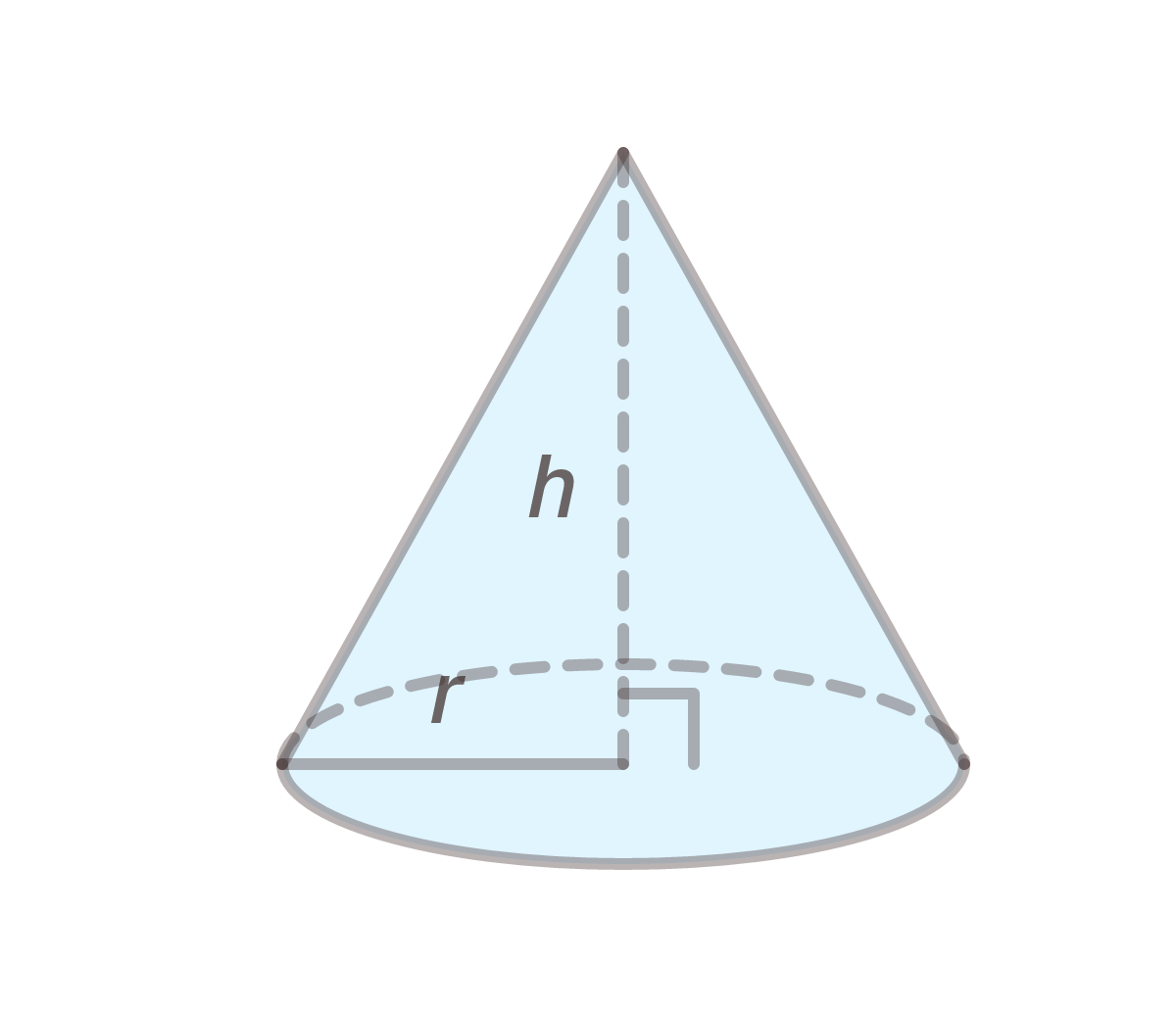
The height is the perpendicular distance from the base to the apex, the dashed line in the figure; in a
right cone it starts at the centre of the base. The slanted edge from the rim of the base up to the apex
is called the slant height and is always longer. Use the slant height instead and the volume comes out too
large.
Worked examples
A textbook cone. Radius 3 cm, height 8 cm: π · 3² · 8 / 3 = 24π ≈ 75.4 cm³.
An ice cream cone. The diameter is 6 cm, so the radius is 3 cm, and the cone is 12 cm deep:
π · 3² · 12 / 3 ≈ 113 cm³, a good tenth of a litre.
A pile of gravel. A cone with a radius of 1.5 m and a height of 1.2 m holds
π · 1.5² · 1.2 / 3 ≈ 2.8 m³.
Common mistakes
- Forgetting the three. You have then calculated the cylinder’s volume and the answer is three times
too large.
- Using the diameter instead of the radius. The diameter is twice as long, and since the radius is
squared the volume comes out four times too large.
- Using the slant height as the height. See above — the height goes straight up, not along the surface.
Common questions
Does the same formula work for a pyramid?
The third does, but the base area changes: V = B · h / 3, where B is the area of the base. For a cone
B = π r².
What is the cone’s lateral surface area?
A = π r l, where l is the slant height rather than the height; it has
its own page. The slant height comes from the
Pythagorean theorem: l² = r² + h².
How much does a sphere of the same radius hold?
More. The volume of a sphere is 4π r³ / 3, which
is as much as four cones of height r.