What the formula says
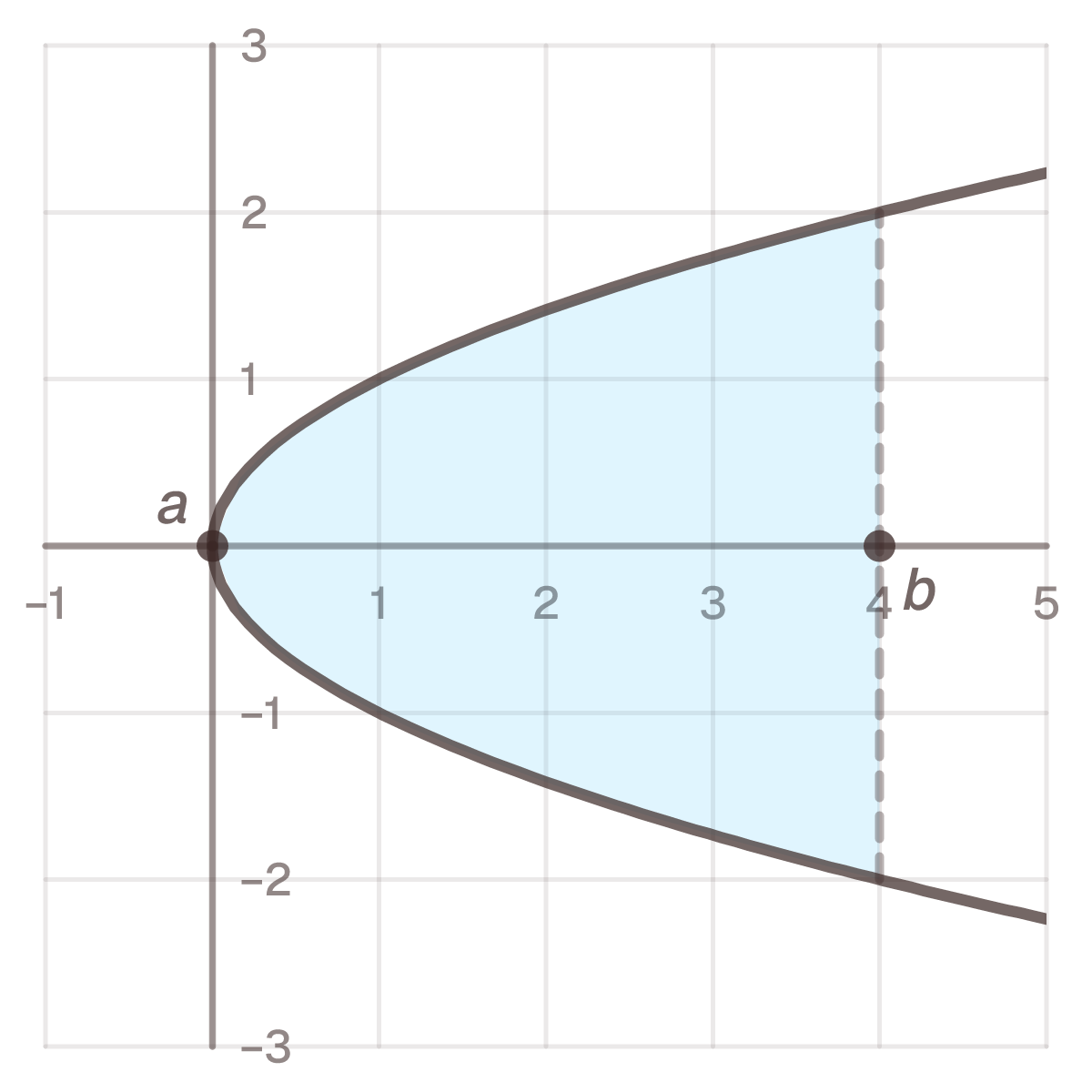
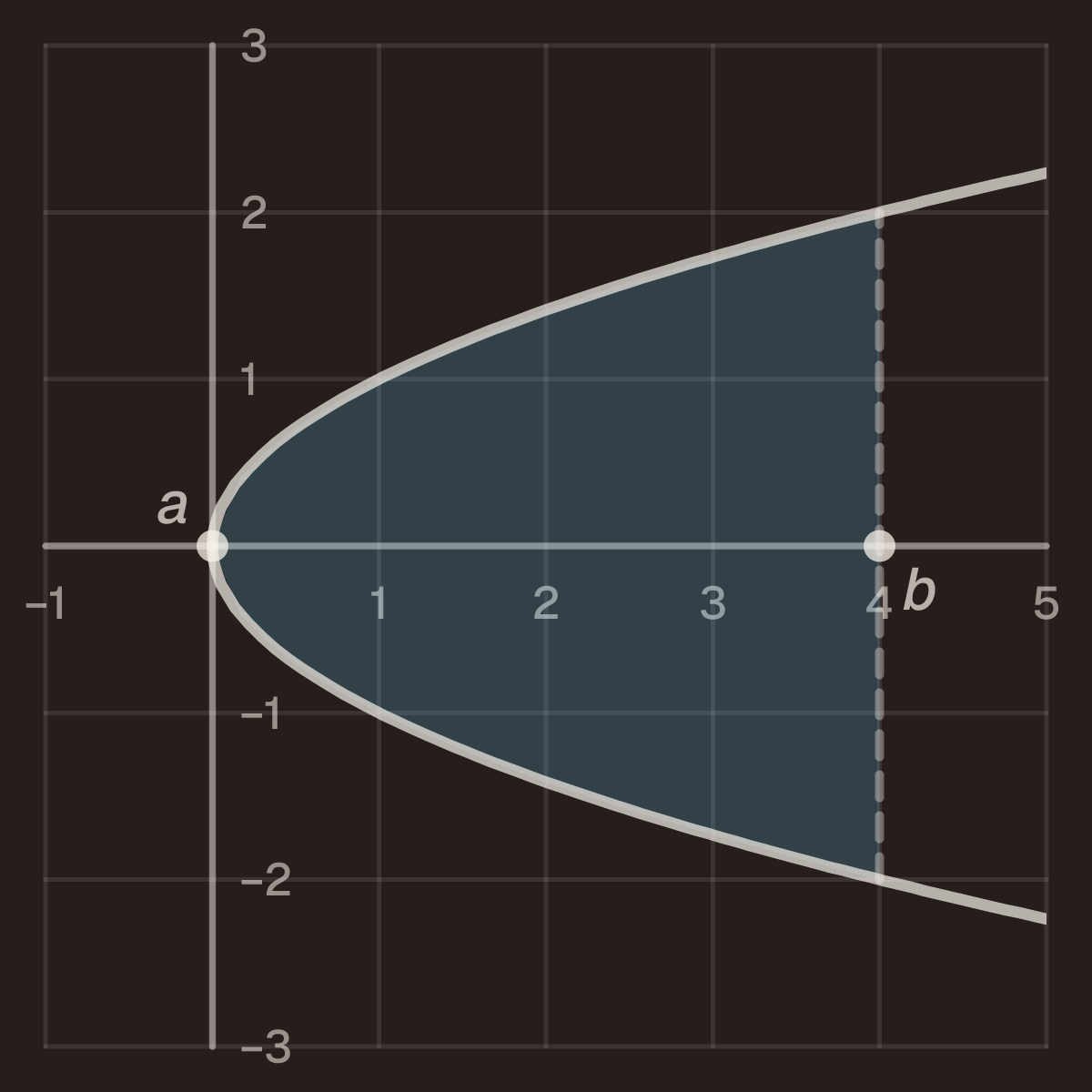
V = π ∫ₐᵇ (f(x))² dx
V is the volume of the solid you get when the curve y = f(x), from x = a to x = b, is rotated a
full turn about the x-axis. The formula is a theorem, and the reason for it is in the slicing: cut
the solid across the axis into thin slices of thickness dx. Each slice is a disc of radius f(x), with
volume π · f(x)² · dx. The definite integral adds
them up.
Example. Rotate y = x from 0 to 3. The solid is a cone with radius 3 and height 3:
V = π ∫₀³ x² dx = π · [x³/3]₀³ = π · 9 = 9π ≈ 28.3
The volume of a cone, πr²h/3 = π · 9 · 3/3 = 9π, gives the same answer — a good first check of the method.
Square first, then integrate
The formula squares the function inside the integral. Two mistakes give a plausible number and are both wrong:
- Forgetting the square. π ∫₀³ x dx = 4.5π. That is π times the area under the line, not a volume.
- Squaring after integrating. π (∫₀³ x dx)² = π · 4.5² = 20.25π. The disc radius is f(x) at each slice, and it has to be squared slice by slice.
A second example: a sphere
The upper half of a circle of radius r is f(x) = √(r² − x²), from −r to r. Rotated, it is a sphere:
V = π ∫₋ᵣʳ (r² − x²) dx = π [r²x − x³/3]₋ᵣʳ = π (2r³ − 2r³/3) = 4πr³/3
The square removed the root, which is what makes the integral easy.
About the y-axis
Rotating about the y-axis instead, the discs are horizontal and the radius is x, written as a function of y:
V = π ∫ᶜᵈ x² dy
Example. y = x², 0 ≤ y ≤ 4, rotated about the y-axis. Here x² = y, so V = π ∫₀⁴ y dy = π · 8 = 8π.
At university a second method is added, the shell method, for rotating the region under y = f(x) about the y-axis: V = 2π ∫ₐᵇ x · f(x) dx. Each thin strip at distance x from the axis sweeps out a cylindrical shell of circumference 2πx.
Two curves: washers
If the region lies between two curves, f(x) above and g(x) below, each slice is a washer — a disc with a hole:
V = π ∫ₐᵇ (f(x)² − g(x)²) dx
Square each radius first and then subtract. π ∫ (f(x) − g(x))² dx is a different and wrong number.
Common mistakes
- No square. V = π ∫ f(x) dx is not a volume.
- No π. The disc area is πr², and π is easy to drop when it stands outside the integral.
- Squaring the integral instead of the function.
- The wrong variable about the y-axis. Rotating about the y-axis integrates in y, with x expressed in terms of y.
Common questions
Why is it π times f(x) squared?
Each thin slice of the solid is a circular disc whose radius is the height of the curve, f(x). A disc of
radius r has area πr², so the slice has volume πf(x)² times its thickness.
Does it matter if the curve goes below the x-axis?
No. The radius is the distance to the axis, and squaring makes it positive. Unlike the area under a
curve, nothing cancels.