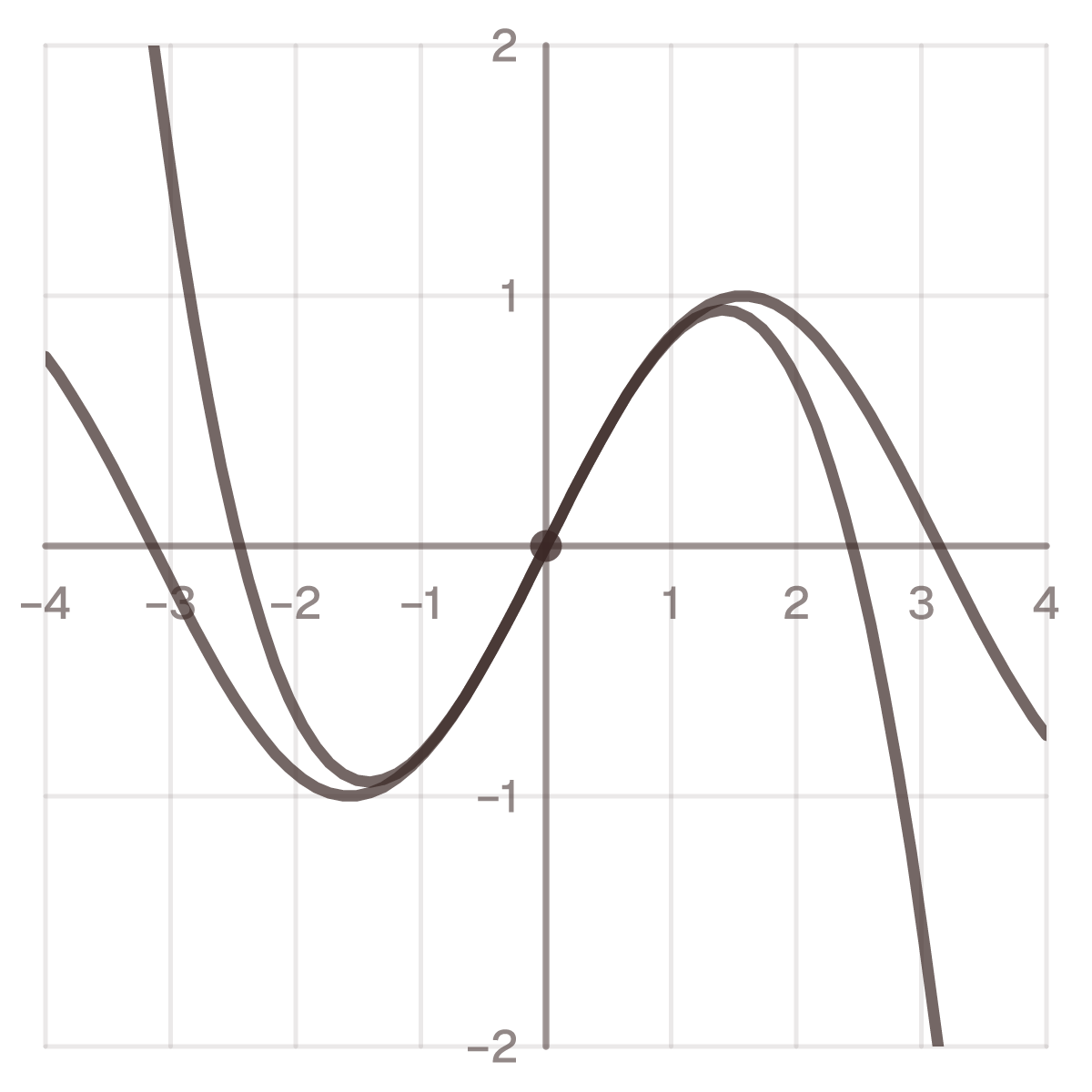
The expansion
- sin x = Σk=0n (−1)k x2k+1/(2k + 1)! + O(x2n+3) as x → 0
Holds when x is in radians. O(x2n+3) is a function that, near 0, is at most a constant times |x|2n+3. The sum ends at x2n+1, and the next power, x2n+2, has the coefficient 0 because sine has only odd powers. So the remainder starts at x2n+3. O(x2n+2) would also be true, but it says less: after x − x³/6 the sharp statement is O(x⁵).
For a value of sin x at a given point, the Taylor polynomial card gives the number and the error bound.
Worked example: a limit
limx→0 (sin x − x)/x³. With n = 1:
sin x − x = −x³/6 + O(x⁵), so (sin x − x)/x³ = −1/6 + O(x²) → −1/6.
A second example: sin x / x
Divide the expansion by x: sin x / x = 1 − x²/6 + O(x⁴). As x → 0 this approaches 1, which is the first of the standard limits, and the expansion also says how fast: the gap to 1 is about x²/6.
Common mistakes
- O(x⁶) after x − x³/6. The next term is x⁵/120, and x⁵ is not a constant times x⁶ near 0. The statement is false.
- Degrees. In degrees the first term is πx/180, not x.
- Factorials left out. The coefficients are 1/3! = 1/6 and 1/5! = 1/120, not 1/3 and 1/5. Those belong to arctan x.
Related pages
The method behind this expansion and the others is on Maclaurin series.