What the formula says
A = ∫ₐᵇ f(x) dx, where f(x) ≥ 0
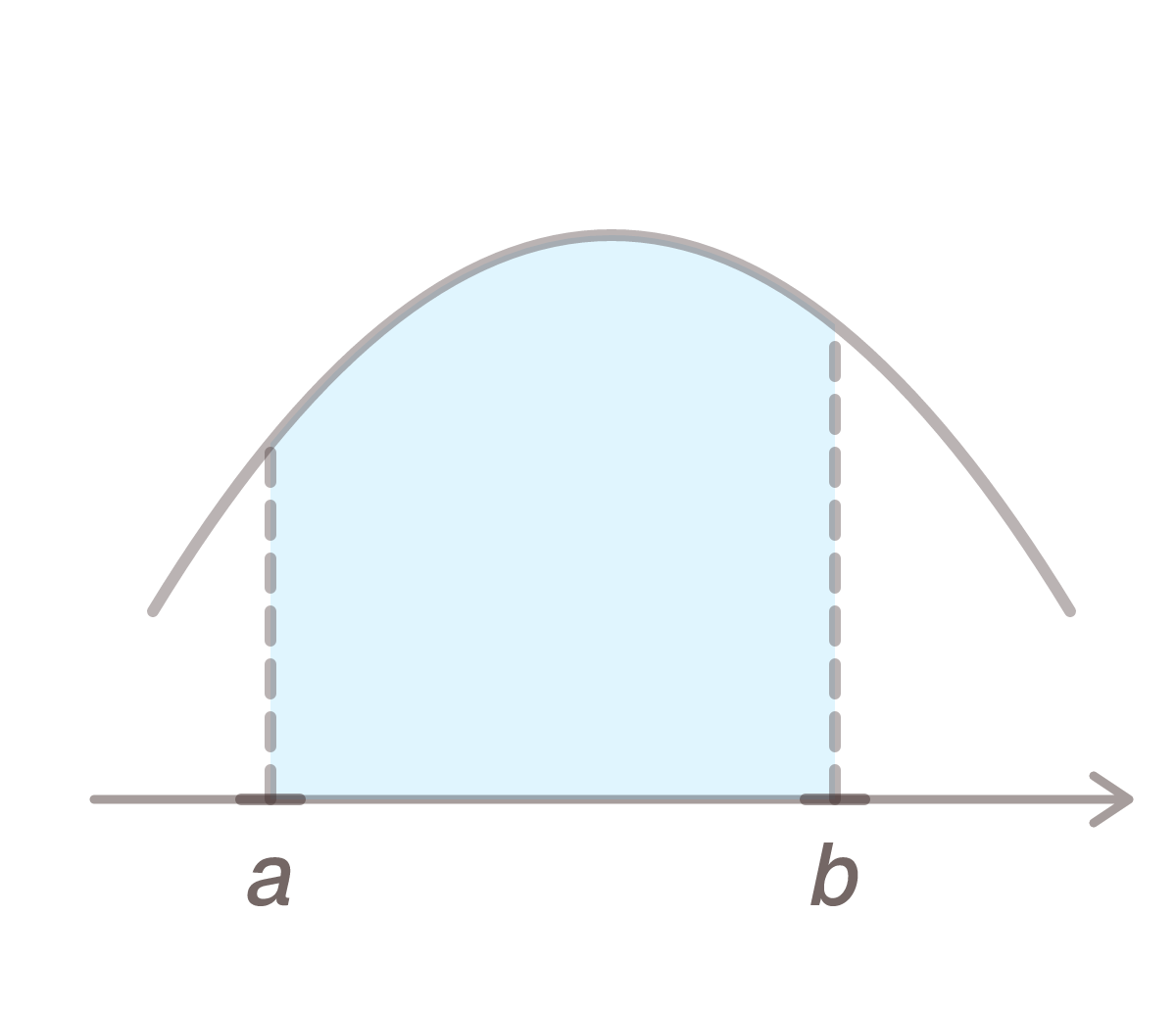
A is the area between the curve y = f(x) and the x-axis, from x = a to x = b. The formula is a
definition: the area under a curve is, by definition, its definite integral.
It is worked out as F(b) − F(a), where F is an antiderivative of f.
The condition f(x) ≥ 0 is the part that is easy to forget. The integral counts what lies below the x-axis as negative. If the curve dips below the axis anywhere between a and b, the integral is no longer the area, and you split the interval at the zeros.
Worked examples
A parabola. The area under y = x² from 0 to 3. An antiderivative is x³/3, so A = 27/3 − 0 = 9.
An arch of sine. The area under y = sin x from 0 to π, where the curve stays above the axis all the way: A = −cos π − (−cos 0) = 1 + 1 = 2.
A whole period of sine. From 0 to 2π the integral is −cos 2π + cos 0 = 0. The second arch lies below the axis and cancels the first. The area is still two arches of 2 each, so 4.
A curve that changes sides. y = x² − 1 from 0 to 2 lies below the axis up to x = 1.
- From 0 to 1: ∫₀¹ (x² − 1) dx = 1/3 − 1 = −2/3. The area is 2/3.
- From 1 to 2: ∫₁² (x² − 1) dx = (8/3 − 2) − (1/3 − 1) = 4/3.
- The area is 2/3 + 4/3 = 2. The integral straight across the whole interval gives 4/3 − 2/3 = 2/3, which is the wrong answer to the question about the area.
Common mistakes
- Integrating straight across a zero. Parts below and above the axis cancel, and the answer comes out too small, sometimes 0. Find the zeros first.
- Not noticing a negative area. An area is never negative. If the answer is negative the curve lies below the axis, and the area is its absolute value.
- Forgetting that the area between two curves is top minus bottom. Between y = x and y = x² from 0 to 1, x is on top, so the area is ∫₀¹ (x − x²) dx = 1/2 − 1/3 = 1/6.
Common questions
Why is the integral negative when the curve is below the x-axis?
Because the integral adds up f(x) times a small width, and where f(x) is negative each such piece is
negative. The integral measures area with a sign. For the ordinary area, take the absolute value of each
part on its own.
How do you find the area between two curves?
Integrate the upper curve minus the lower one, from where they cross to where they cross next. If the
curves swap places on the way, split the interval there, just as at the zeros.
What unit is the area under a curve in?
The unit on the y-axis times the unit on the x-axis. If x is time in seconds and y is speed in metres per
second, the area is in metres: the distance travelled. That is why integrals turn up far outside
geometry.