Skip to content
LoveToCalc

Theorem — what does that mean?

Taylor polynomial for ln(1 + x)

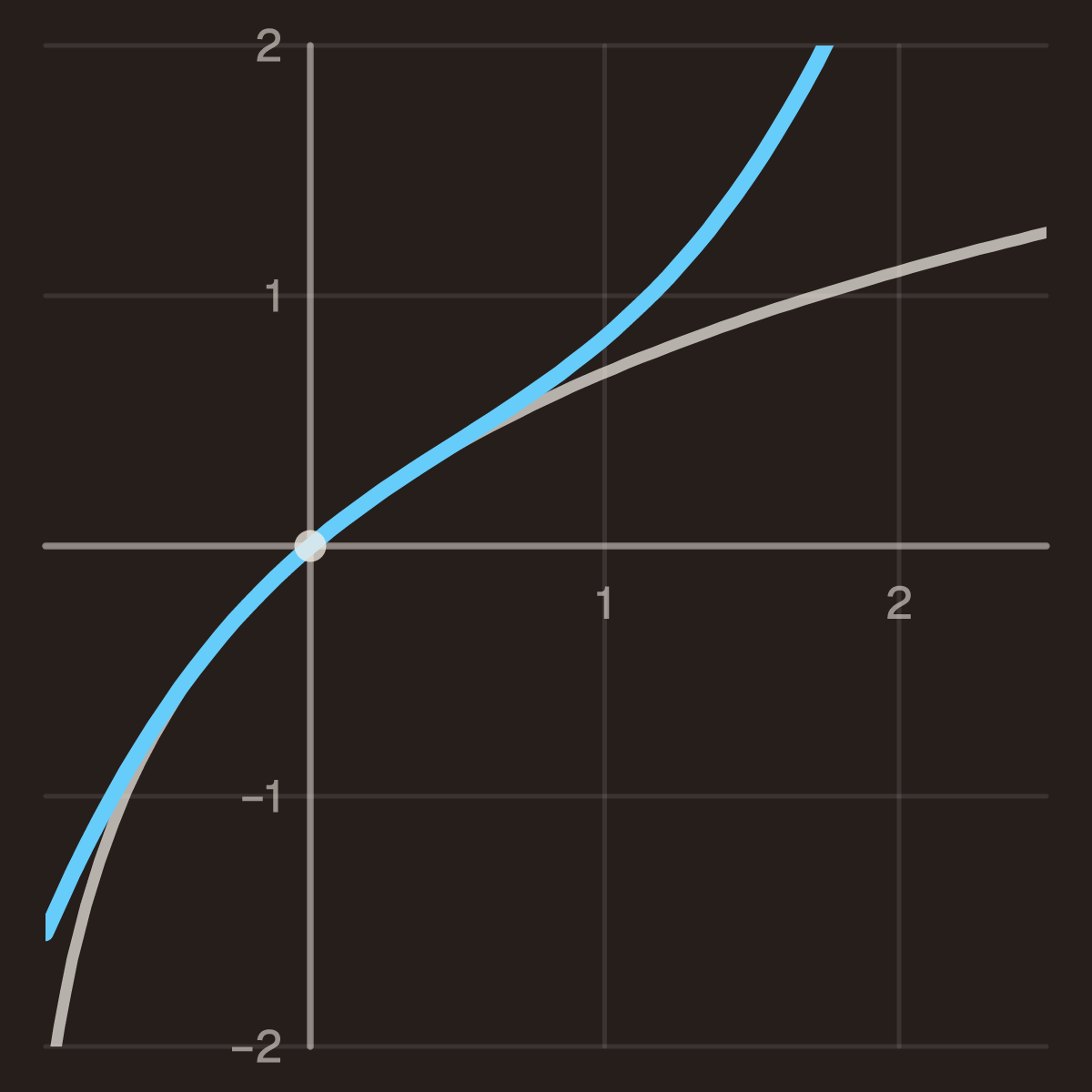
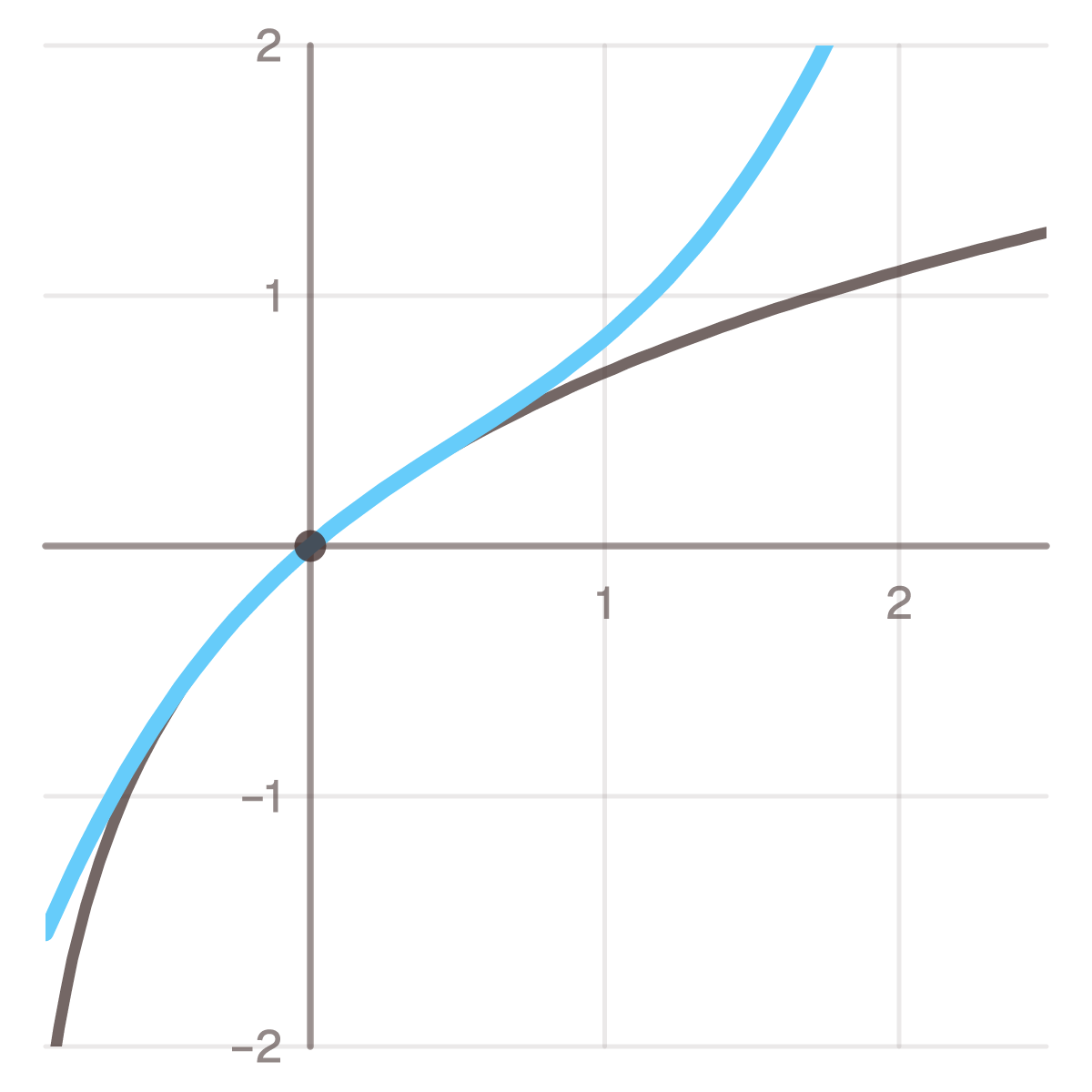
The coefficients are ±1/k, and the polynomial is useful for x between −1 and 1.

In Swedish: Taylorpolynom för naturliga logaritmen av 1 + x

Taylor polynomial for the natural logarithm of 1 + x

The relation

Pn=nΣk=1(−(−1)kxkk)

ln(1 + x) ≈ x − x²/2 + x³/3 − … ± xⁿ/n, with the Lagrange bound on the error beside the answer.
Pn≈0.4167

P n equals the sum for k from 1 to 3 of (minus (((minus 1) to the power of k times 0.5 to the power of k) divided by k)). The Lagrange error bound is 0.0156: ln(1 + x) lies within this distance of the polynomial.

Working1 steps

The formula

The k-th derivative of ln(1 + x) at 0 is (−1)k+1(k − 1)!, so the coefficient of xk is (−1)k+1/k. Enter x and the degree n in the card above. Beside the answer it shows the Lagrange bound |x|n+1 / ((n + 1)(1 + min(x, 0))n+1). For x ≥ 0 that is xn+1/(n + 1).

Holds when x is above −1. The series converges for −1 < x ≤ 1; outside that the bound is true but does not shrink as n grows.

Worked example: ln 1.5 with degree 3

The bound is 0.54/4 = 0.0156, and the true ln 1.5 = 0.405 465 is 0.011 away.

A second example: ln 2

With x = 1 and n = 4: 1 − 1/2 + 1/3 − 1/4 = 0.5833, against ln 2 = 0.6931. The bound is 1/5 = 0.2, so four terms are far from enough. The series is slow at x = 1.

Common mistakes

Frequently asked questions

How do I get ln of a number from this? Write the number as 1 + x: ln 1.5 uses x = 0.5, and ln 0.9 uses x = −0.1.

Looking for another letter? The formula solved for each one
Solved for each letter
Solve forRearrangedWith the numbersComes to
PnnΣk=1(−(−1)kxkk)3Σk=1(−(−1)k·0.5kk)0.4167

Last reviewed October 11, 2026 ·How pages are reviewed

Calculate it in practice

CalculusAll formulas

Put this formula on your site

Copy the code into your page where the formula card should appear. It loads from lovetocalc.com, so it stays current on its own — all we ask is that the credit line comes with it.