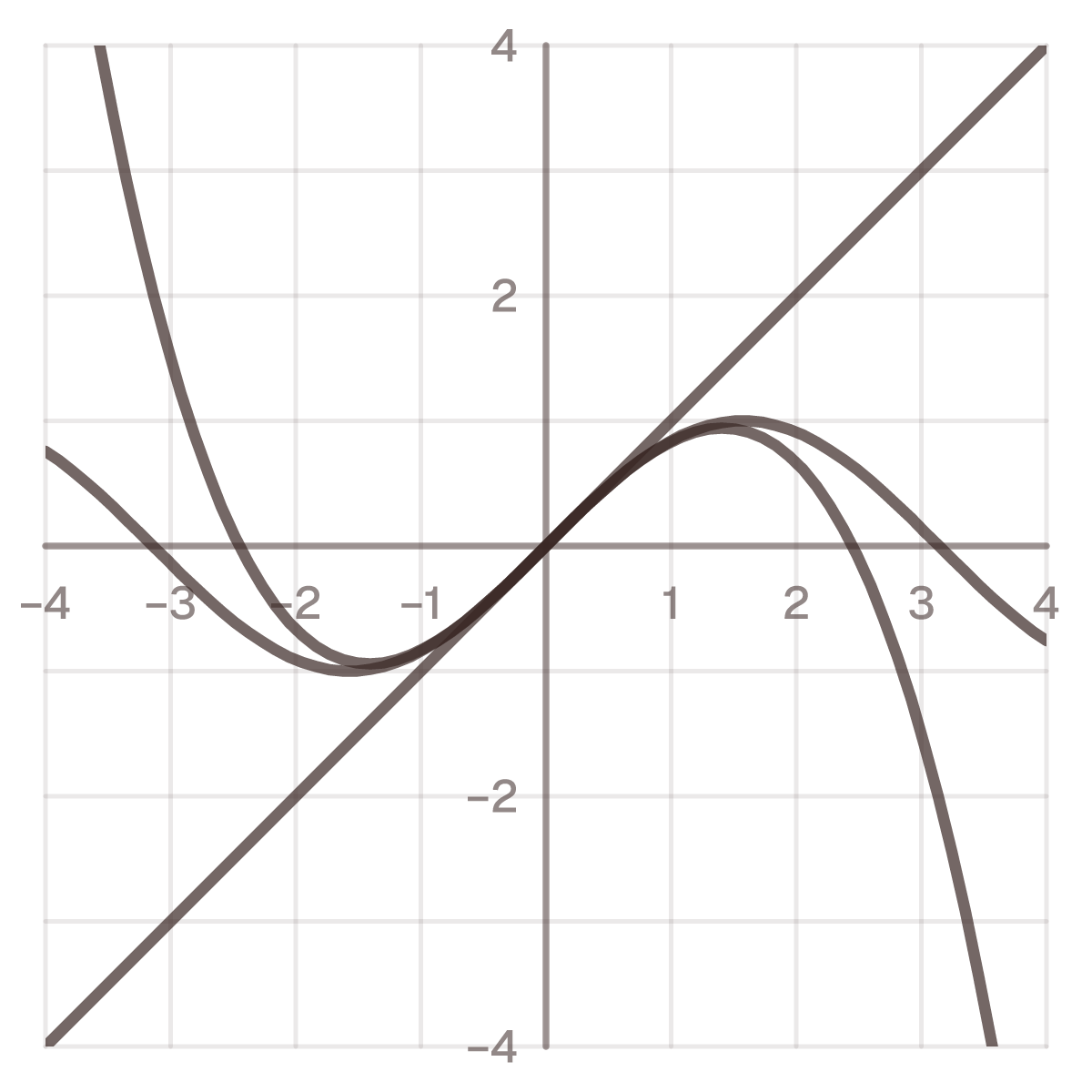
The formula
- f(x) = f(0) + f′(0) · x + f″(0)/2! · x² + f‴(0)/3! · x³ + …
Term k is the k-th derivative at 0, divided by k!, times xk. Stop after the xn term and you have the Maclaurin polynomial of degree n, the best polynomial of that degree near 0. It is the Taylor series with its centre at 0.
Why it works
The polynomial is built to agree with f at 0 in value, slope, curvature and every derivative up to its degree. The k! is there because differentiating xk k times gives k!, and it has to cancel for the k-th derivatives to match.
The series worth knowing
| Function | Series | Valid for |
|---|---|---|
| ex | 1 + x + x²/2! + x³/3! + … | every x |
| sin x | x − x³/3! + x⁵/5! − … | every x |
| cos x | 1 − x²/2! + x⁴/4! − … | every x |
| ln(1 + x) | x − x²/2 + x³/3 − … | above −1, up to and including 1 |
| 1/(1 − x) | 1 + x + x² + x³ + … | |x| below 1 |
For ex every derivative is ex, which is 1 at 0, so every coefficient is 1/k!. For sin x the derivatives at 0 run 0, 1, 0, −1, and repeat, which is why only odd powers appear with alternating signs.
Worked examples
e0.1 with four terms. 1 + 0.1 + 0.005 + 0.000 167 = 1.105 167. The true value is 1.105 171.
sin 0.5 with three terms. 0.5 − 0.020 833 + 0.000 260 = 0.479 427. The true value is 0.479 426.
A limit. (sin x − x)/x³ as x → 0: the series gives (−x³/6 + …)/x³, so the limit is −1/6. That is l’Hôpital’s rule three times, done in one line.
How many terms you need
For ex, sin x and cos x each new term is smaller than the last by a factor about x/k, so a handful is enough near 0 and more are needed further out. For sin and cos, where the signs alternate, the error is smaller than the first term you left out, as long as the terms are shrinking. Near the edge of where a series is valid, such as ln(1 + x) at x = 1, it converges slowly and needs thousands of terms for three decimals.
Frequently asked questions
What is the difference between Maclaurin and Taylor?
A Taylor series can be centred on any point a, with powers of (x − a). A Maclaurin series is the special
case a = 0.
Does every function have a Maclaurin series?
No. It needs every derivative at 0: ln x and √x do not have one. And even when the series exists it may
converge only for some x, like 1/(1 − x).