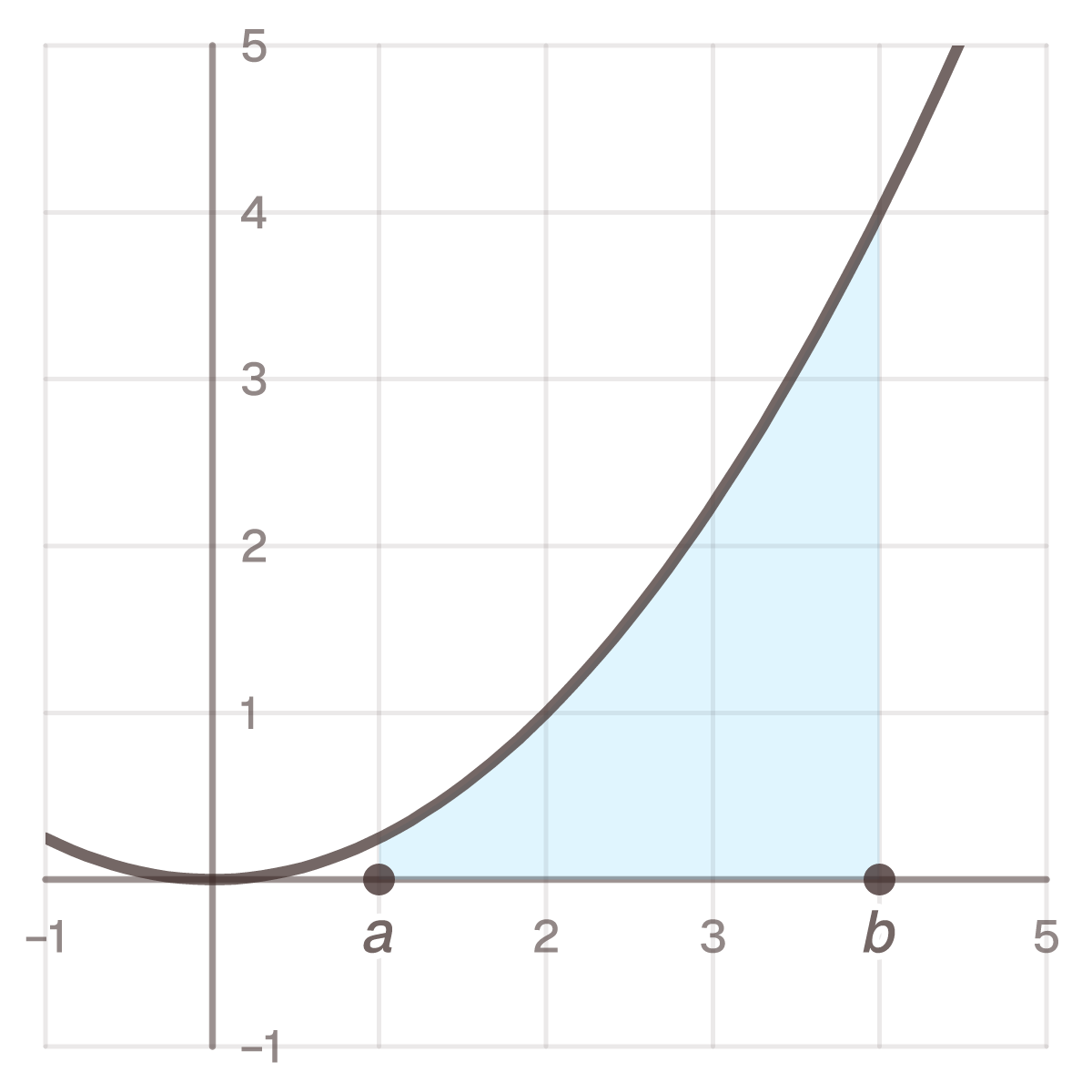
What the formula says
∫ₐᵇ f(x) dx = F(b) − F(a)
The definite integral of f from a to b is a number. F is an
antiderivative of f, that is, a function whose derivative is f. The
theorem says that the number is found by putting the upper limit into F, putting in the lower one and
taking the difference. It is a theorem, the fundamental theorem of calculus, and it needs f to be
continuous on all of [a, b].
Which antiderivative you pick does not matter. The constant C is in both F(b) and F(a) and cancels in the difference.
Worked examples
A power. ∫₁³ x² dx. An antiderivative is F(x) = x³/3.
- F(3) = 27/3 = 9.
- F(1) = 1/3.
- ∫₁³ x² dx = 9 − 1/3 = 26/3 ≈ 8.667.
Sine. ∫₀^π sin x dx. An antiderivative is −cos x: −cos π − (−cos 0) = 1 + 1 = 2.
Negative parts. ∫₀² (x² − 1) dx = [x³/3 − x]₀² = (8/3 − 2) − 0 = 2/3. The curve lies below the x-axis between 0 and 1, and that part counts as negative. The integral is therefore smaller than the area between the curve and the axis.
When the theorem does not apply. ∫₋₁¹ 1/x² dx. Worked blindly with F(x) = −1/x it comes to −1 − 1 = −2, a negative answer for a function that is never negative. The error is that 1/x² has no value at x = 0, in the middle of the interval. The integral does not exist.
Common mistakes
- Working out F(a) − F(b). The upper limit goes first. The other order gives the right number with the wrong sign.
- Using the theorem across a point where f has no value. The 1/x² example shows what happens: a number comes out, but it means nothing.
- Adding + C. The answer to a definite integral is a number. C belongs only in the indefinite one.
Common questions
Do you need + C in a definite integral?
No. With F(x) + C the difference is (F(b) + C) − (F(a) + C) = F(b) − F(a). The constant always drops
out, so you may as well take C = 0.
What is the difference between a definite and an indefinite integral?
The indefinite integral ∫ f(x) dx is all the antiderivatives of f, written F(x) + C. The definite
∫ₐᵇ f(x) dx is a number, which the theorem above works out using one of them.
Can a definite integral be negative?
Yes. Where f is negative the integral adds a negative amount, and if more of the curve lies below the
axis than above, the total is negative. For the area, counted positive on both sides, split at the
zeros. The area under a curve page shows how.