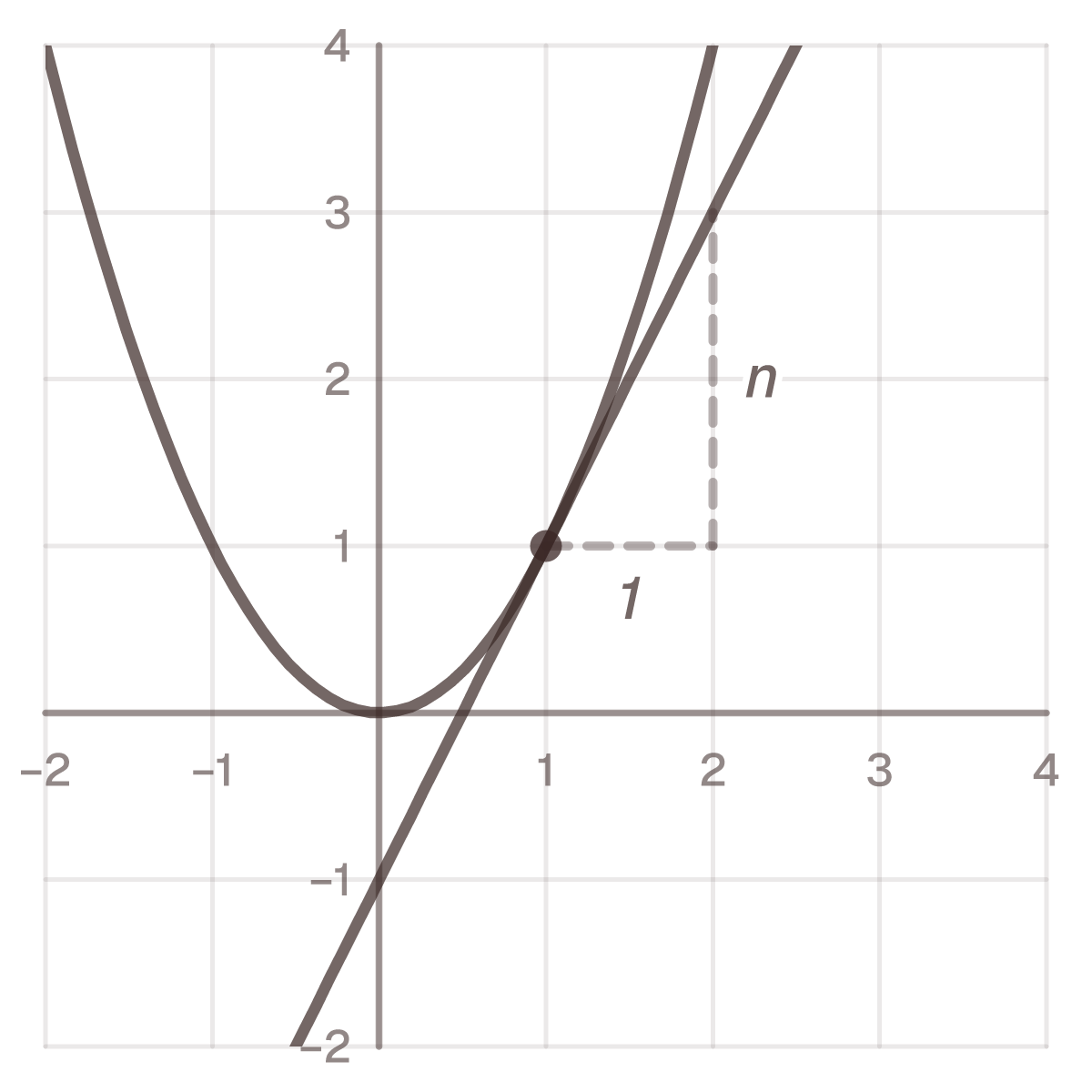
The rule in words
Differentiating a power of x takes two steps, always in this order:
- Bring the exponent down as a factor in front.
- Reduce the exponent by one.
So x⁵ becomes 5x⁴. x² becomes 2x. x becomes 1, since x is x¹ and 1·x⁰ = 1.
Together with the sum rule it is enough to differentiate any polynomial at all.
Worked examples
| Function | Exponent down | One off the exponent | Derivative |
|---|---|---|---|
| x³ | 3·x³ | 3·x² | 3x² |
| x⁷ | 7·x⁷ | 7·x⁶ | 7x⁶ |
| x | 1·x¹ | 1·x⁰ | 1 |
| x⁻² | −2·x⁻² | −2·x⁻³ | −2x⁻³ |
| √x = x^(1/2) | ½·x^(1/2) | ½·x^(−1/2) | 1/(2√x) |
With a constant in front. The constant comes along: the derivative of 4x³ is 4·3x² = 12x². The number in front is not differentiated, it is multiplied.
A constant on its own. The derivative of 7 is 0. A number that does not change has no rate of change, and that agrees with the rule: 7 = 7x⁰, and 0·7x⁻¹ = 0.
Why it looks like that
Take the definition of the derivative on x² and work out the quotient for a small step h:
((x + h)² − x²) / h = (x² + 2xh + h² − x²) / h = (2xh + h²) / h = 2x + h
As h shrinks to zero the last term disappears and 2x is left, which is what the rule says. The same arithmetic on x³ gives 3x² + 3xh + h², and the same thing happens: everything containing an h goes. The factor n comes from the fact that squaring a sum and its relatives always leave exactly n identical terms carrying one h.
Negative exponents and roots
The rule holds for every real exponent, not only the positive whole numbers, as long as x is where the power is defined: x ≠ 0 for negative exponents and x > 0 for exponents that are not whole numbers. The trick is to rewrite the expression as a power first:
- 1/x = x⁻¹, which differentiates to −1·x⁻² = −1/x²
- 1/x³ = x⁻³, which differentiates to −3x⁻⁴ = −3/x⁴
- √x = x^(1/2), which differentiates to ½x^(−1/2) = 1/(2√x)
- ∛x = x^(1/3), which differentiates to ⅓x^(−2/3)
It is the same two steps every time. The only new thing is rewriting the fraction or the root as a power before you start.
Common mistakes
- Forgetting to reduce the exponent. x⁴ becomes 4x³, not 4x⁴. Both steps, every time.
- Differentiating the constant in front. The derivative of 5x² is 10x, not 10. The 5 is a factor, not a term.
- Thinking the exponent gets smaller in absolute terms. x⁻² becomes −2x⁻³. The exponent −3 is lower than −2, even though it looks bigger.
- Using the rule on 2ˣ. There x is the exponent and not the base, and a completely different rule applies. The power rule requires the exponent to be constant.
Frequently asked questions
Does the rule work for x to the power of zero?
Yes, and it gives the right answer. x⁰ = 1 is a constant, and the rule gives 0·x⁻¹ = 0 — the derivative
of a constant.
What if the exponent is a letter?
Nothing special happens, as long as that letter is not x. The derivative of xⁿ is n·xⁿ⁻¹ whatever n is,
because n is treated as a number. That is how the formula on this page is written.
Why is it called the power rule and not the exponent rule?
Because it is the power xⁿ that is being differentiated. The rule for the exponential function — where x
sits in the exponent — is a different one, and it looks nothing like this.