The rule in words
The derivative of cos x is −sin x. The same pair of functions as in the sine rule, but with a minus sign that is not there.
Like the sine rule, it holds only in radians. In degrees the factor π/180 tags along.
Where the minus sign comes from
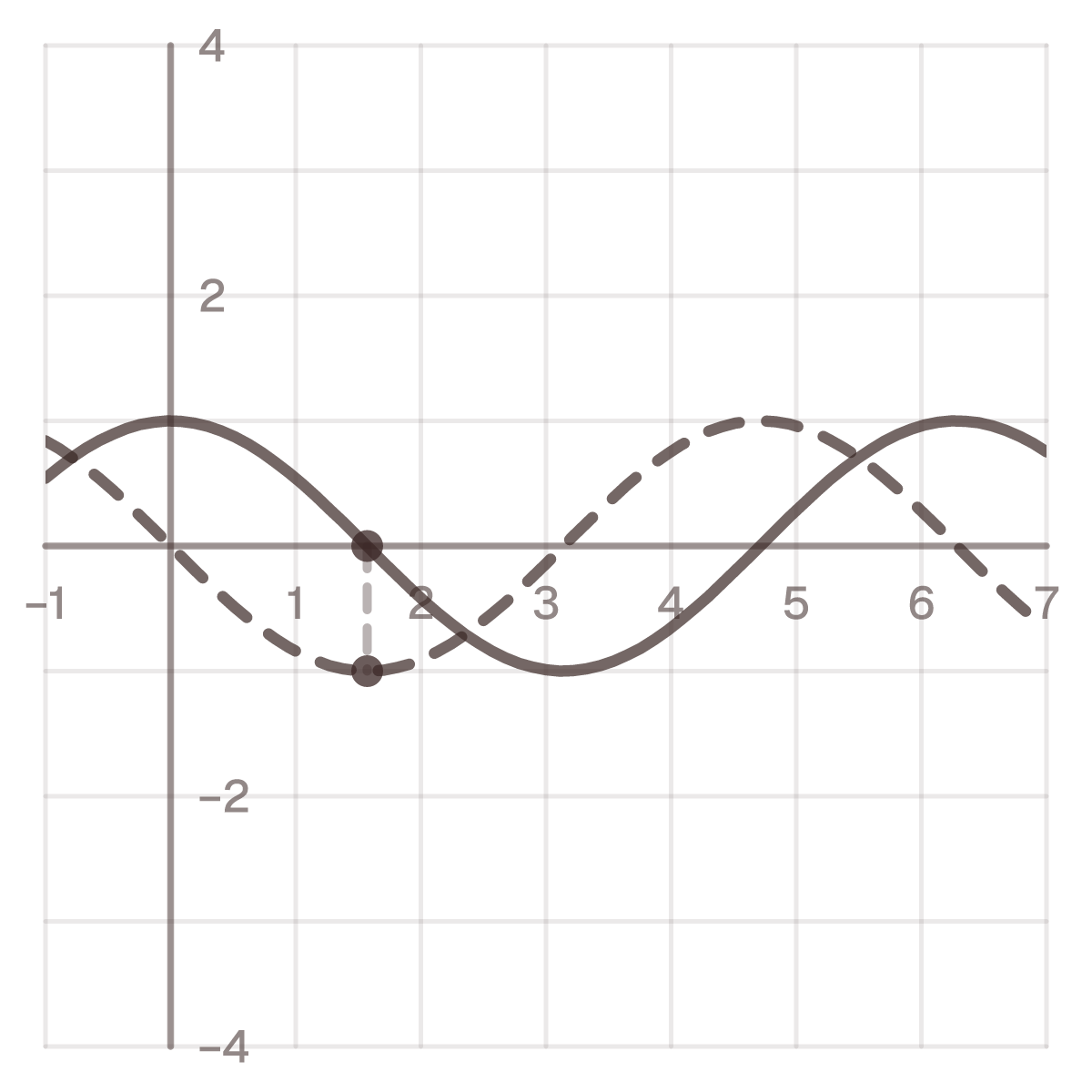
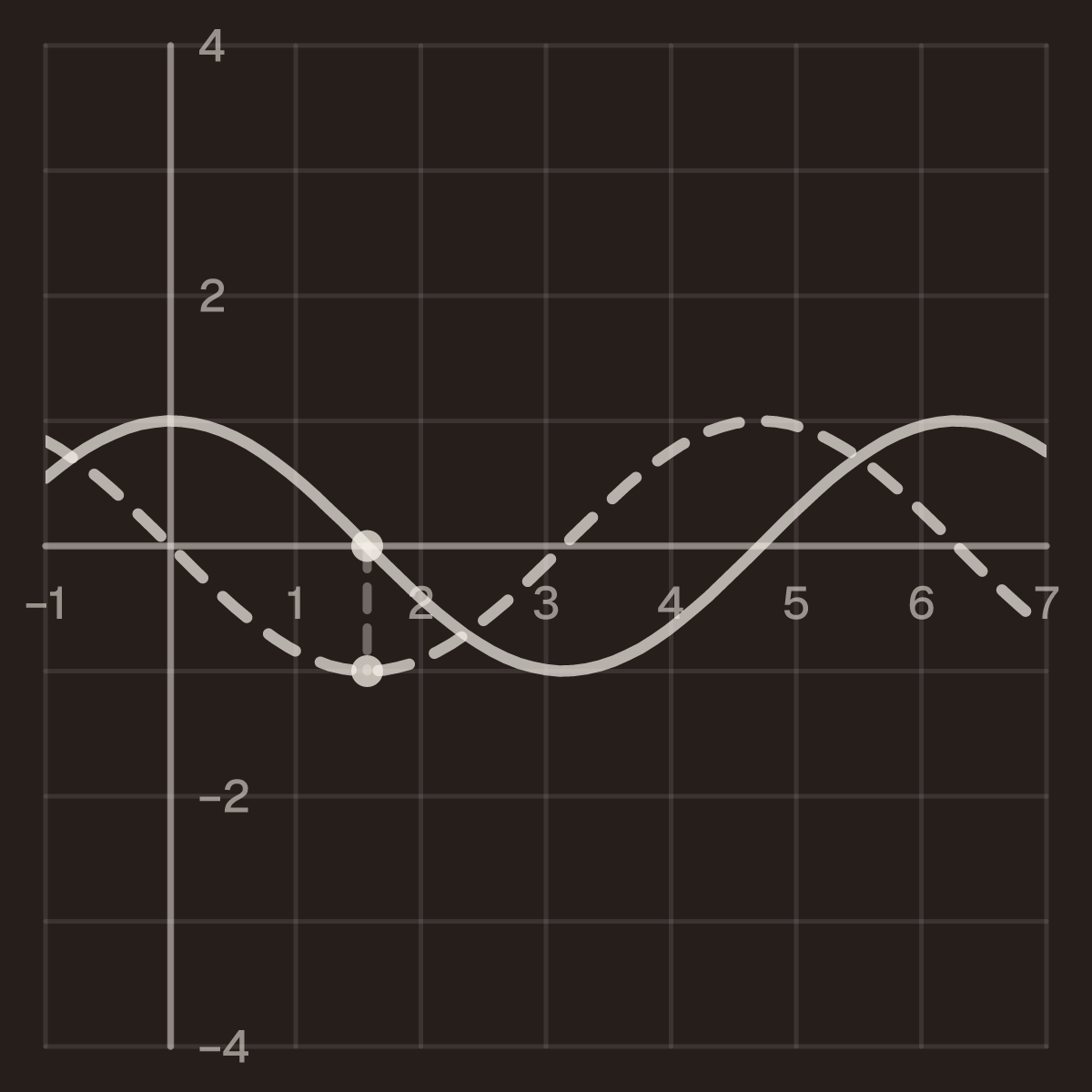
The cosine curve starts at its highest value, cos 0 = 1. A curve standing on its peak can only go down, and it does so immediately: the derivative at x = 0 is −sin 0 = 0, and just after that it turns negative. Cosine falls through the whole first quarter turn while sine rises — so their slopes must have opposite signs.
Put the curves side by side:
| x | cos x | Slope of cos | −sin x |
|---|---|---|---|
| 0 | 1 | flat, at the top | 0 |
| π/2 | 0 | steepest downwards | −1 |
| π | −1 | flat, at the bottom | 0 |
| 3π/2 | 0 | steepest upwards | 1 |
The rightmost column is the column beside it, written as a number. The minus sign follows from the shape of the curve: cosine starts at its maximum and falls from there.
The cycle of four
The two rules together go round:
cos x → −sin x → −cos x → sin x → cos x
Four derivatives and you are back. So the second derivative of cos x is −cos x, the function itself with its sign reversed — and a function whose second derivative is its own negation describes an oscillation. That is why cosine turns up in things that swing, vibrate or travel in waves.
Compare eˣ, where the cycle has length one: the function comes straight back without ever turning. One grows, the other oscillates, and the difference is visible already in the derivative.
Worked examples
| Function | Derivative |
|---|---|
| cos x | −sin x |
| 5 cos x | −5 sin x |
| cos x + x³ | −sin x + 3x² |
| x · cos x | cos x − x · sin x |
| cos(3x) | −3 sin(3x) |
In the fourth row the minus sign comes from the product rule: the first term is 1 · cos x and the second is x · (−sin x).
Common mistakes
- Dropping the minus sign. A common mistake, and it is hard to spot afterwards because the answer still looks reasonable.
- Putting the minus on the sine rule instead. Sine differentiates to plus cosine. Only one of the two rules carries a minus, and this is the one.
- Working in degrees. The same trap as with sine: check that the calculator is in RAD.
- Forgetting the inside. cos(4x) differentiates to −4 sin(4x). Both the factor and the sign are needed.
Common questions
What is the second derivative of cos x?
−cos x. Differentiate twice: cos x → −sin x → −cos x. That the second derivative is the function with
its sign reversed is what characterises simple harmonic motion.
Why does sine have no minus sign but cosine does?
Because sine starts at zero and rises, while cosine starts at its maximum and falls. The curves are a
quarter turn apart, and that shift is what becomes a minus sign when you differentiate.
What is the derivative of cos²x?
−2 cos x · sin x, which can also be written −sin(2x). Here a power of cosine is being differentiated,
not cosine itself, so both the power rule and this one are needed.