The rule in words
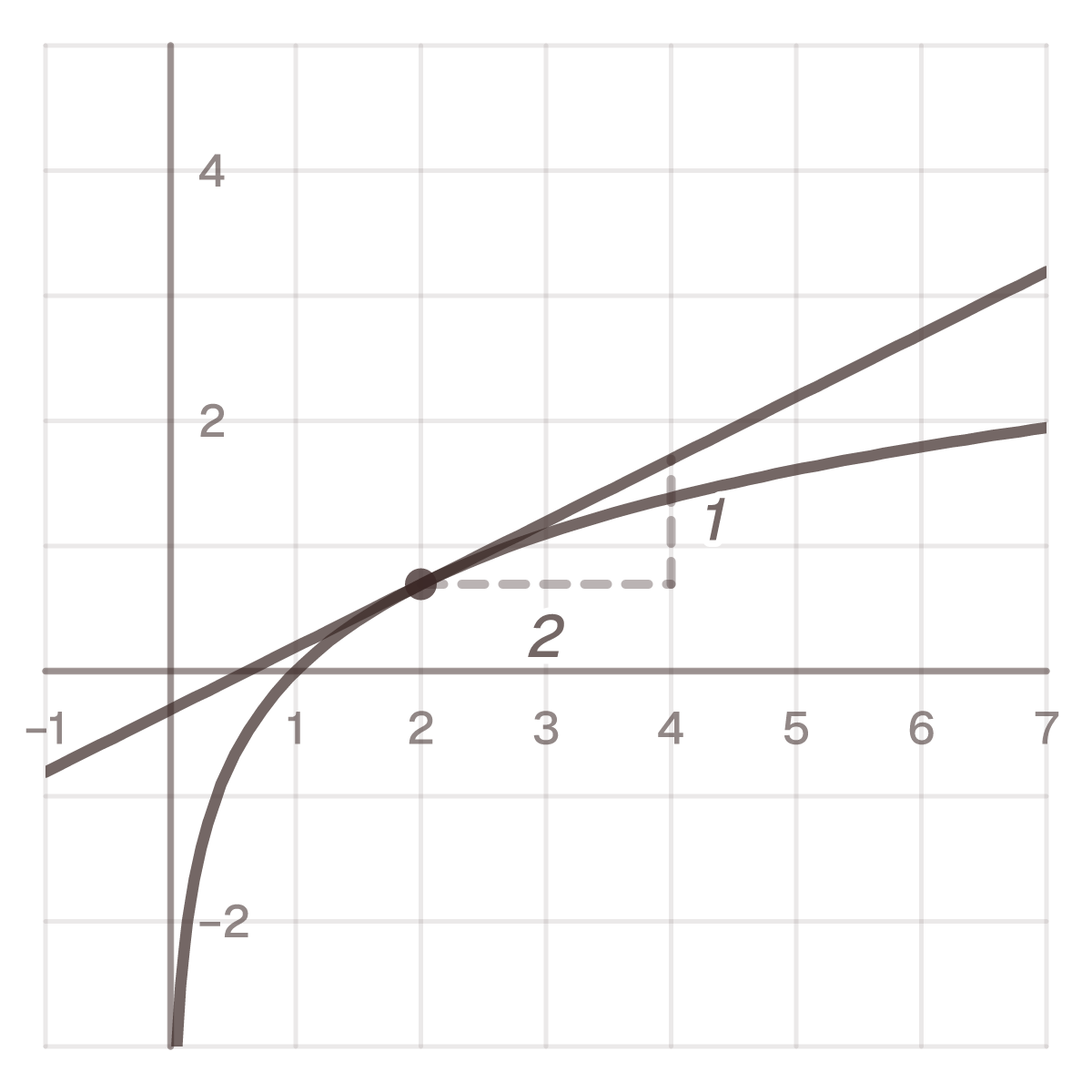
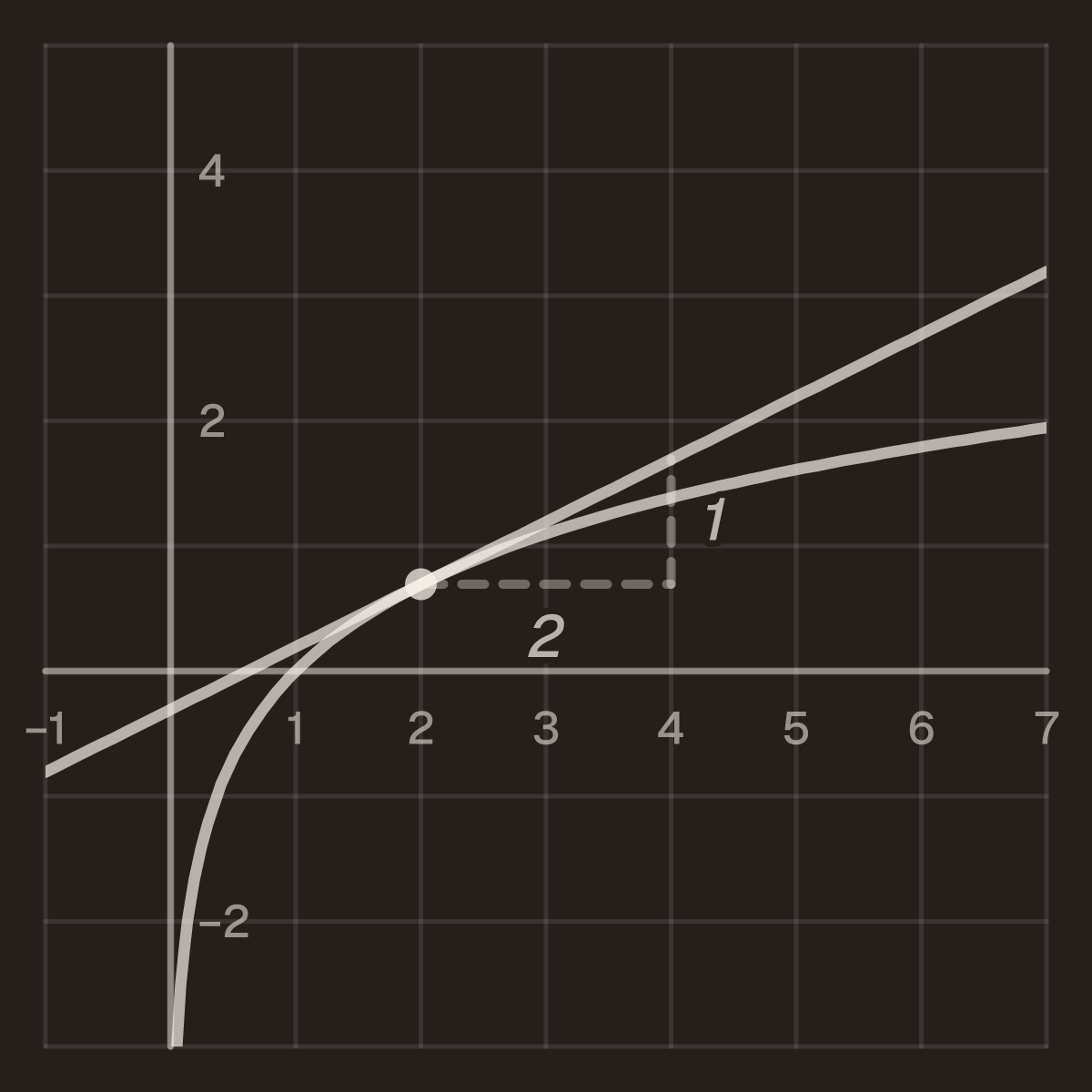
The derivative of ln x is 1/x. An answer with no logarithm in it, which is unusual enough to be worth memorising as written.
That the derivative is positive for every x > 0 says ln x always grows. That it is 1/x says it grows ever more slowly: at x = 1 the curve has slope 1, at x = 10 it has slope 0.1, at x = 100 it has slope 0.01. The logarithm never stops, but it flattens.
The hole in the power rule
The power rule says xⁿ differentiates to n·xⁿ⁻¹. Which power would you have to differentiate to get 1/x, that is, x⁻¹?
You would need n − 1 = −1, so n = 0. But x⁰ is the constant 1, and the rule then gives 0·x⁻¹ = 0, not x⁻¹. The factor n in front destroys it.
So no power of x has 1/x as its derivative. Every other exponent is reachable — x², x⁻³, √x — but that one gap the power rule leaves empty. ln x is the function that fills it.
It is also why the logarithm appears the moment you integrate: everything except 1/x has a power as its antiderivative, and 1/x has ln.
Other bases
For a logarithm in any other base, a factor appears:
d/dx log_a x = 1 / (x · ln a)
So the derivative of log₁₀ x is 1/(x · ln 10), about 0.434/x. Set a = e and ln e = 1, leaving 1/x. It is the same pattern as with eˣ: the natural base is the only one that escapes the factor.
Worked examples
| Function | Derivative |
|---|---|
| ln x | 1/x |
| 5 ln x | 5/x |
| ln x + x³ | 1/x + 3x² |
| x · ln x | ln x + 1 |
| ln(2x) | 1/x |
The last one deserves a second look. ln(2x) = ln 2 + ln x by the laws of logarithms, and ln 2 is a constant, which differentiates to zero. What is left is 1/x — the same derivative as ln x. Multiplying the inside by a positive number shifts the curve up or down without changing its slope anywhere.
Common mistakes
- Writing 1/x as x⁻¹ and assuming it came from the power rule. It did not: n = 0 gives 0, not x⁻¹.
- Differentiating ln x to 1/x and then forgetting the inside. ln(x²) differentiates to 2/x, not 1/x².
- Confusing ln x with 1/ln x. The second is a fraction with a logarithm in the denominator and needs the quotient rule.
- Forgetting that x must be positive. ln x does not exist for x ≤ 0, so the derivative only applies there.
Common questions
What is the second derivative?
−1/x². Differentiate 1/x = x⁻¹ with the power rule: −1·x⁻² = −1/x². That it is negative for every
x > 0 says ln x is concave everywhere — the curve bends downwards the whole way.
Why ln and not log?
ln means the logarithm to base e. In school texts log usually means base 10; at
university and in programming, log often means base e instead. Write ln when you mean base e and nobody
can misread it.
Does the rule hold for the log of a negative number?
No — ln of a negative number does not exist among the real numbers. When integrating, the answer is
therefore usually written ln|x| with absolute values, so that it covers both sides of zero.