- P2(x) = f(a) + f′(a)(x − a) + f″(a)/2 · (x − a)²
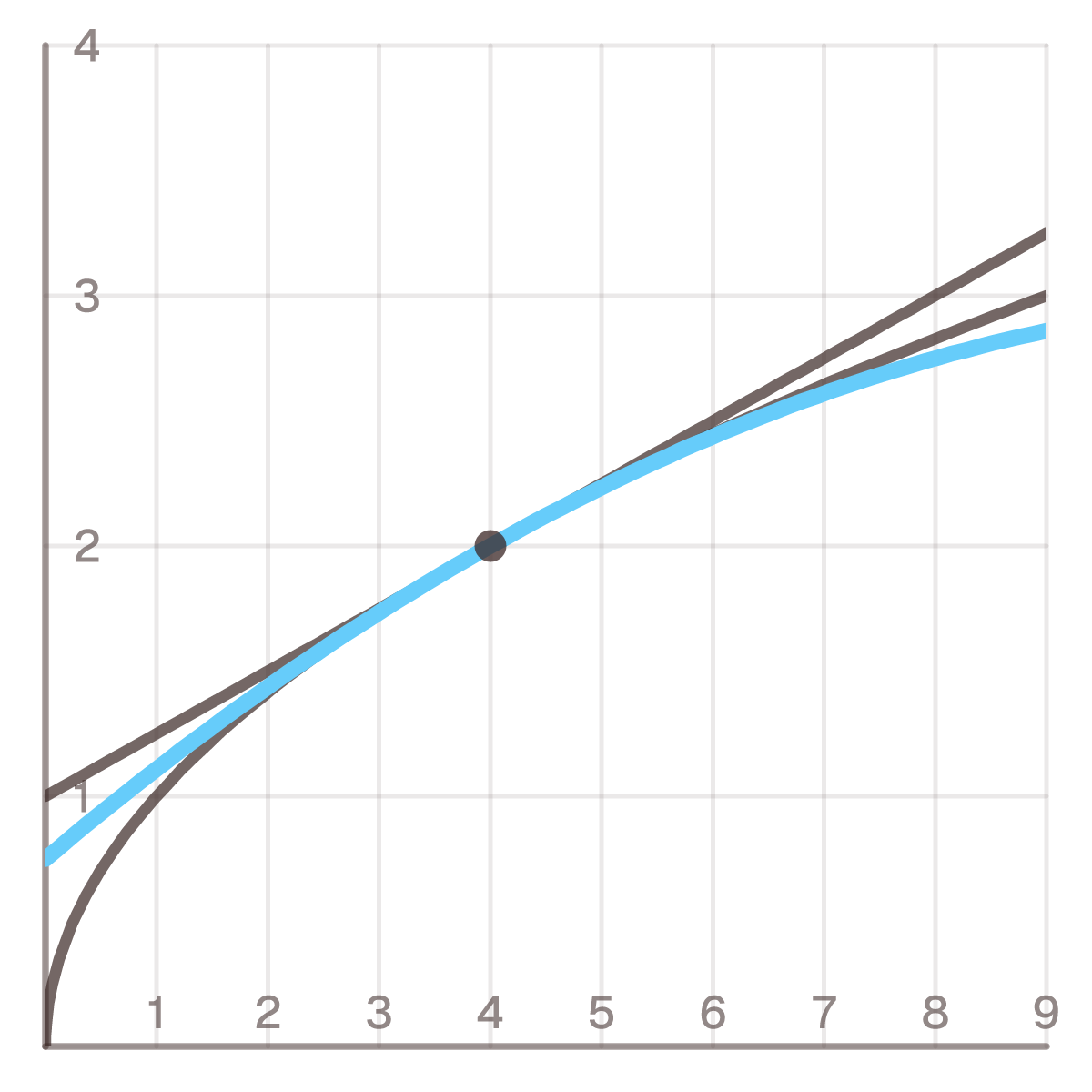
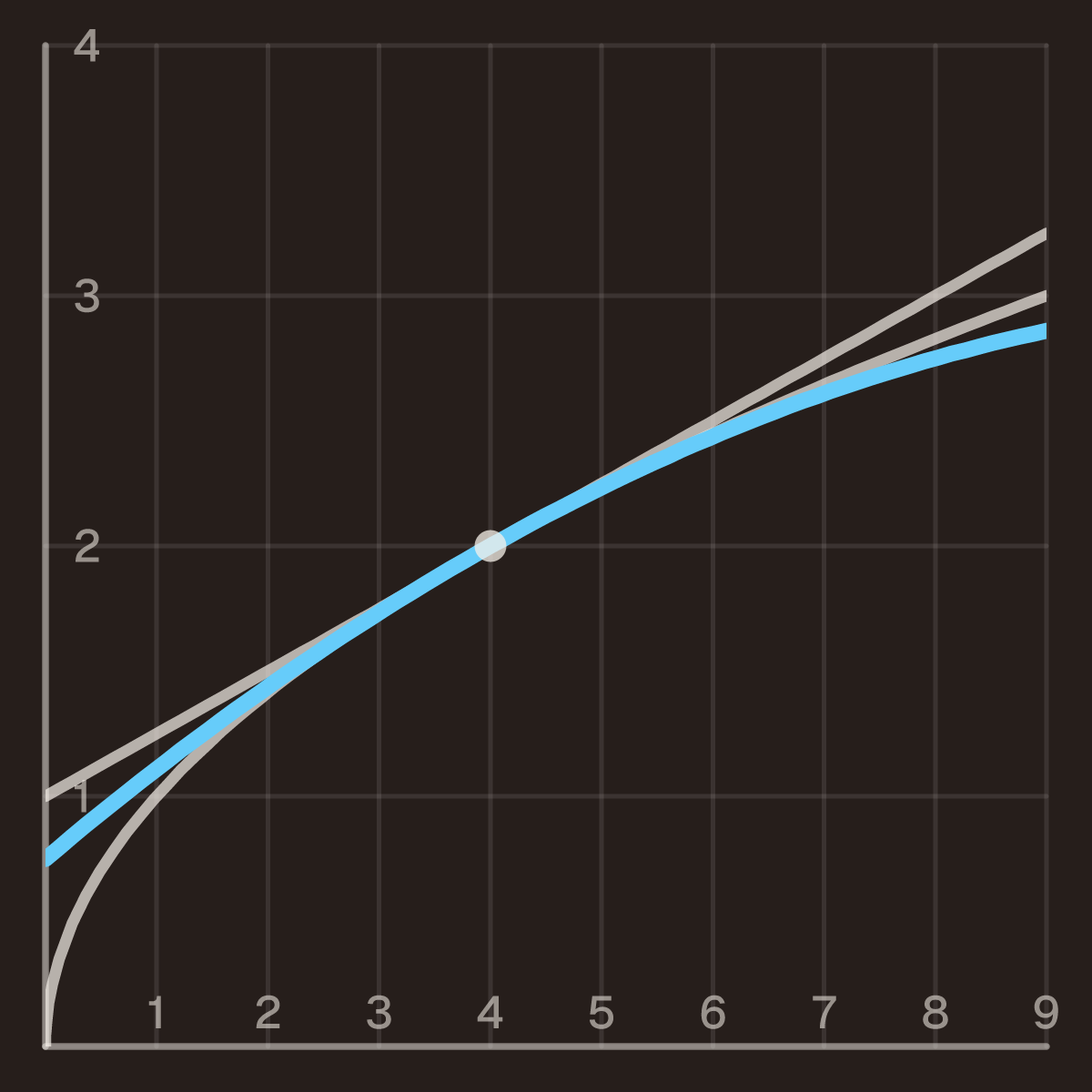
The parabola has the same value, the same slope and the same curvature as f at x = a. Put the three
numbers into the card above, with a and x, and it adds the terms up. The card does not differentiate: you
bring f(a), f′(a) and f″(a), so it works for every function.
Worked example: √4.2
Take f(x) = √x around a = 4. Then f(4) = 2, f′(4) = 1/4 and f″(4) = −1/32. For x = 4.2, x − a = 0.2:
- P2(4.2) = 2 + 0.25 · 0.2 + (−1/32)/2 · 0.04 = 2 + 0.05 − 0.000 625 = 2.049 375
The true value is 2.049 390, so the parabola is within 0.000 02. The tangent line alone gives 2.05.
The step people drop
The last term is f″(a)/2, not f″(a). Without the ½ the parabola passes through the right point with the
right slope and bends twice as much as f. With f″(4) = −1/32 the wrong version gives 2.049 375 − 0.000 625
= 2.048 750, which is further away than the tangent.
A second example
For f(x) = ex around a = 0 all three numbers are 1, so P2(0.1) = 1 + 0.1 + 0.005 = 1.105.
The true value is 1.105 171. For how far off a Taylor polynomial can be at most, see the
Lagrange remainder.
Common mistakes
- Forgetting the ½ in front of f″(a).
- Writing x² instead of (x − a)² when a is not 0. The powers are of the distance from a.
- Taking the derivatives at x instead of at a. All three numbers belong to the centre.
Frequently asked questions
Is this the same as a Maclaurin polynomial?
A Maclaurin polynomial is a Taylor polynomial with a = 0. Books differ on the letter for the centre:
a in some, x0 in others.
How good is the approximation?
The error is bounded by the Lagrange remainder, which needs a bound on the third derivative.