What the theorem says
limx→0 (eˣ − 1) / x = 1
Both the numerator and the denominator approach 0, so the substitution says nothing. It is one of the standard limits, next to sin x / x.
A table of values
| x | (eˣ − 1) / x |
|---|---|
| 0.1 | 1.0517 |
| 0.01 | 1.0050 |
| 0.001 | 1.0005 |
| −0.01 | 0.9950 |
The quotient comes from both sides towards 1.
Why it is 1
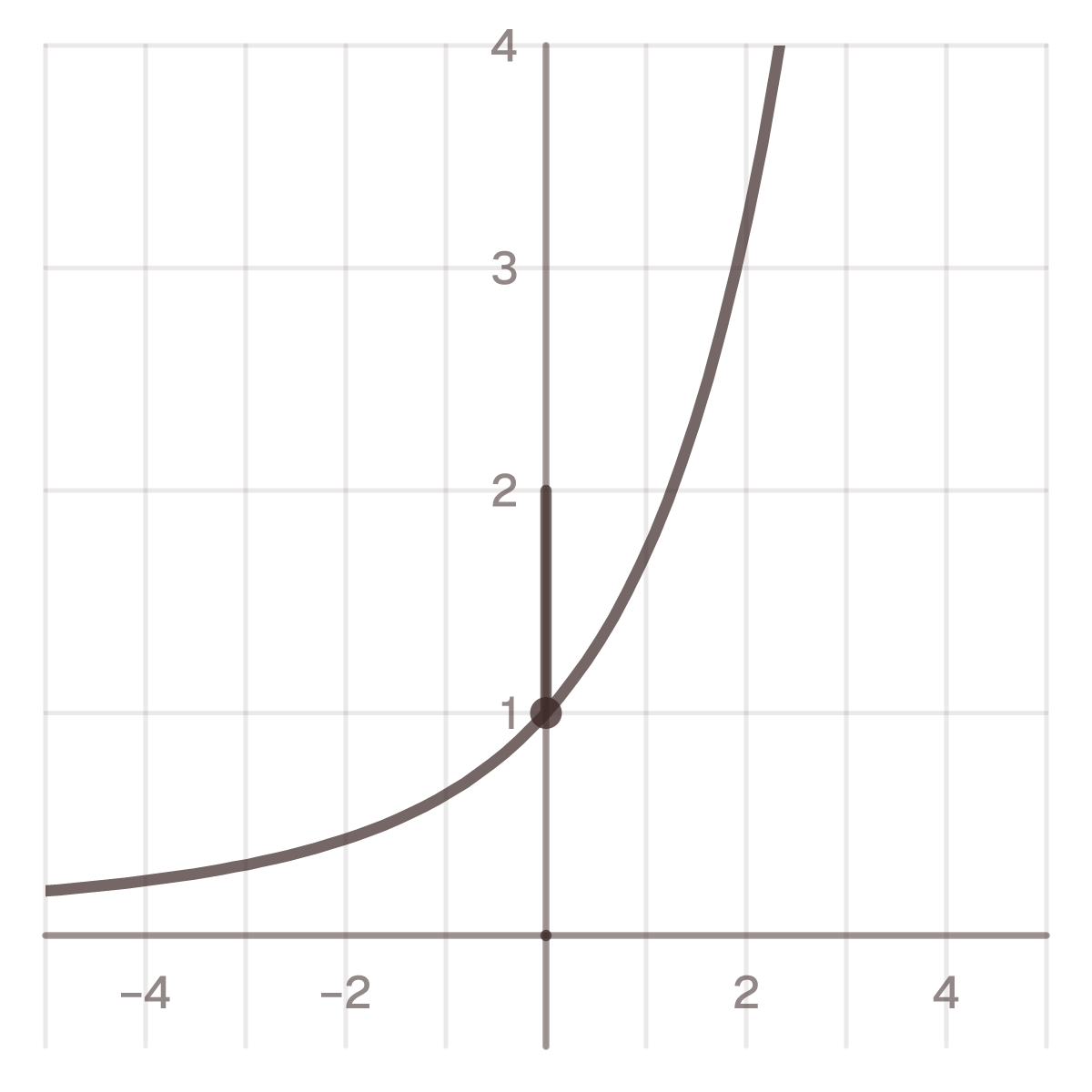
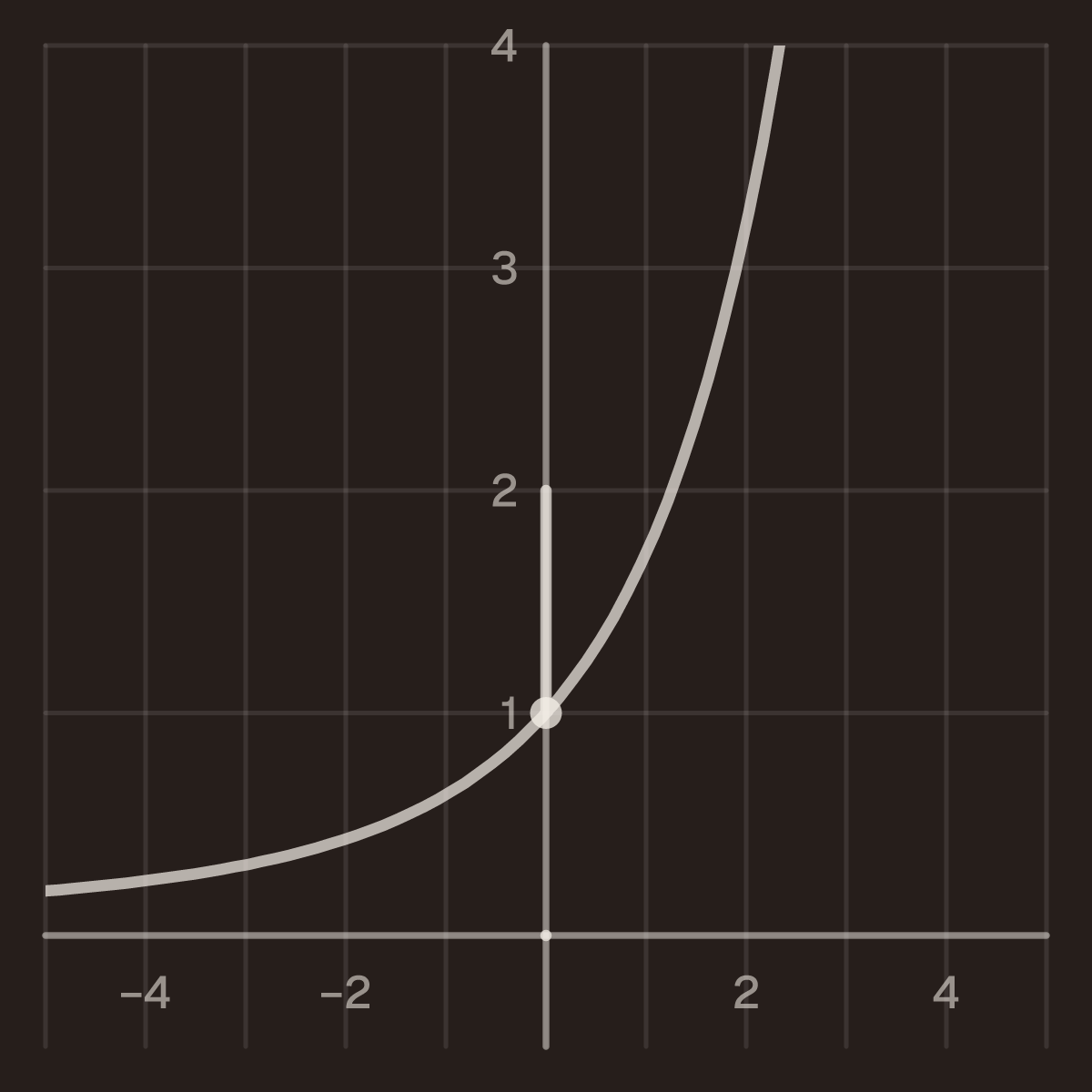
(eˣ − 1)/x = (eˣ − e⁰)/(x − 0) is the slope between the points at 0 and at x on the curve y = eˣ. In the limit it is the slope at 0, which is the derivative of eˣ there. The number e is the base for which that slope is 1, and that is why the derivative of eˣ is eˣ.
Worked examples
- lim (e²ˣ − 1)/x = 2 · (e²ˣ − 1)/(2x) → 2 · 1 = 2.
- lim (e⁵ˣ − 1)/(3x) = (5/3) · (e⁵ˣ − 1)/(5x) → 5/3.
The exponent and the denominator have to contain the same expression, as for sin x / x.
Common mistakes
- Answering 0 because e⁰ − 1 = 0. The denominator is 0 too.
- (e²ˣ − 1)/x → 1. The exponent is 2x and the denominator is x, so the answer is 2.
- Using x → ∞. The quotient grows without bound there.
Common questions
Can I use L’Hôpital’s rule?
It gives eˣ/1 → 1, the right answer. But the derivative of eˣ is worked out from this limit, so as a proof it
goes round in a circle. See L’Hôpital’s rule.