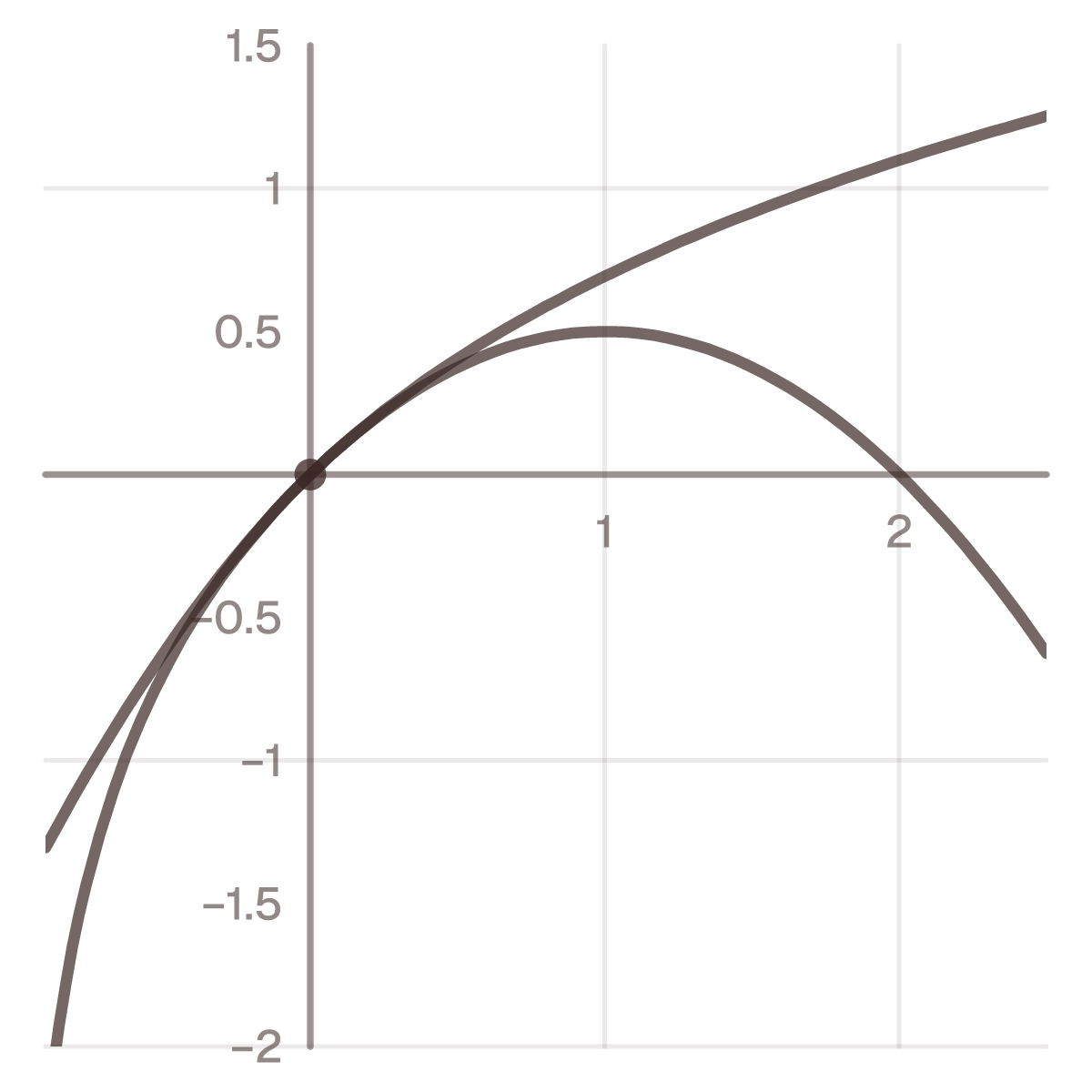
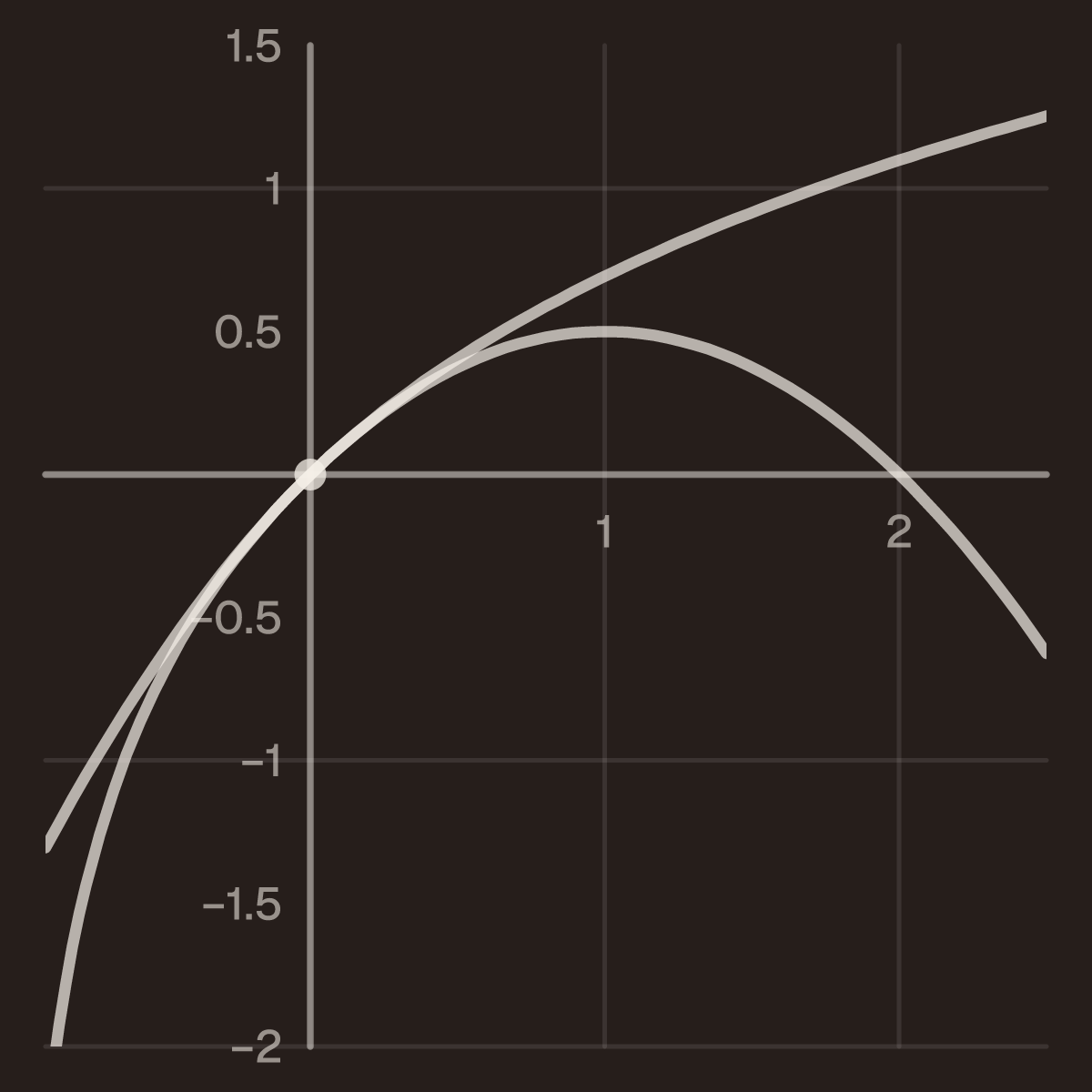
The expansion
- ln(1 + x) = Σk=1n (−1)k+1 xk/k + O(xn+1) as x → 0
The remainder O(xn+1) is, near 0, at most a constant times |x|n+1, and the term it starts with, ±xn+1/(n + 1), is not 0, so no higher power will do.
The expansion is of ln(1 + x), around x = 0, because ln x itself has no value at 0 and so no expansion there. For a number at a point, the Taylor polynomial card computes Pn(x) with the error bound.
Worked example: a limit
limx→0 (ln(1 + x) − x)/x². With n = 2:
ln(1 + x) − x = −x²/2 + O(x³), so the quotient is −1/2 + O(x) → −1/2.
A second example: ln(1 − x)
Put −x in place of x: ln(1 − x) = −x − x²/2 − x³/3 + O(x⁴). Every sign turns negative, because (−x)k carries the sign that (−1)k+1 took away. Subtracting the two expansions gives ln((1 + x)/(1 − x)) = 2x + 2x³/3 + O(x⁴).
Common mistakes
- Factorials. The coefficients are 1/k, not 1/k!. 1/k! belongs to eˣ.
- ln x instead of ln(1 + x). To expand ln x around 1, write x = 1 + h and expand ln(1 + h).
- Reading it far from 0. The statement is about x near 0; the series itself converges only for −1 < x ≤ 1.
Related pages
Maclaurin series has the method, and the standard limit ln(1 + x)/x → 1 is this expansion at n = 1.