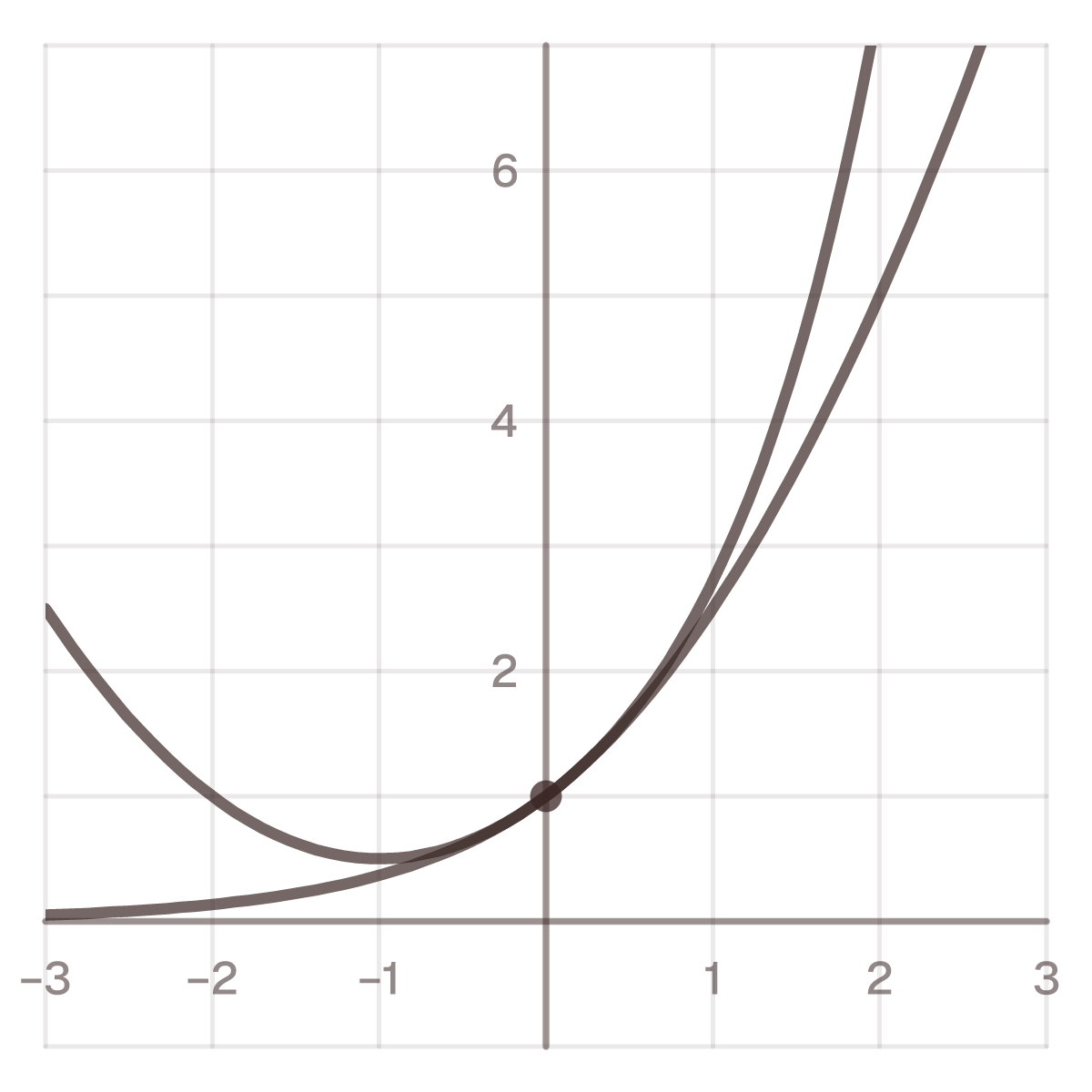
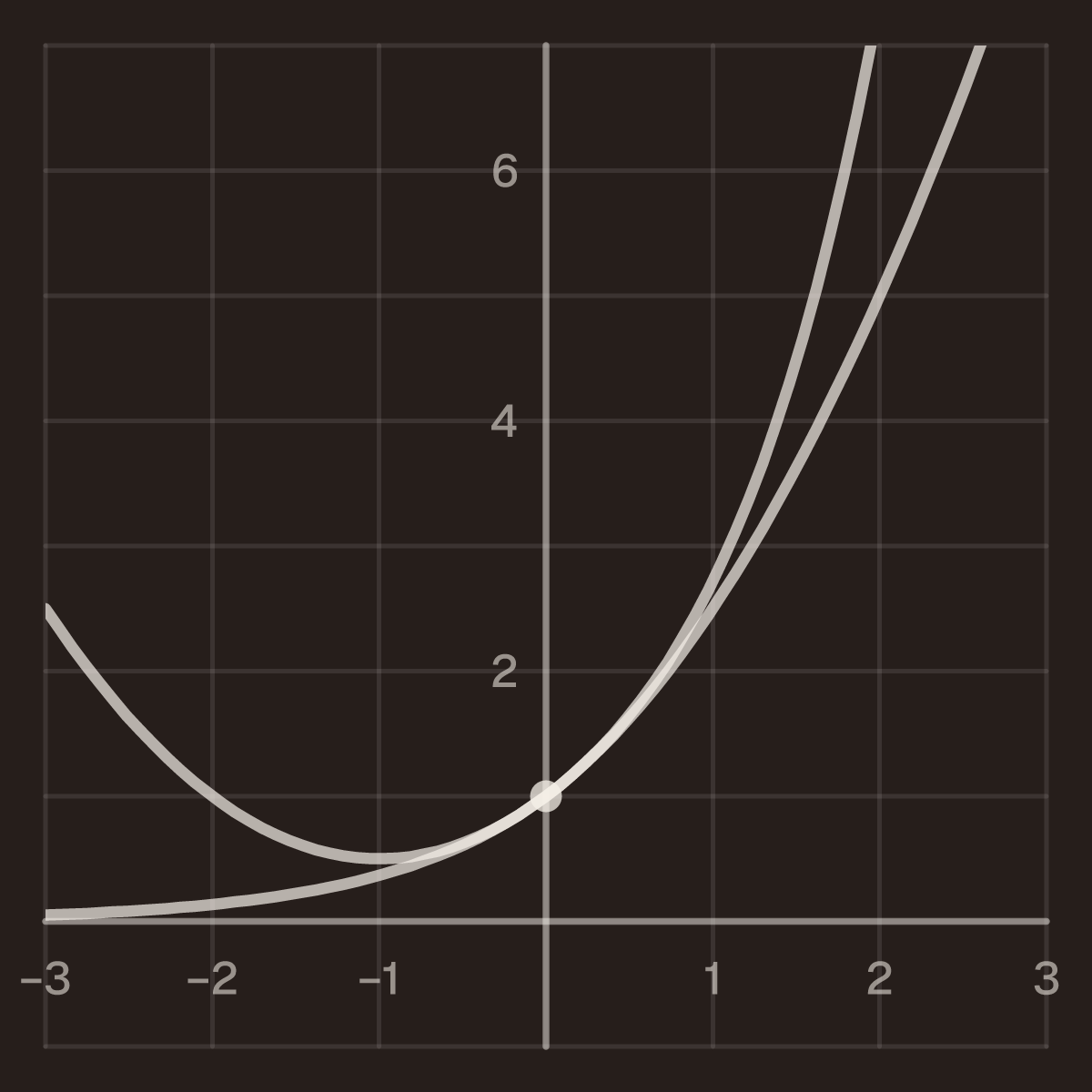
The expansion
- eˣ = Σk=0n xk/k! + O(xn+1) as x → 0
O(xn+1) stands for a function that, for x close enough to 0, is at most a constant times |x|n+1. It is what the polynomial leaves out. For eˣ that remainder begins with xn+1/(n + 1)!, so the order cannot be raised: O(xn+2) after the same polynomial is false.
The statement is about x near 0 and gives no number at x = 5. For a number, the Taylor polynomial card computes Pn(x) with the Lagrange bound beside it.
Worked example: a limit
limx→0 (eˣ − 1 − x)/x². Expand to one power past the denominator:
eˣ − 1 − x = x²/2 + O(x³), so (eˣ − 1 − x)/x² = 1/2 + O(x) → 1/2.
O(x³) divided by x² is O(x), which goes to 0.
A second example: e2x
Put 2x in place of x: e2x = 1 + 2x + 2x² + O(x³). Inside the O, (2x)³ = 8x³ is still a constant times x³, so the remainder keeps its order.
Common mistakes
- Dropping the O-term. eˣ = 1 + x + x²/2 holds only at x = 0. With O(x³) after it, it holds near 0.
- Too few terms. In the limit above, eˣ = 1 + x + O(x²) leaves O(x²)/x², which is bounded but not known.
- Reading O as a number. O(x³) − O(x³) is O(x³), not 0: the two remainders need not be the same function.
Related pages
The general series is on Maclaurin series. The standard limit (eˣ − 1)/x → 1 is this expansion at n = 1 divided by x.