What the theorem says
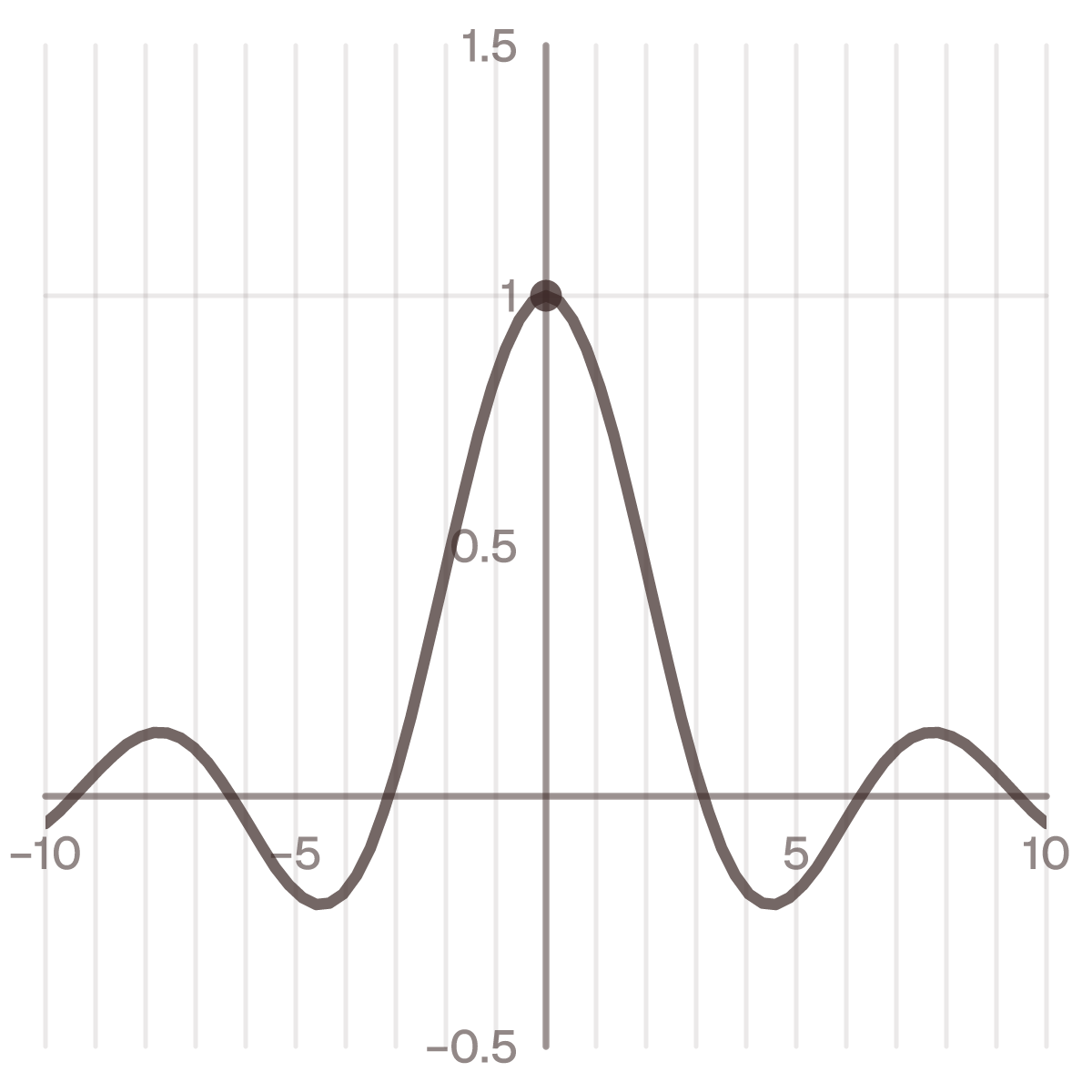
limx→0 sin x / x = 1
As x approaches 0, both sin x and x approach 0, so putting in x = 0 gives 0/0 and says nothing. The quotient still closes in on 1: for small x, sin x is very nearly x. It is a theorem.
Holds when x is measured in radians. In degrees the quotient approaches π/180 ≈ 0.01745 instead.
Worked example
limx→0 sin 3x / x. Rewrite it so that the same thing stands inside the sine and in the denominator:
sin 3x / x = 3 · sin 3x / (3x)
As x → 0, 3x → 0 too, so sin 3x / (3x) → 1. The limit is 3.
A check on a calculator in radians: x = 0.01 gives sin 0.03 / 0.01 = 2.99955.
Radians, not degrees
A limit can be tried on a calculator by putting in a small x. With the calculator in degrees the answer is wrong, and it does not look wrong:
| Calculator mode | sin 0.01 / 0.01 |
|---|---|
| Radians (RAD) | 0.99998… — right, close to 1 |
| Degrees (DEG) | 0.01745… — wrong, that is π/180 |
The calculus of sine and cosine is built on radians. That is why the derivative of sine is cos x and nothing else: the derivative of sin x at 0 is this limit.
A second example: 1 − cos x
limx→0 (1 − cos x) / x². Again, putting in 0 gives 0/0. With 1 − cos x = 2 sin²(x/2):
(1 − cos x) / x² = 2 sin²(x/2) / x² = ½ · (sin(x/2) / (x/2))²
The bracket approaches 1, so the limit is ½. A sine or cosine in the expression does not make the answer 1; the rewrite into the form sin u / u is what decides it.
The standard limits
| Limit | As | Value |
|---|---|---|
| sin x / x | x → 0 | 1 |
| (eˣ − 1) / x | x → 0 | 1 |
| ln(1 + x) / x | x → 0 | 1 |
| (1 + 1/n)ⁿ | n → ∞ | e |
| xᵃ / eˣ, a > 0 | x → ∞ | 0 |
| ln x / xᵃ, a > 0 | x → ∞ | 0 |
The second is the derivative of eˣ at 0, which is why eˣ is its own derivative. The fourth has a page of its own under limits. The last two say that eˣ grows faster than any power of x, and ln x more slowly.
An example with e. limx→0 (e²ˣ − 1) / x = 2 · (e²ˣ − 1) / (2x) → 2 · 1 = 2.
Where to go next
When a 0/0 expression cannot be rewritten into one of the forms in the table, L’Hôpital’s rule is the next tool.
Common mistakes
- The calculator in degrees. The limit 1 assumes radians.
- sin 3x / x = 1. The angle and the denominator have to be the same expression. Here the answer is 3.
- Cancelling the sine. sin x / x is not “sin”, and sin 3x / 3 is not sin x.
- (1 + 1/n)ⁿ → 1. The base approaches 1 while the exponent grows. The limit is e.
Common questions
How do you prove that sin x / x approaches 1?
With areas in the unit circle. For 0 < x < π/2 the sector with angle x lies between two
triangles, which gives sin x < x < tan x. Divide by sin x and turn the fractions over:
cos x < sin x / x < 1. As x → 0, cos x approaches 1, and the quotient is squeezed between two
expressions that both approach 1.
Can I use L’Hôpital’s rule on sin x / x?
The arithmetic gives the right answer, cos 0 / 1 = 1. But the rule needs the derivative of sin x, and
that derivative is worked out from this very limit. As a proof it goes round in a circle.
Why does the quotient not approach 1 in degrees?
An angle of x degrees is πx/180 radians, so sin x° / x = (π/180) · sin(πx/180) / (πx/180), and the last
quotient approaches 1. What is left is π/180.