The rule in words
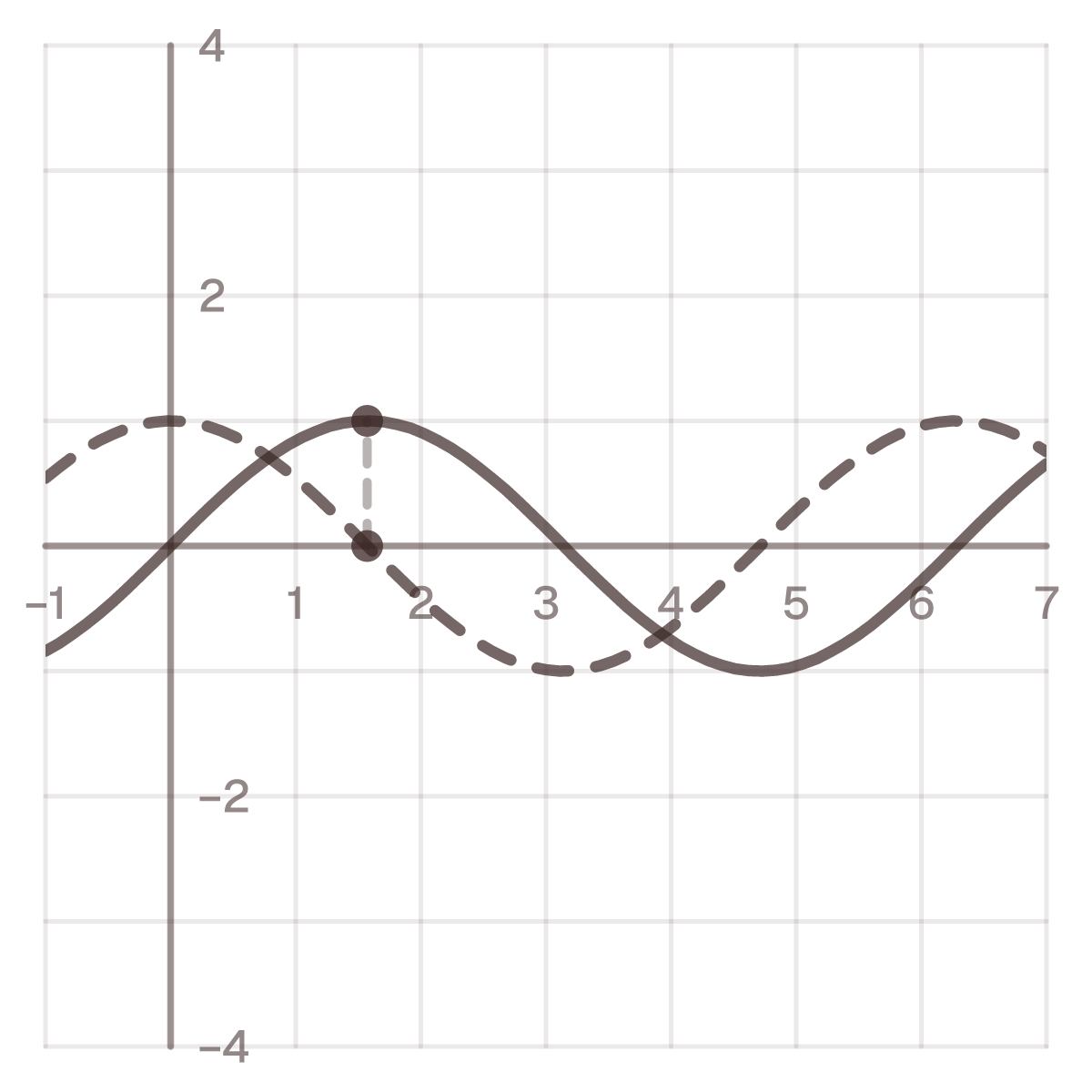
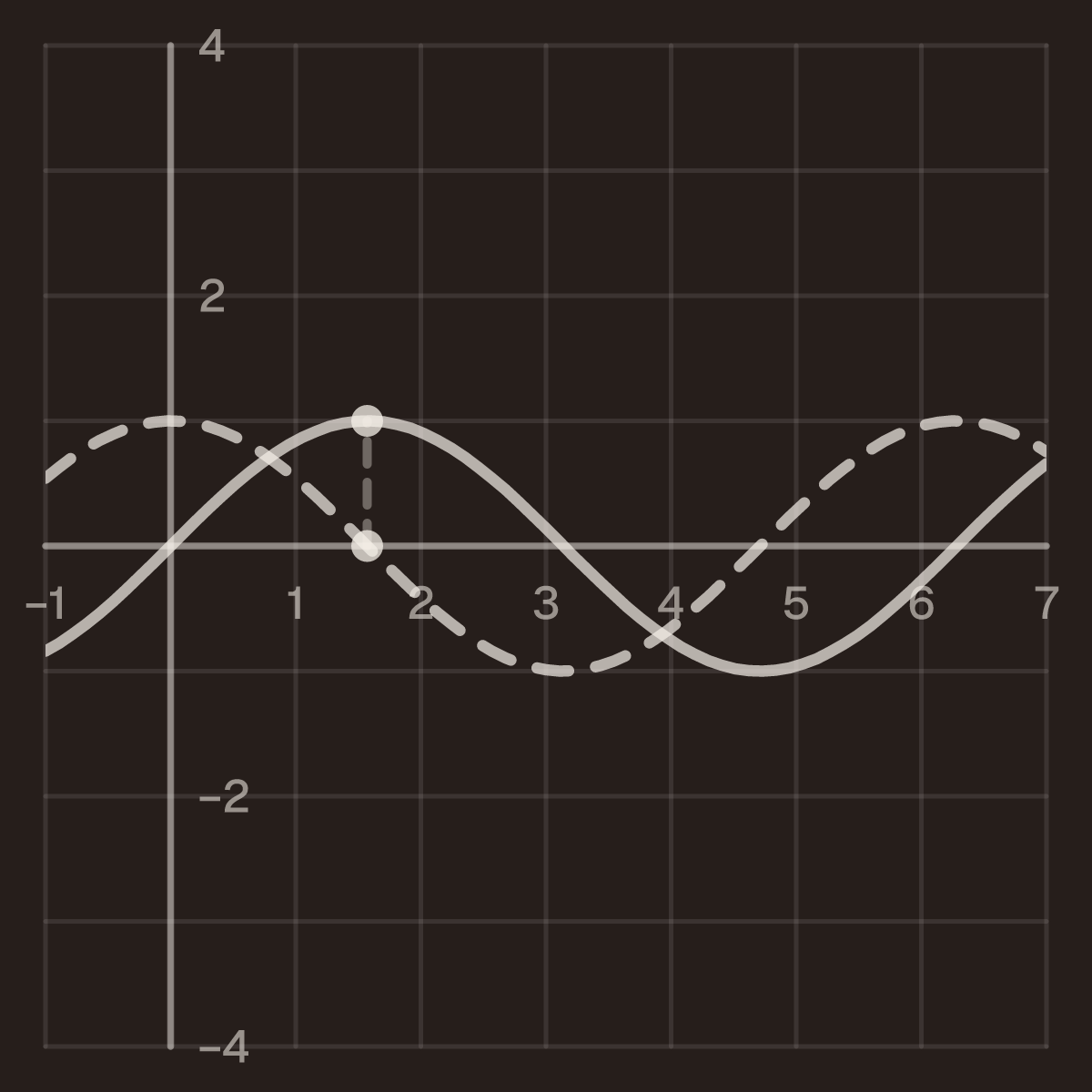
The derivative of sin x is cos x. The slope of the sine curve at every point is the cosine of the same angle.
You can see it without calculating. The sine curve starts at the origin and rises most steeply there — and cos 0 = 1, the largest slope there is. At the peak, x = π/2, the curve stands still for an instant before turning — and cos(π/2) = 0. At x = π it falls most steeply, and cos π = −1. The cosine curve is the sine curve’s slope, point by point.
Radians are not a detail
The rule holds only if x is in radians. In degrees, the derivative of sin x is instead
cos(x) · π/180 ≈ 0.01745 · cos(x)
The factor π/180 would then be dragged through every calculation in the whole of calculus. That is why all differentiation and integration happens in radians: the conversion between degrees and radians is the factor you avoid by choosing the right unit from the start.
So radians are not a harder way to measure angles. They are the measure in which the sine curve’s slope at the origin is exactly 1, which is why calculus uses them — in the same way that e is the base that makes a factor equal one.
Where it comes from
The definition of the derivative gives the quotient
(sin(x + h) − sin x) / h
The addition formula rewrites the numerator as sin x · cos h + cos x · sin h − sin x, which groups into
sin x · (cos h − 1) / h + cos x · (sin h / h)
As h shrinks towards zero, (cos h − 1)/h goes to 0 and sin h / h goes to 1 — and both of those limits hold only in radians. What is left is cos x.
The second limit is the important one: sin h ≈ h for small angles is the same statement as the sine curve having slope 1 at the origin, and that property is what makes the rule so simple.
Worked examples
| Function | Derivative |
|---|---|
| sin x | cos x |
| 3 sin x | 3 cos x |
| sin x + x² | cos x + 2x |
| x · sin x | sin x + x · cos x |
| sin(2x) | 2 cos(2x) |
The last one shows the pattern for anything sitting inside the sine: what is on the inside comes out as a factor. sin(2x) oscillates twice as fast, so its slope is twice as large.
Common mistakes
- Working in degrees. Calculators are often set to DEG. If yours is, every answer is wrong by a factor of π/180, and the error does not show in the shape of the result.
- Putting the minus sign on the wrong rule. Sine differentiates to plus cosine. It is cosine that takes the minus sign.
- Forgetting the inside. sin(3x) differentiates to 3cos(3x), not cos(3x).
- Confusing sin²x with sin(x²). The first is (sin x)² and differentiates as a power; the second has a square on the inside.
Common questions
What happens if you differentiate four times?
You are back where you started. sin x → cos x → −sin x → −cos x → sin x. The cycle has length four, and
because the second derivative of sin x is −sin x, sine and cosine turn up where something oscillates.
What is the derivative of tan x?
1/cos²x, also written sec²x. It follows from the
quotient rule applied to sin x / cos x, together
with the Pythagorean identity.
Does the rule hold for negative angles?
Yes. It holds for every real x, positive or negative, and the curve continues in both directions with
nothing changing.