What it measures
The average rate of change answers a question with two halves: how much did the function change, and
over how wide an interval? The answer is one divided by the other.
- The change in y: f(b) − f(a)
- The change in x: b − a
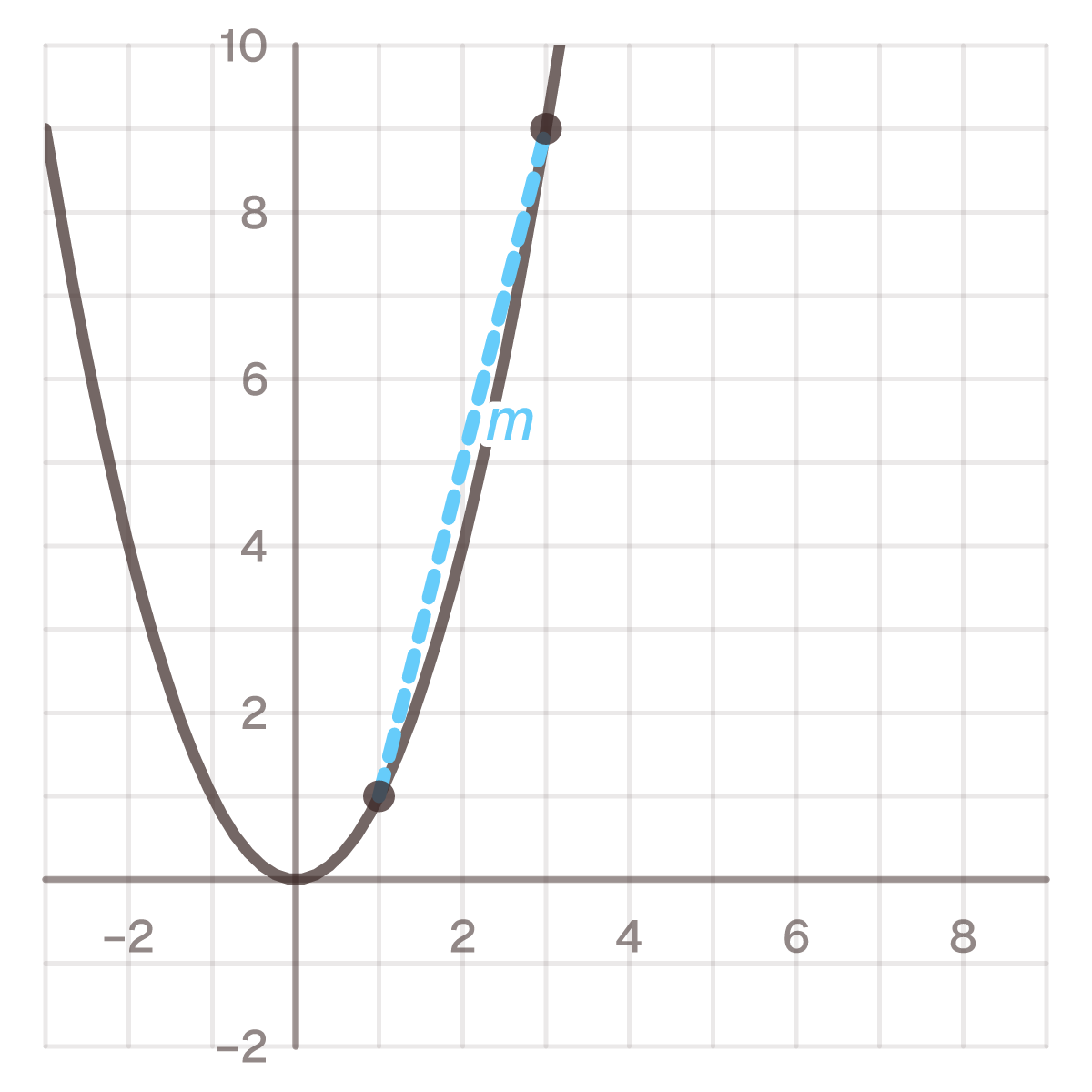
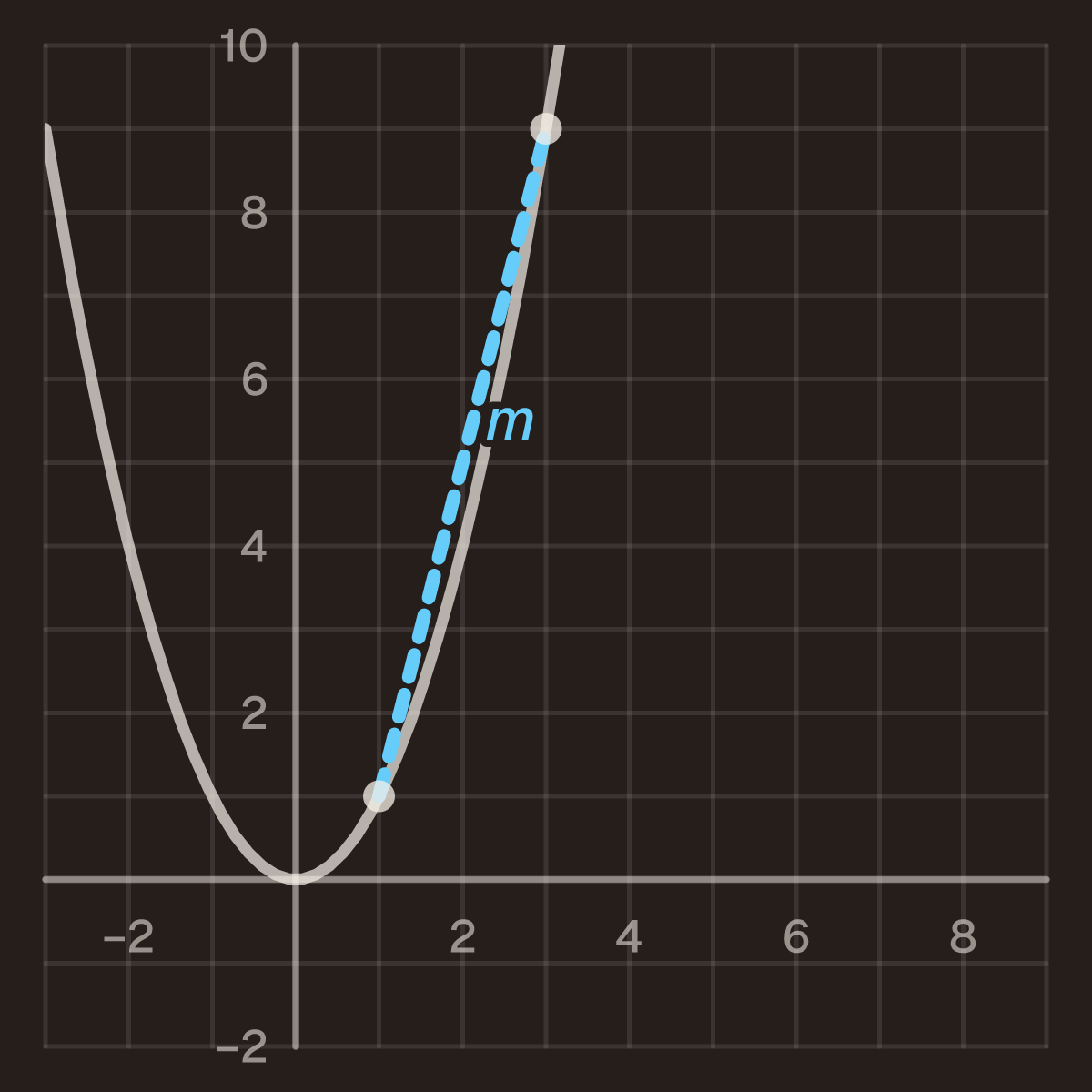
The quotient is often written Δy/Δx, where Δ (delta) means “change in”. Geometrically it is the slope of
the straight line between the two points on the curve — the secant. The curve can do anything it likes
between a and b; the average rate of change only sees where it started and where it ended.
Worked examples
Step by step. f(x) = x² − 4x on the interval [1, 5].
- Evaluate f at both endpoints: f(1) = 1 − 4 = −3 and f(5) = 25 − 20 = 5.
- Take the differences: f(5) − f(1) = 5 − (−3) = 8, and 5 − 1 = 4.
- Divide: 8 / 4 = 2.
So the function grew by 2 units per unit of x on average across the interval — even though it first fell
to its minimum at x = 2 and rose afterwards. That is what “on average” means.
With units. A car covers 240 km in 3 hours. Here x is time and f(x) is distance, so the average rate
of change is 240 / 3 = 80 km/h. That is the average speed, and it says nothing about what the speedometer
read at any single moment.
Negative. f(x) = 100 − x² on [2, 6] gives (64 − 96) / (6 − 2) = −32 / 4 = −8. A negative value
means the function fell.
One step from the derivative
| The question |
What it is called |
How it is worked out |
| How fast did it change over an interval? |
Average rate of change |
(f(b) − f(a)) / (b − a) |
| How fast is it changing at a point? |
Instantaneous rate of change, the derivative |
The limit as b approaches a |
Put b = a in the formula and the denominator is 0, so the quotient is undefined there. This is why the
derivative is needed: a rate at a point is not a quotient, it is a limit. Let the interval shrink and
the secant eventually becomes a tangent, and its slope is the derivative f′(a).
This page is the last step before limits: the derivative is what the quotient approaches as b − a goes
to zero.
The same arithmetic as slope
Slope from two points is worked out
exactly the same way: (y₂ − y₁) / (x₂ − x₁). What differs is what you have in front of you. Given a line
and two points on it, it is a slope. Given a function and an interval, it is an average rate of
change. The arithmetic is the same because a secant is a straight line.
Common mistakes
- Taking the differences in opposite orders. Both the numerator and the denominator must run from a
to b. Swap the order in only one of them and you get the right figure with the wrong sign.
- Dividing by the wrong thing. The denominator is b − a, not b. The interval [3, 7] is 4 wide, not 7.
- Thinking it says something about the middle. The function may have turned several times between the
endpoints. The average only sees the start and the end.
- Dropping the units. If distance changes per unit of time the answer is a speed; if dollars change per
month it is dollars per month. The unit follows from what y and x are.
Frequently asked questions
What does an answer of 0 mean?
That the function ended at the same value it started at. It may have moved a great deal in between —
f(x) = x² − 4x on [0, 4] starts and ends at 0 but dips to −4 on the way.
Does b have to be larger than a?
No. The arithmetic gives the same answer either way round, because the numerator and the denominator
both change sign. It is still conventional to write the interval with the smaller end first.
How is it different from the average value of the function?
They are two different things. The average rate of change averages how fast the function was changing.
The average value of a function averages how large it was, and is worked out with an integral.