The expansion
- (1 + x)α = Σk=0n C(α, k) xk + O(xn+1) as x → 0
The coefficient is C(α, k) = α(α − 1)…(α − k + 1)/k!. When α is a whole number from 0 up, this is the coefficient of the binomial theorem, and every coefficient past k = α has the factor α − α = 0, so the sum stops by itself. For any other α no factor is 0 and the terms never stop. The remainder O(xn+1) is what the polynomial leaves out: near 0, at most a constant times |x|n+1.
Worked example: √(1 + x)
α = ½. C(½, 1) = ½, C(½, 2) = ½ · (−½)/2 = −1/8 and C(½, 3) = ½ · (−½) · (−3/2)/6 = 1/16, so
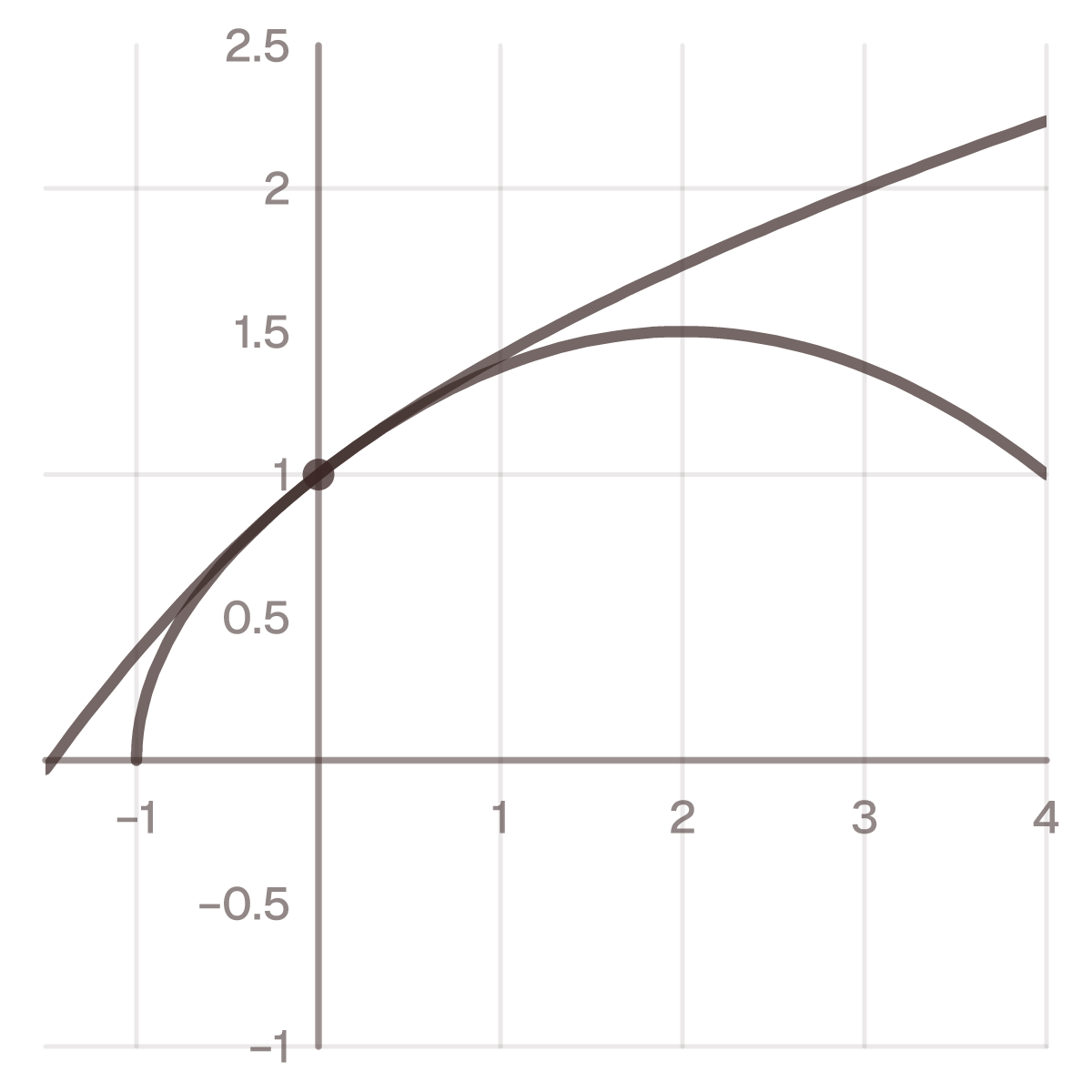
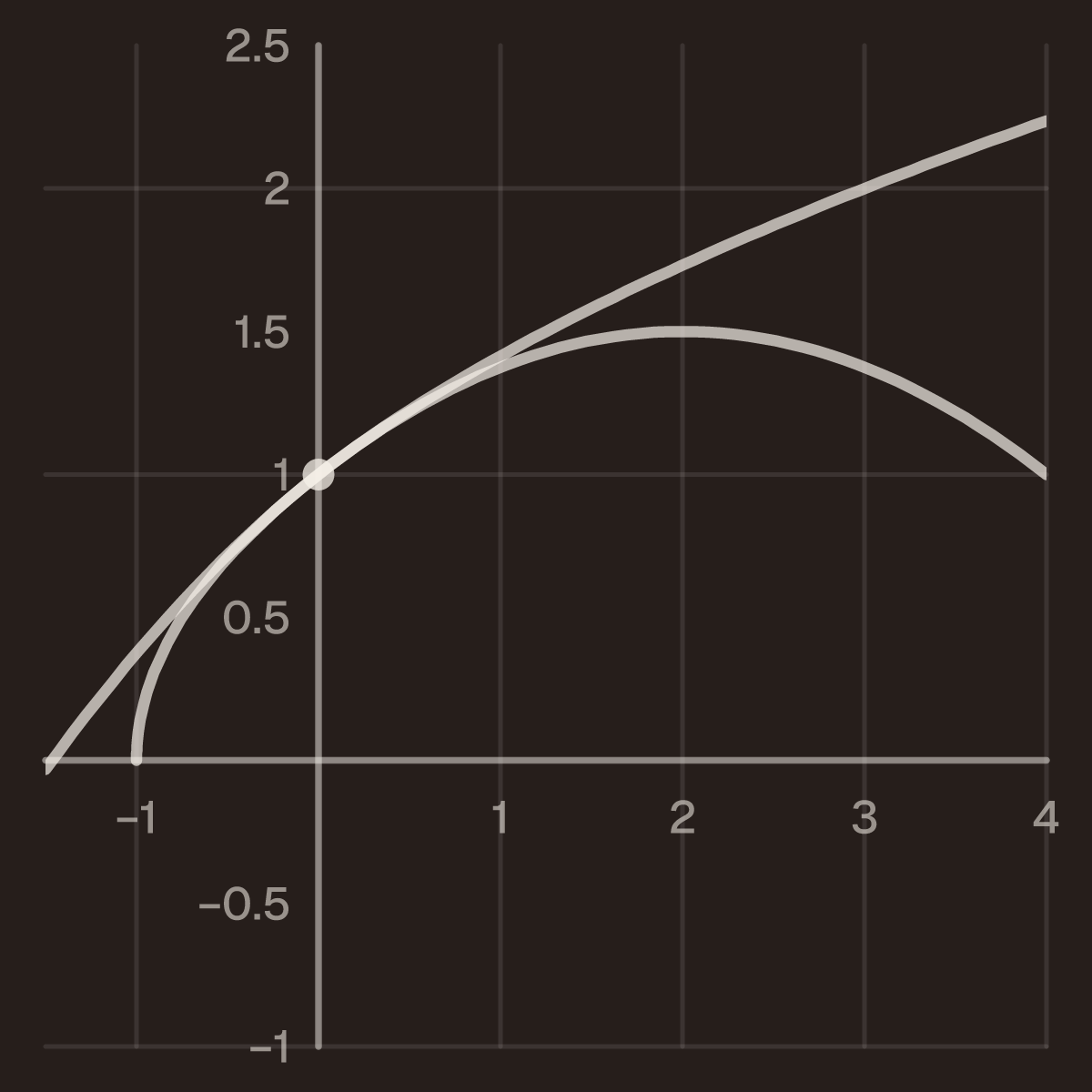
√(1 + x) = 1 + x/2 − x²/8 + x³/16 + O(x⁴).
At x = 0.1 the polynomial gives 1.0488125 and √1.1 = 1.0488088…, a gap of about 4 · 10⁻⁶, the size of the next term, −5x⁴/128.
A limit
limx→0 (√(1 + x) − 1 − x/2)/x². With n = 2:
√(1 + x) − 1 − x/2 = −x²/8 + O(x³), so the quotient is −1/8 + O(x) → −1/8.
Common mistakes
- Looking for a last term. For α = ½ there is none; the sum stops at the n you choose, and the O-term says what is left.
- α!. The coefficient needs no factorial of α, only the product α(α − 1)…(α − k + 1).
- Reading it far from 0. When α is not a whole number from 0 up, the series diverges for |x| > 1.
Related pages
Maclaurin series has the method behind this expansion and the others.