The definition
- f(x, y) = c
The level curve of f at the level c is the set of points (x, y) in the plane where f(x, y) = c. It is what a contour line on a map is: f is the height, and each line joins the points of one height. For three variables the same set, F(x, y, z) = c, is a level surface in space. The tangent plane to a level surface is a page of its own.
The level curve lies in the xy-plane. The surface z = f(x, y) cut by the plane z = c is a curve at height c, and the level curve is its shadow in the xy-plane.
Worked example: x² + 2y²
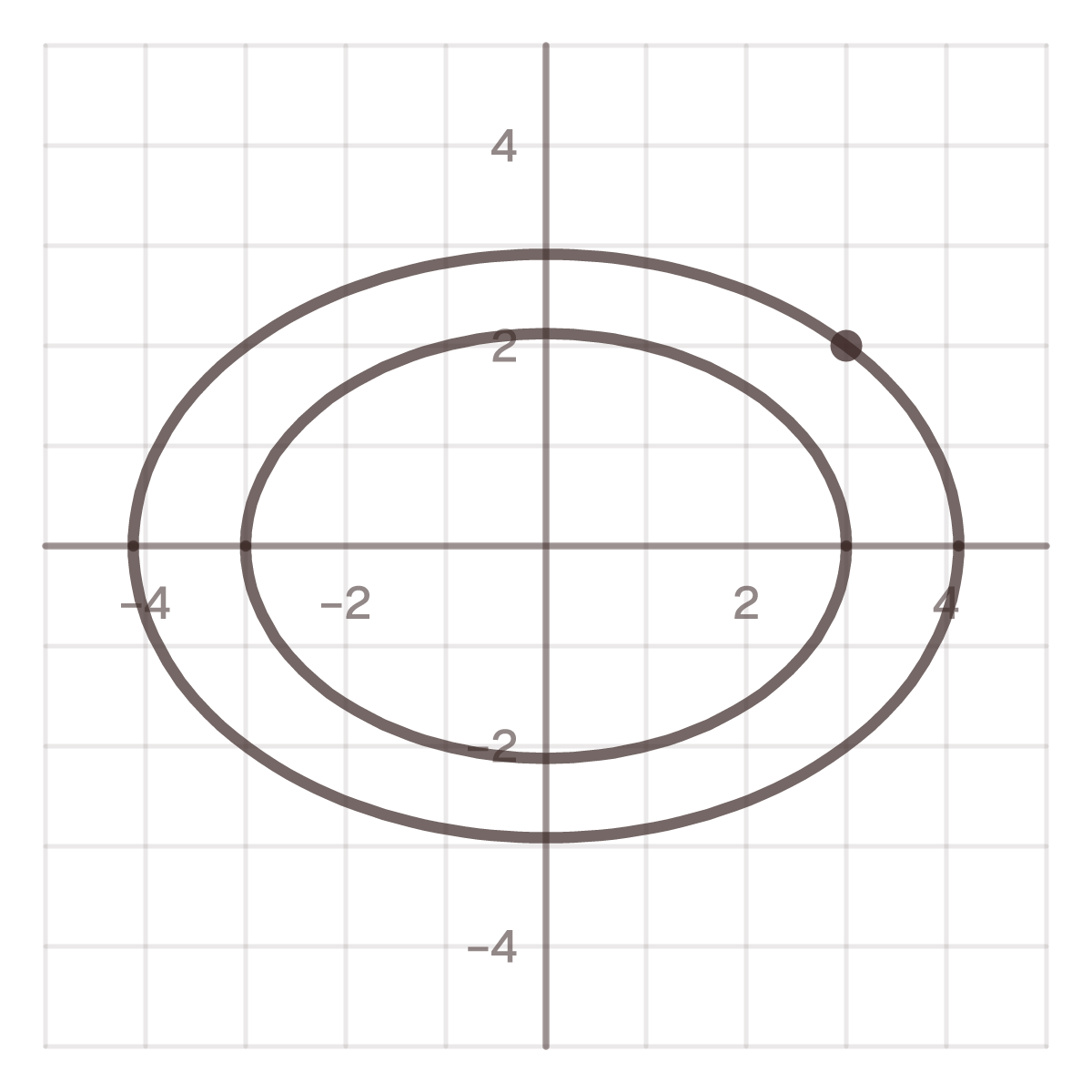
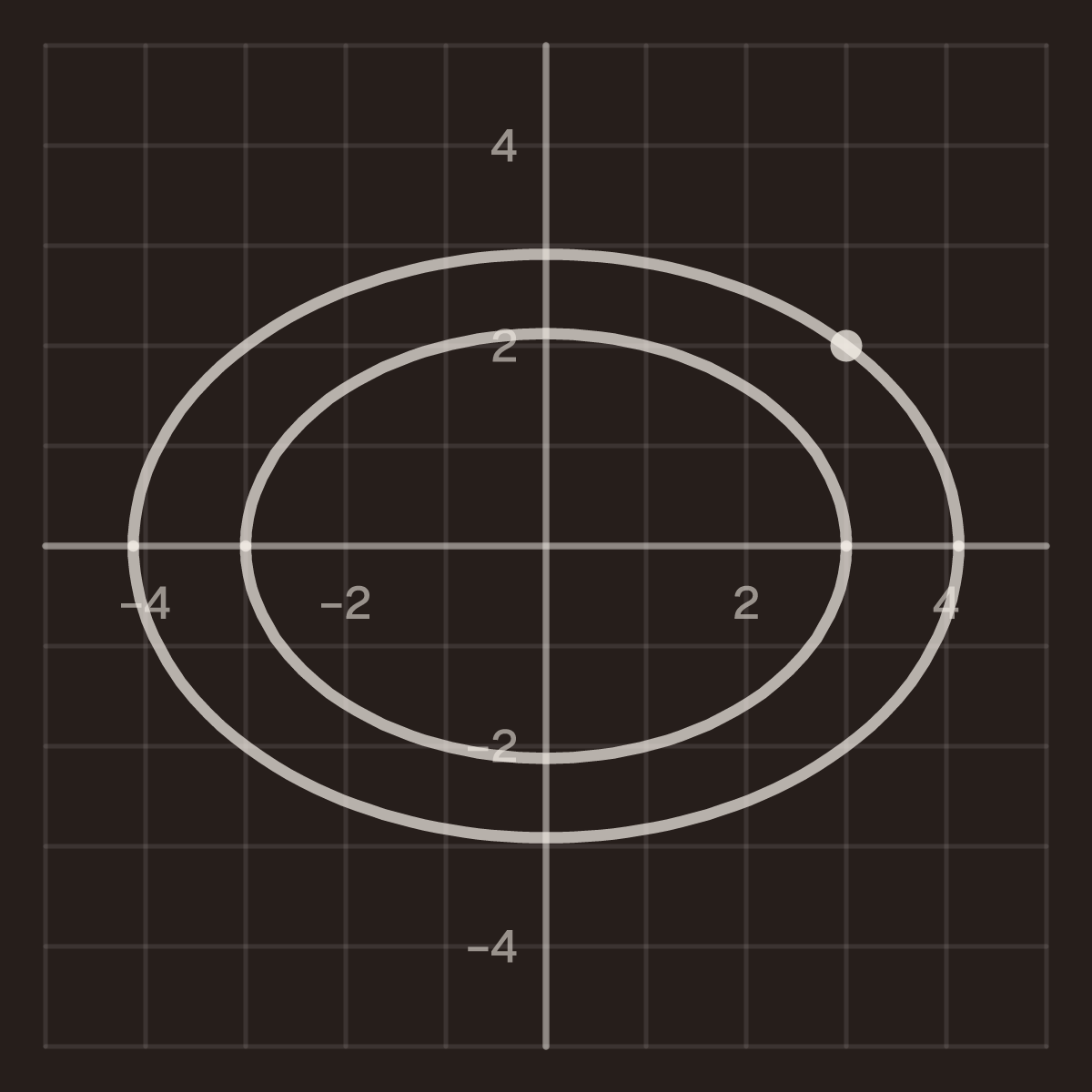
At the level c = 17 the level curve is x² + 2y² = 17, an ellipse. The point (3, 2) lies on it, since f(3, 2) = 9 + 8 = 17, and (2, 3) does not: f(2, 3) = 4 + 18 = 22. At c = 9 the ellipse is smaller, and at c = 0 the level curve is the single point (0, 0). For c below 0 there is no point at all, because f is never negative.
For f(x, y) = x² + y² the level curves are circles of radius √c, which is the picture on the gradient page.
A second example: xy
For f(x, y) = xy and c ≠ 0 the level curve is the hyperbola xy = c, in the first and third quadrants for c above 0 and in the second and fourth for c below 0. The level c = 0 is the two axes together, which cross at the origin: a level set need not be a smooth curve.
What the level curves tell you
- Level curves at different levels have no point in common, since a point has one value of f.
- With the levels evenly spaced, as on a map: where level curves lie close together, f changes quickly across them; where they are far apart, slowly.
- The gradient is perpendicular to the level curve through the point and points towards higher levels. Along the level curve the directional derivative is 0.
- Where Fy ≠ 0 the level curve F(x, y) = c is locally the graph of a function y(x), and implicit differentiation gives its slope.
Common mistakes
- Mixing the curve up with the cut of the surface. The level curve has two coordinates and lives in the plane; the cut has three and sits at height c.
- Expecting a curve at every level. A level can be a point, empty, or a crossing of curves, as the examples show.
- Swapping the letters. f(2, 3) and f(3, 2) are different numbers whenever f treats x and y differently.
Related: partial derivative.