What the formula says
f′(a) = lim_(h→0) (f(a + h) − f(a)) / h
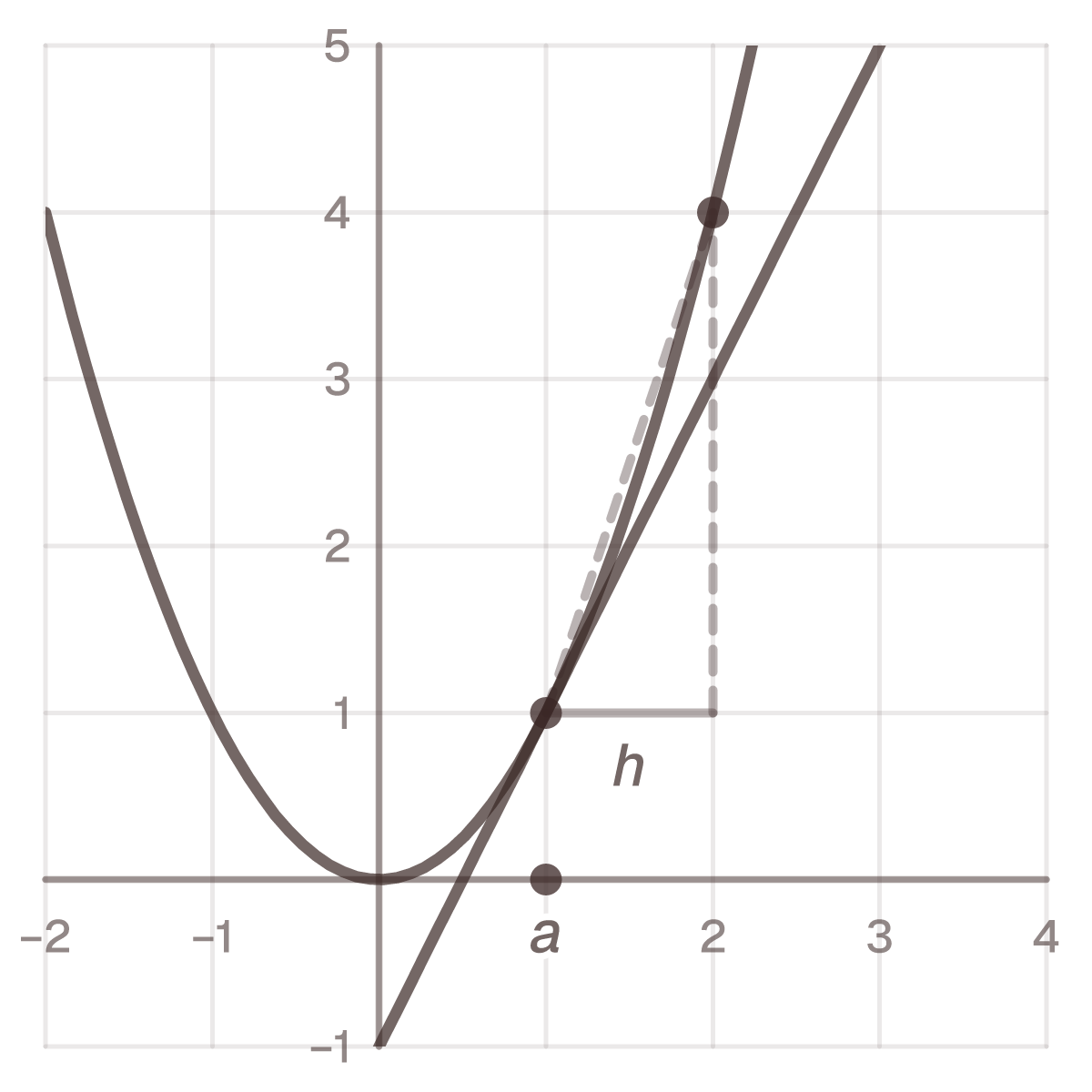
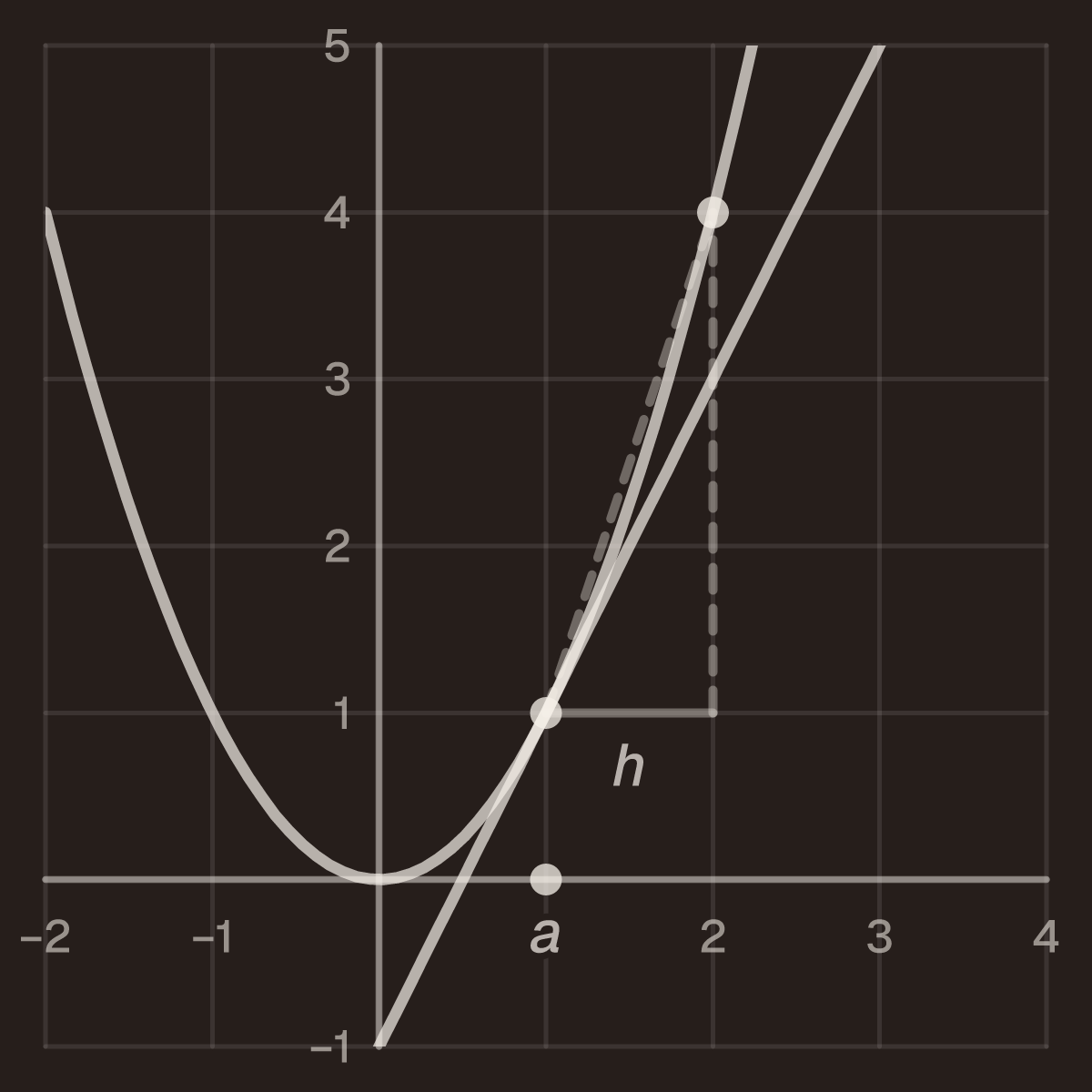
a is the point where the derivative is wanted and h a small step away from it. The quotient
(f(a + h) − f(a))/h is the slope of the secant through (a, f(a)) and (a + h, f(a + h)), the same
difference quotient that gives an average rate of change. It is a
definition: the derivative is the value that slope closes in on as h shrinks towards zero.
h may never be zero, because then it reads 0/0. That is why a limit is needed. You do not put in h = 0;
you ask what the quotient approaches.
Worked examples
f(x) = x³ at a = 2, in numbers. The quotient for ever smaller h:
| h | (f(2 + h) − f(2))/h |
|---|---|
| 0.1 | 12.61 |
| 0.01 | 12.0601 |
| 0.001 | 12.006001 |
| −0.1 | 11.41 |
| −0.01 | 11.9401 |
From both sides the quotient closes in on 12.
The same, algebraically. (2 + h)³ = 8 + 12h + 6h² + h³, so (f(2 + h) − f(2))/h = (12h + 6h² + h³)/h = 12 + 6h + h². Now h can go to zero, and what is left is f′(2) = 12. That agrees with the power rule: f′(x) = 3x² and 3 · 2² = 12.
A straight line. f(x) = 5x + 1 gives (5(a + h) + 1 − 5a − 1)/h = 5h/h = 5. The quotient is 5 for every h, and the derivative is 5, the slope of the line.
With the derivative at a point you can write the equation of the tangent.
Common mistakes
- Putting in h = 0 straight away. That gives 0/0, which is not a number. Simplify the quotient first so that h leaves the denominator.
- Dropping the brackets in f(a + h). For f(x) = x², f(a + h) = (a + h)² = a² + 2ah + h², not a² + h².
- Taking the limit for an approximation. The table gives approximations, but the limit is exact: f′(2) is 12, not about 12.
Common questions
Why is it called a difference quotient?
Because it divides how much the function changes, f(a + h) − f(a), by how much x changes, h. It is the
slope of a secant, and the derivative is what that slope approaches as the secant becomes a tangent.
Do you have to use the definition to differentiate?
No. The differentiation rules were derived from the definition once and for all, and they are enough in
practice. But a question that asks you to differentiate “from first principles” wants to see the limit.
What does it mean if the limit does not exist?
That the function is not differentiable at the point. f(x) = |x| at a = 0 gives the quotient 1 from the
right and −1 from the left, and the graph has a corner there.