The definition
lim f(x) = ∞ or −∞ as x → a⁺ or as x → a⁻
If this holds from at least one side, the line x = a is a vertical asymptote of y = f(x). The four combinations (∞ or −∞, from the left or the right) are all allowed, and the two sides need not agree.
Worked examples
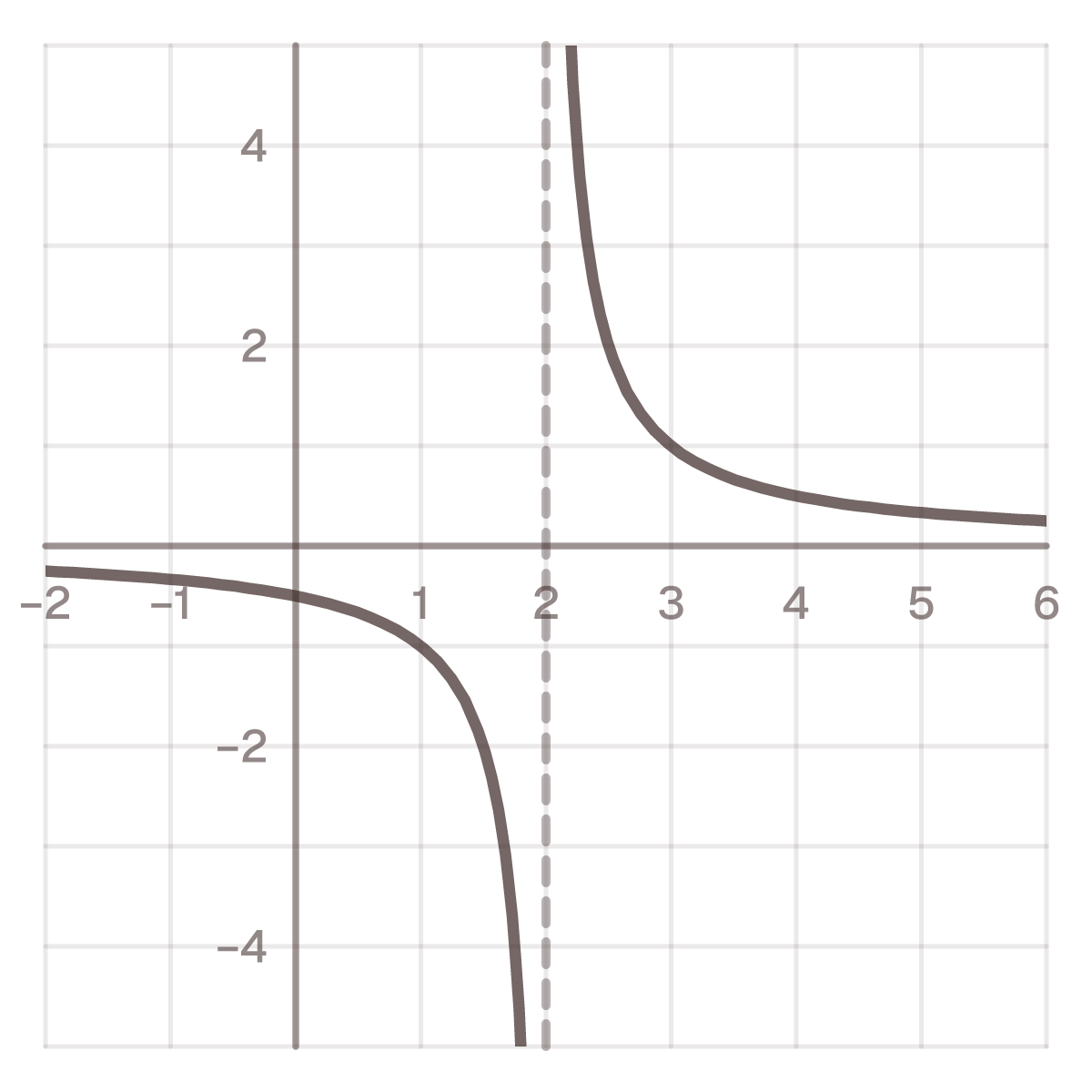
1/(x − 2). From the right (x → 2⁺) the denominator is a small positive number, so f → ∞. From the left it is a small negative number, so f → −∞. The line x = 2 is a vertical asymptote.
A fraction with two zeros. f(x) = (x + 1)/(x² − 4). The denominator is 0 at x = ±2, the numerator is not (3 and −1), so there are asymptotes at x = 2 and x = −2.
ln x. ln x → −∞ as x → 0⁺, so x = 0 is an asymptote, from the right only.
A hole, not an asymptote. f(x) = (x² − 4)/(x − 2) = x + 2 for x ≠ 2. The limit at 2 is 4, a finite number, so there is a hole at (2, 4) and no asymptote.
Common mistakes
- Taking every zero of the denominator for an asymptote. If the numerator is zero there too, check the limit; it may be finite.
- Confusing it with a horizontal asymptote.
- Checking only one side. The sign of ∞ can differ on the two sides.
Common questions
Can a graph cross a vertical asymptote?
No. At x = a the function is not defined, or it would have to take a finite value there while approaching
±∞ close by. Compare standard limits for limits that are finite.