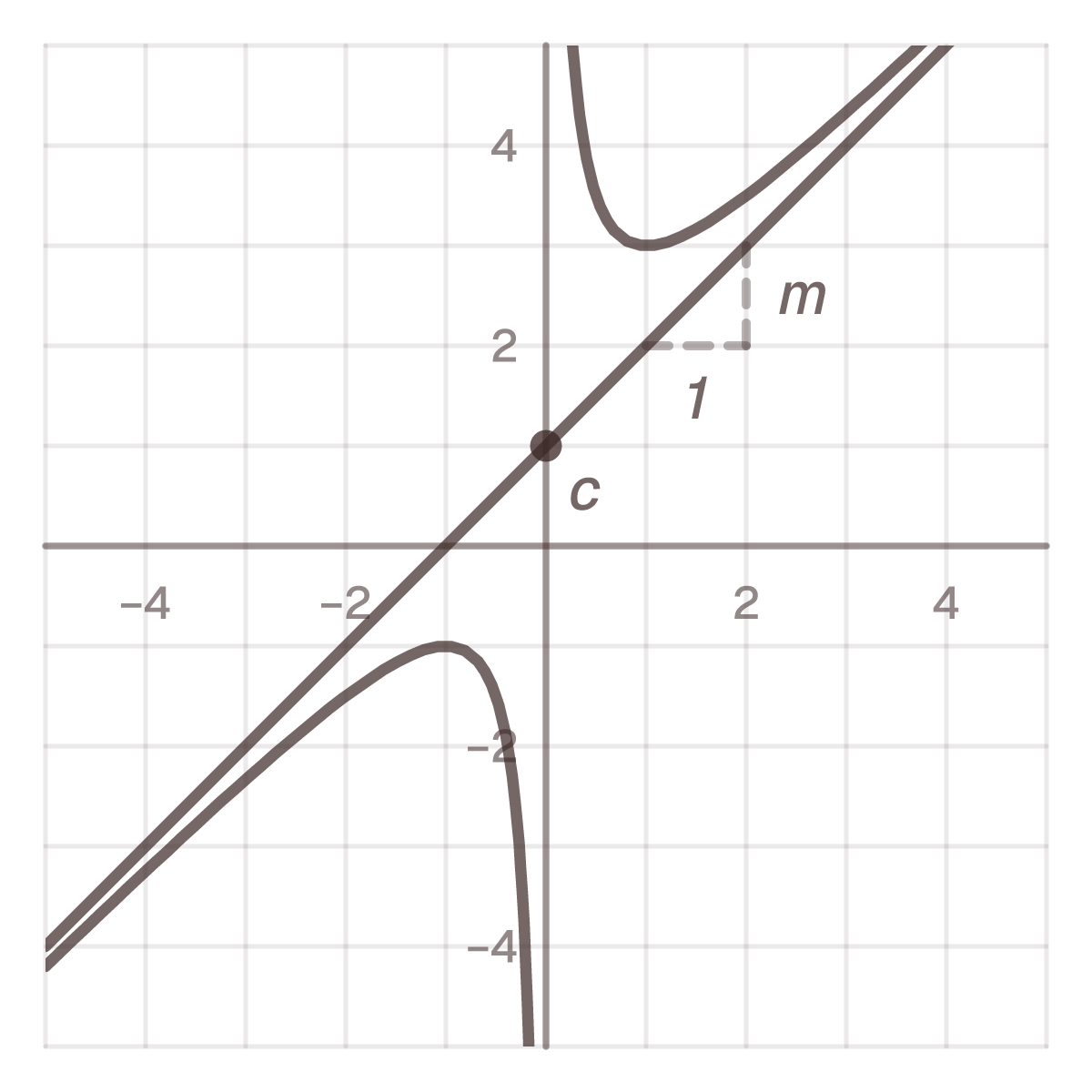
The definition
- lim (x → ∞) ( f(x) − (mx + c) ) = 0
The line y = mx + c is an oblique asymptote of f if the vertical gap between the graph and the line shrinks towards 0 as x grows (or as x → −∞). The line is slanted, so m ≠ 0 — with m = 0 it would be a horizontal asymptote.
A rational function p(x)/q(x) has one exactly when the numerator’s degree is one more than the denominator’s.
How to find it: divide
Find the oblique asymptote of f(x) = (2x² + x + 3) / (x − 1).
Polynomial division gives 2x² + x + 3 = (x − 1)(2x + 3) + 6, so
- f(x) = 2x + 3 + 6/(x − 1)
As x grows, 6/(x − 1) shrinks to 0, and what is left is the line. The asymptote is y = 2x + 3.
At x = 101 the gap is 6/100 = 0.06; at x = 1,001 it is 0.006. That shrinking gap is the definition above.
The shortcut that gets half of it
Dividing only the leading terms, 2x² / x = 2x, gives the right slope and the wrong line: y = 2x is parallel to the asymptote and 3 units below it. The constant term comes from the rest of the division, and there is no way to see it without doing it.
| Method | Result | |
|---|---|---|
| Leading terms only | y = 2x | slope right, intercept missing |
| Full division | y = 2x + 3 | correct |
A second example: the asymptote through the origin
f(x) = (x² + 1) / x. Divide term by term: f(x) = x + 1/x. The remainder 1/x goes to 0, so the asymptote is y = x, with c = 0. The graph lies above the line for positive x and below it for negative x.
Where next
- The division itself: polynomial division.
- What lim means: limits.
- The line: equation of a straight line.
Common mistakes
- Stopping at the leading terms. That gives m but not c, as in the table above.
- Keeping the remainder. The remainder is what goes to 0; the asymptote is the quotient alone.
- Looking for one when the degrees differ by two or more. (x³ + 1)/x has no oblique asymptote; the graph bends away like a parabola.
- Forgetting the vertical asymptote. (2x² + x + 3)/(x − 1) also has x = 1, where the denominator is 0. A graph can have both.
Common questions
Can a graph cross its oblique asymptote?
Yes. The definition only says what happens far out; close to the origin the graph may cross the line any
number of times.
Is it the same at x → −∞?
For a rational function, yes — the same line at both ends. Other functions can have one asymptote at +∞ and
another, or none, at −∞.
Can a function that is not a fraction have one?
Yes. f(x) = 2x + 3 + e⁻ˣ has y = 2x + 3 as x → ∞. The method is the same idea: split off the part that goes
to 0.