What the formula says
f⁻¹(f(x)) = x
The inverse f⁻¹ undoes what f did. Let f work on x, then let f⁻¹ work on the answer, and you are back at x. It is a definition, and it can also be read as a change of direction: y = f(x) means exactly the same as x = f⁻¹(y).
Not every function has an inverse. To go back, each value of the function has to come from a single x. A function that gives the same value for two different x cannot be turned round until you limit which x it may take.
Worked examples
A straight line. f(x) = 2x + 1. Write y = 2x + 1 and solve for x: x = (y − 1)/2. So the inverse is f⁻¹(x) = (x − 1)/2. Check: f(4) = 9, and f⁻¹(9) = (9 − 1)/2 = 4, where we started.
The other way round. f(f⁻¹(9)) = f(4) = 9. The inverse works from both sides.
A function that has to be restricted. f(x) = x² gives f(2) = f(−2) = 4. The question “which x gave 4?” has two answers, so f has no inverse on all numbers. Restricted to x ≥ 0 it does: f⁻¹(x) = √x, and √(3²) = 3.
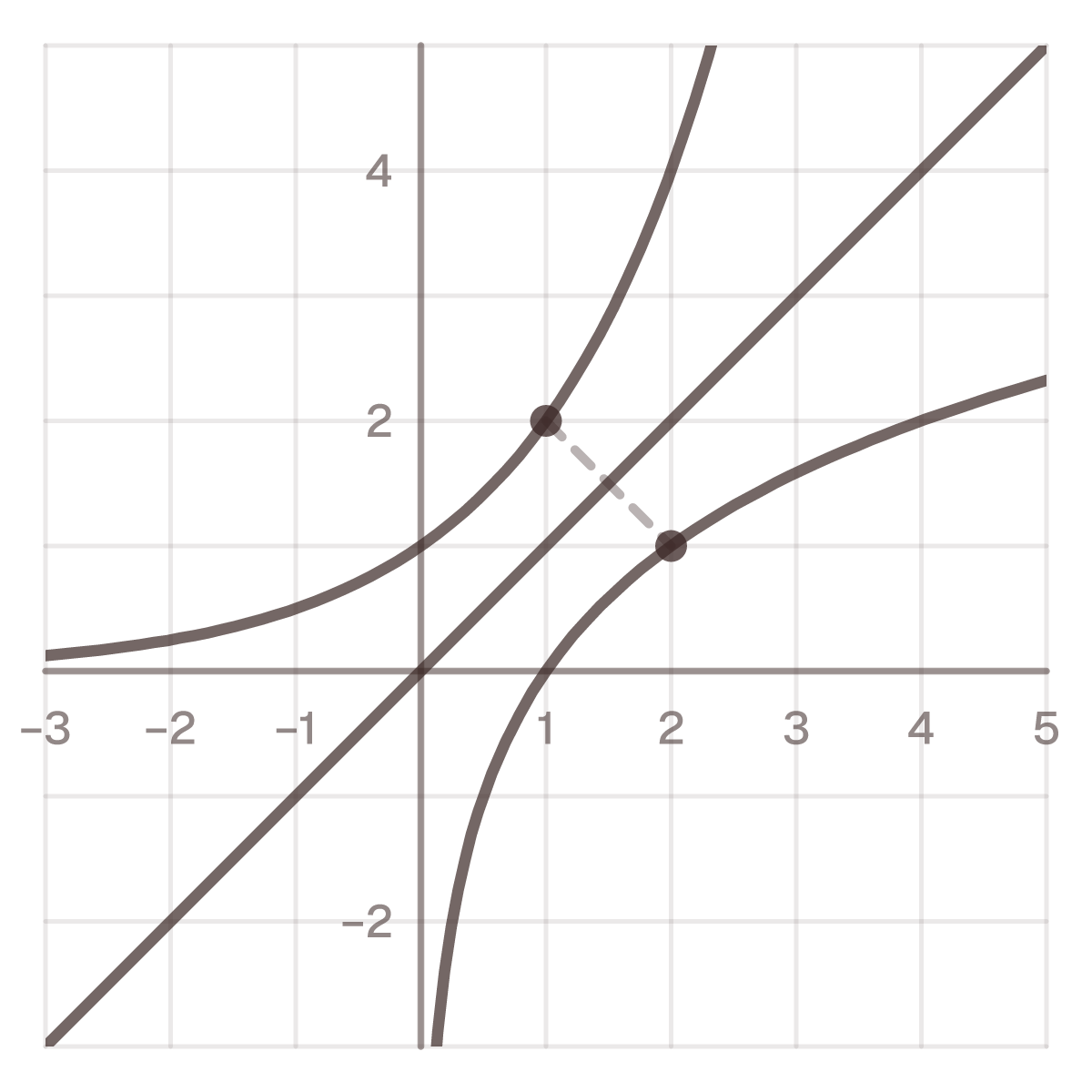
The graph. The graph of f⁻¹ is the graph of f reflected in the line y = x. The point (4, 9) on y = 2x + 1 corresponds to the point (9, 4) on y = (x − 1)/2.
Composed with f, the inverse gives x back; see composite function. A straight line is easy to invert by hand.
Common mistakes
- Reading f⁻¹ as 1/f. The −1 here means “the inverse”, not “one over”. For f(x) = 2x + 1, f⁻¹(9) = 4, while 1/f(9) = 1/19.
- Assuming every function has an inverse. If two x give the same value, the function cannot be turned round without restricting its domain first.
- Swapping x and y and then stopping. After the swap, x = 2y + 1, you still have to solve for y. That step is what gives f⁻¹(x) = (x − 1)/2.
Common questions
How do you find the inverse of a function?
Write y = f(x) and solve for x. The expression you get, with y renamed x, is f⁻¹(x). Check by putting a
number in: f⁻¹(f(x)) should give it back.
Does every function have an inverse?
No, only those where each value comes from a single x. On a graph it looks like this: no horizontal line
may cross the graph more than once.
Why is the graph reflected in the line y = x?
The inverse swaps input and output. The point (a, b) on the graph of f becomes (b, a) on the graph of
f⁻¹, and swapping the x and y coordinates is exactly a reflection in y = x.
Which inverses come up at school?
The square root is the inverse of x² for x ≥ 0, ln x is the inverse of eˣ, and arcsin, arccos and
arctan are the inverses of the trigonometric functions, each on a restricted interval.