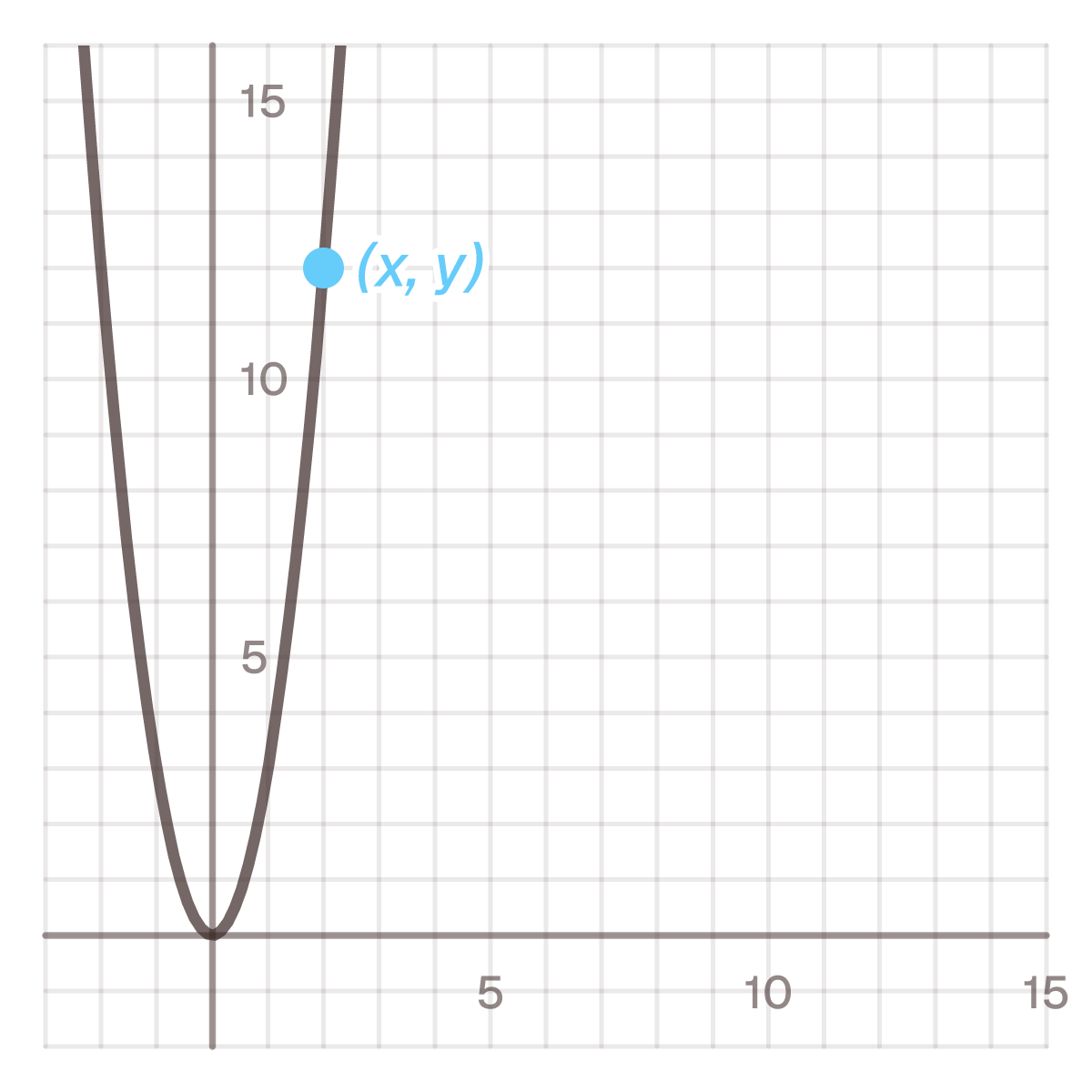
k is a constant that stretches the curve, n is the fixed exponent that decides its shape, and x is the variable.
Swedish textbooks write y = C · xᵃ, with C and a where this page has k and n.
y = 3x² at x = 2: y = 3 · 2² = 3 · 4 = 12.
Several familiar curves are power functions: y = x² (a parabola), y = x³, y = √x = x^0.5, and y = 1/x = x⁻¹.
Power function or exponential function?
The two formulas use the same letters in different places:
|
Formula |
x sits in |
At x = 10 |
| Power function |
y = 3 · x² |
the base |
3 · 100 = 300 |
| Exponential function |
y = 3 · 2ˣ |
the exponent |
3 · 1,024 = 3,072 |
Both start small and both rise, so a graph or a table of the first few values will not always tell them apart.
Ask where the x is. In a power function the exponent is a number you could read off the page; in an
exponential function the exponent is the thing that changes.
A second example: find k from a point
The curve y = kx³ passes through (2, 40). Find k. Put the point in: 40 = k · 2³ = 8k, so k = 40 / 8 = 5.
And where does y = 5x³ reach 625? 5x³ = 625, so x³ = 125 and x = 125^(1/3) = 5. That last step is a
power equation.
Negative and fractional exponents
| n |
Curve |
What happens as x grows |
| n > 1 |
y = x², x³ … |
grows faster and faster |
| 0 < n < 1 |
y = √x = x^0.5 |
grows, but slower and slower |
| n < 0 |
y = 1/x = x⁻¹ |
falls towards 0 |
y = 8/x at x = 2: 8 · 2⁻¹ = 8 / 2 = 4. A hyperbola is a power function with exponent −1.
Where next
Common mistakes
- Confusing it with an exponential function. 3x² and 3 · 2ˣ are different functions. Check which letter
is in the exponent.
- Raising k as well. 3x² is 3 · (x²), not (3x)². At x = 2 that is 12, not 36.
- Dividing by n instead of taking the root. If 2x³ = 54, then x³ = 27 and x = 3, not 27/3.
- Forgetting that 1/x is a power function. Exponents can be negative and fractional; it is still y = kxⁿ.
Common questions
Is a straight line a power function?
y = kx is: n = 1. A line with an intercept, y = kx + c, is not, because the + c breaks the shape.
Why is x restricted to positive values?
For a whole-number exponent x can be anything. For an exponent like 0.5 or 2.5, a negative x has no real
value — the square root of a negative number — so the general power function is defined for x > 0.
How do I find both k and n?
You need two points. Divide the two equations to make k cancel, solve for n with a logarithm, then put n back
to find k. With only one point, one of the two has to be given.