The same factor every step
A savings account paying 5% does not grow by the same number of dollars each year. The second year
earns more than the first, because the interest is worked out on a larger balance. That is what
separates exponential growth from linear growth: linear growth adds the same amount each step,
exponential growth multiplies by the same factor.
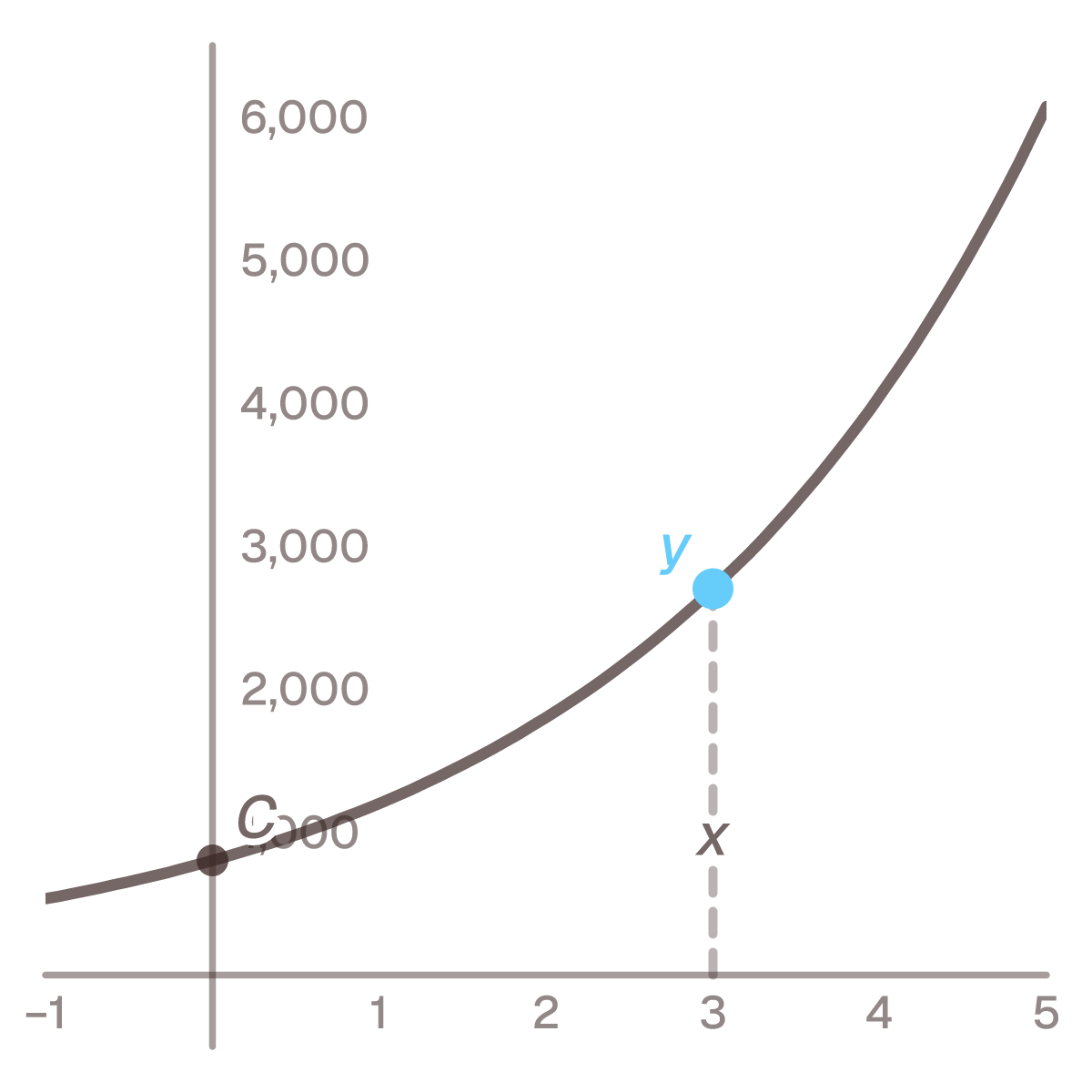
where C is the initial amount, a the growth factor, x the number of steps and y the amount
after those steps. A step is usually a year, but it can be anything — a month, an hour, a generation —
as long as the growth factor belongs to the same step.
The growth factor is not the percentage
A common mistake is putting the percentage where the factor belongs. A rise
of p per cent per step gives the factor
| Change per step |
Growth factor |
| +5% |
1.05 |
| +50% |
1.5 |
| +100% (doubling) |
2 |
| −15% |
0.85 |
| −50% (halving) |
0.5 |
A factor above 1 means the amount grows, a factor below 1 means it shrinks, and a factor of exactly 1
means nothing happens. There is more about the factor on the page about the
change factor.
Worked examples
An amount growing by 50% a year. $800 for three years: y = 800 · 1.5³. Since 1.5³ = 3.375, that
is 800 · 3.375 = $2,700.
A population growing by 2% a year. 12,000 people for ten years: y = 12,000 · 1.02¹⁰ ≈ 12,000 · 1.2190 ≈ 14,628 people. So 2% for ten years is not 20% but a little under 22%.
A value going down. A car worth $250,000 that loses 15% of its value a year is worth
250,000 · 0.85⁴ = 250,000 · 0.5220 ≈ $130,502 after four years — roughly half, even though
4 · 15% is 60%.
The other three questions
The card at the top of the page solves for whichever of the four quantities you are missing. Three of
them are rearrangements of the formula:
| What you do not know |
The rearrangement |
| The initial amount |
C = y / aˣ |
| The growth factor |
a = (y / C)^(1/x) |
| The number of steps |
x = ln(y / C) / ln a |
The initial amount. If an amount is $2,700 after three years at a factor of 1.5, it started at
2,700 / 1.5³ = 2,700 / 3.375 = $800.
The growth factor. From $800 to $2,700 in three years: 2,700 / 800 = 3.375, and the cube root of
3.375 is 1.5 — that is, 50% a year. You cannot divide the percentage by the number of years here;
the growth factor is the cube root of the ratio.
The number of steps. How long does it take to go from $800 to $2,700 at 50% a year?
x = ln 3.375 / ln 1.5 = 1.2164 / 0.4055 = 3 years. It is the only one of the four questions that
needs a logarithm: x sits in the exponent, and the four operations cannot bring it back out.
Common mistakes
- Adding the percentages up. 10% a year for three years is not 30%. It is 1.1³ = 1.331, that is
33.1%.
- Assuming +20% and −20% cancel out. 1.2 · 0.8 = 0.96 — you end 4% below where you started,
whichever order you do them in.
- Writing 5 or 0.05 instead of 1.05. The formula multiplies by the factor, not by the increase.
- Dividing instead of taking a root. The growth factor over
x steps is the x-th root of the
ratio, not the ratio divided by x.
- Mixing up steps and time. If the factor is per month,
x has to be counted in months. Five years
at a monthly factor is x = 60.
Questions people ask
How is this different from linear growth?
Linear growth adds the same amount each step and is written y = mx + c
(equation of a straight line). Exponential growth multiplies
by the same factor each step. $1,000 rising by $100 a year is $2,000 after ten years; $1,000 rising by
10% a year is $2,594.
How do I handle exponential decay?
With the same formula. Exponential decay is y = C · aˣ with a factor between 0 and 1. A fall of
p per cent per step gives a = 1 − p / 100, so −15% becomes 0.85 and −50% becomes 0.5. The formula,
the rearrangements and the card on this page all work the same way in that direction; the only difference
is that y comes out smaller than C.
Which logarithm should I use when solving for x?
Any of them, as long as you use the same one top and bottom. ln 3.375 / ln 1.5 and log 3.375 / log 1.5
both give 3, because changing base multiplies the numerator and the denominator by the same number. The
formula here is written with ln because most calculators have that key.