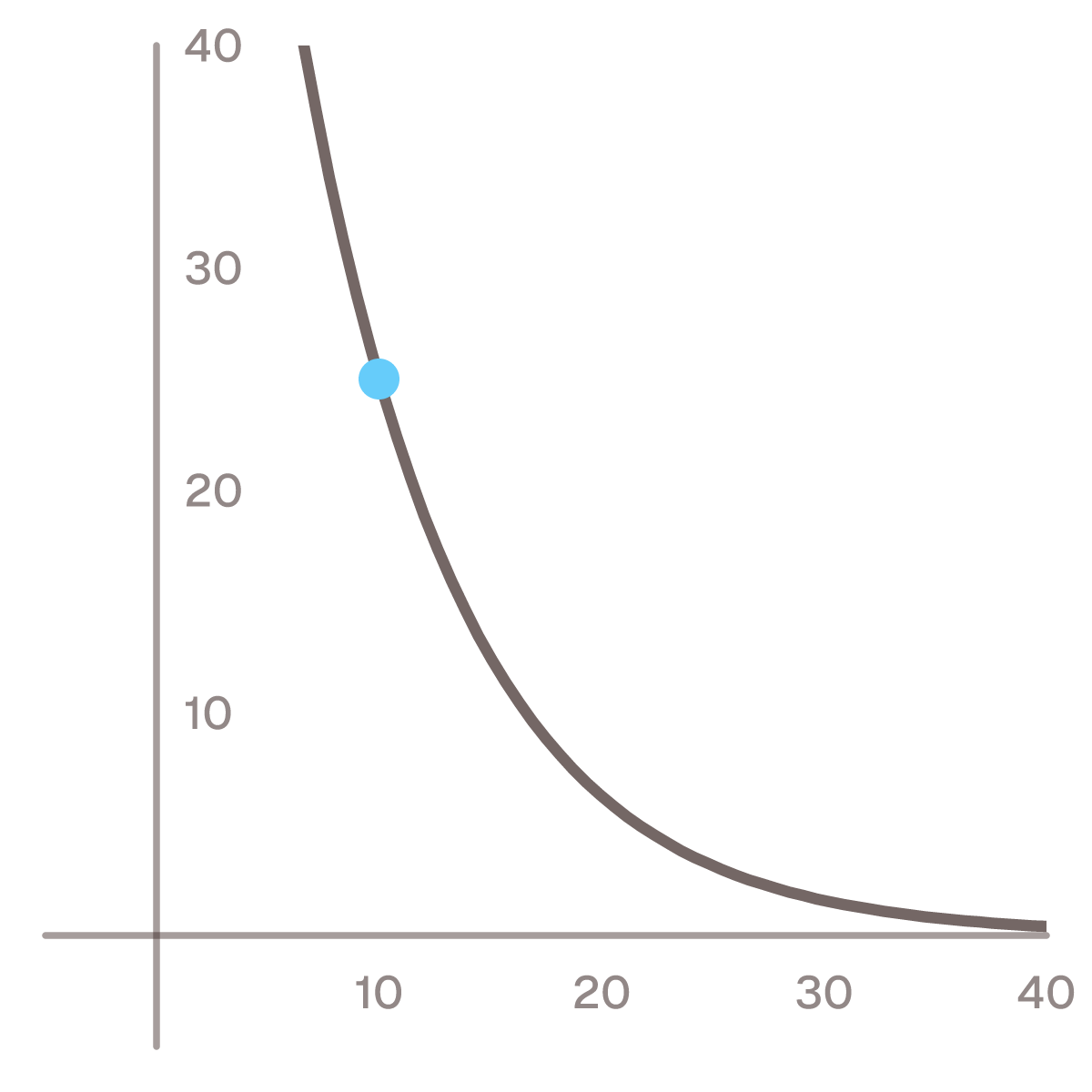
N₀ is what there was to begin with, N what is left, t the time that has passed and T the
half-life. All the formula does is count how many half-lives have gone by: if two have passed the
exponent is 2, and half of a half is a quarter.
That is why it is written this way rather than as an ordinary
exponential change. That formula would
do the same arithmetic with a base of 0.5^(1/T), and that number is rarely given. You are told the
half-life is 5,730 years, and the formula takes that figure directly.
| Half-lives passed |
Exponent |
Left of the original |
| 0 |
0 |
100% |
| 1 |
1 |
50% |
| 2 |
2 |
25% |
| 3 |
3 |
12.5% |
| 4 |
4 |
6.25% |
Two things show up at once. What is left depends only on how many half-lives have passed, never on
how much there was to start with — 25% of 80 grams and 25% of 8 tonnes are both two half-lives. And the
curve never reaches zero: each step takes half of what is there, and half of something is always
something.
Worked examples
How much is left? 240 mg of a substance with a half-life of 4 days, after 8 days. The exponent is
8/4 = 2, so 240 · (1/2)² = 60 mg.
How long did it take? From 1,000 units down to 125, with a half-life of 3 hours. 125 is an eighth,
which is three half-lives: t = 3 · 3 = 9 hours.
When the share left is not a power of 1/2, the logarithm is needed. Solved for the time, the formula gives
- t = T · ln(N/N₀) / ln(1/2)
and both logarithms are negative, so the quotient comes out positive. It is the same move as on
exponential equation: the unknown
sits in the exponent and the logarithm brings it down.
Common mistakes
- Subtracting instead of halving. After two half-lives 25% is left, not nothing. Each step takes
half of whatever is there at that moment, not half of the original.
- Mixing units.
t and T have to be measured in the same unit. 90 minutes with a half-life of one
hour is 1.5 half-lives, not 90.
- Confusing half-life with lifetime. Nothing ever disappears completely under this formula. After ten
half-lives barely a thousandth is left — small, but not zero.
- Using it on something that falls linearly. A car losing $2,000 a year is not doing this. The
formula applies when what disappears is a share of what is there.
Common questions
What is a half-life, exactly?
The time it takes for half of something to disappear. It is constant: 100 down to 50 takes as long as
50 down to 25, and as 4 down to 2. That constancy is what makes the idea useful.
Can the formula run backwards in time?
Yes. A negative t gives how much there was before, because (1/2) raised to something negative is a
number greater than one. That is how a find is dated with carbon-14.
How does half-life relate to doubling time?
They are the same calculation with opposite signs. One halves, the other doubles, and both are solved
with a logarithm. Doubling time is the version for
interest.