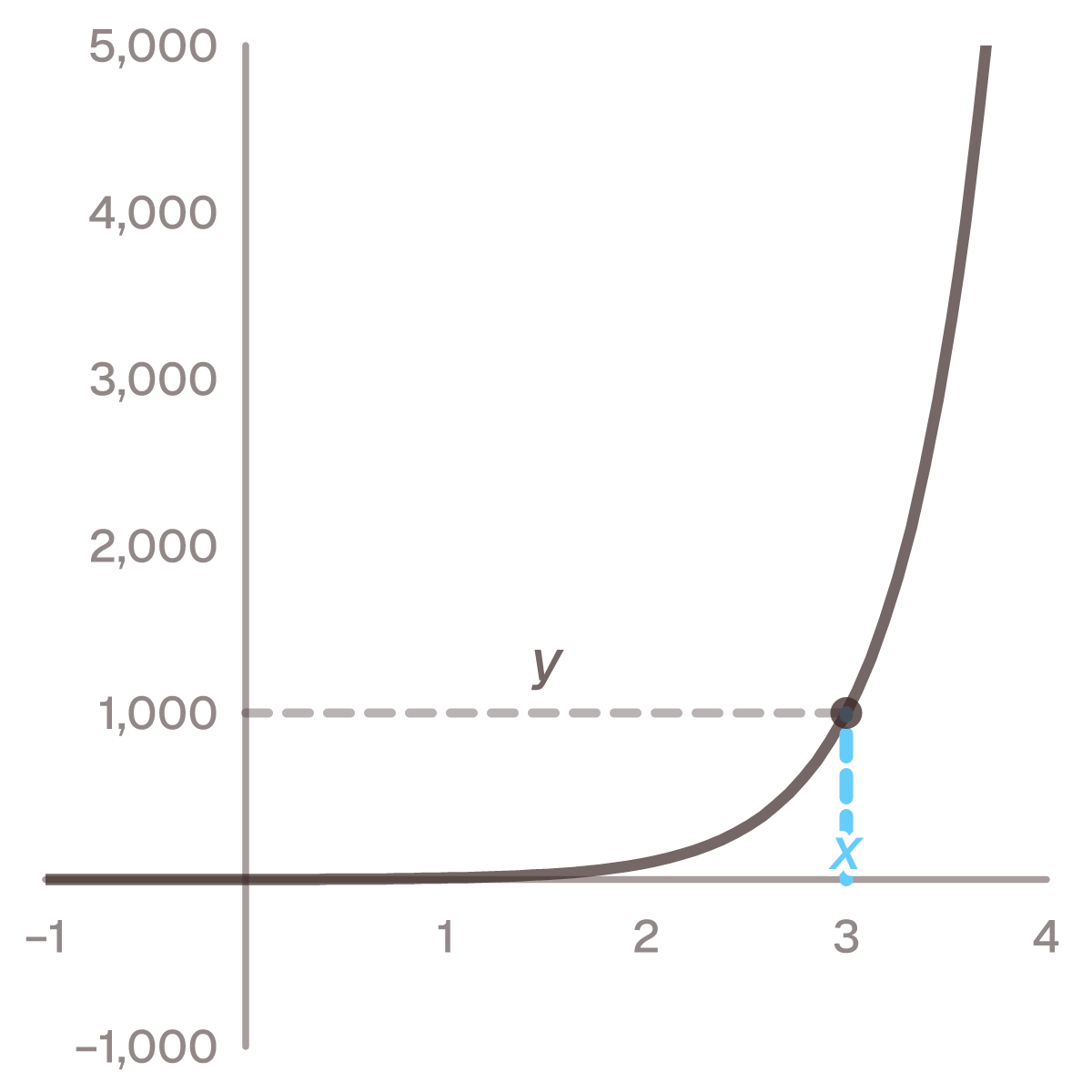
The definition
The two lines say the same thing in two directions. The logarithm is the exponent: log y is the number you
raise 10 to in order to get y.
log 1,000. What power of 10 gives 1,000? 10³ = 1,000, so log 1,000 = 3.
Swedish books write lg for the base-10 logarithm; this page writes log (or log₁₀), as English books
and calculators do.
The mistake: dividing instead of counting
log 1,000 is not 1,000 / 10 = 100. It counts how many factors of 10 there are, not how many tens:
| y |
as a power of 10 |
log y |
| 1,000 |
10³ |
3 |
| 100 |
10² |
2 |
| 10 |
10¹ |
1 |
| 1 |
10⁰ |
0 |
| 0.1 |
10⁻¹ |
−1 |
| 0.01 |
10⁻² |
−2 |
Each step down the table divides y by 10 and subtracts 1 from the logarithm. That is what a logarithm does: it
turns multiplication into addition.
A second example: the other direction
Solve log y = 4. By the definition, y = 10⁴ = 10,000.
And log y = −3? y = 10⁻³ = 0.001. A negative logarithm is fine — it belongs to a number between 0 and 1.
Where no logarithm exists
log 0 and log of a negative number do not exist. Every power of 10 is positive, so no exponent gives 0 or −5.
Your calculator shows an error message.
Where next
Common mistakes
- Dividing by 10. log 1,000 = 3, not 100.
- Thinking log 1 is 1. 10⁰ = 1, so log 1 = 0.
- Expecting a positive answer. log 0.01 = −2. Numbers below 1 have negative logarithms.
- Taking log of 0 or a negative number. There is no such logarithm.
Common questions
What is log 2?
About 0.301, because 10^0.301 ≈ 2. Most logarithms are not whole numbers; only powers of 10 have whole
logarithms.
Is log the same as ln?
No. log has base 10, ln has base e ≈ 2.718. Both are logarithms and follow the same rules, but log 100 = 2
while ln 100 ≈ 4.6.
Why is it a definition and not a formula to prove?
Because before this line, “log” means nothing. The line is what gives the word its meaning; the logarithm laws
are what can be proved from it.