The natural logarithm
The relation
ey
The logarithm to base e. ln x answers the question: to what power must e be raised to give x?
Solve for
Solved for y
y
y≈2.9957
y equals the natural logarithm of (20), is approximately 2.9957
Den här sidan finns på svenska. Byt till svenska
Definition — what does that mean?
The logarithm to base e. ln x answers one question: what exponent does e need in order to become x?
In Swedish: Naturliga logaritmen
ey
The logarithm to base e. ln x answers the question: to what power must e be raised to give x?
y
y≈2.9957
y equals the natural logarithm of (20), is approximately 2.9957
You are given
Round to 3 decimals.
That is the whole definition, and it is a question asked backwards. The power e³ asks what does this
come to? The logarithm ln 20 asks what was the exponent? The answer 2.9957 says that e raised to
2.9957 is 20, and nothing more than that.
So the two lines above are interchangeable. Wherever you see ln, you may rewrite it as a power, and the other way round. That one move is often all it takes to solve an equation with ln in it.
e ≈ 2.718 281 828. It never ends and never repeats, just like π, and like π it has earned its own key
because it turns up wherever something grows continuously.
Why that number? Because it is the base where the growth is exactly as big as the amount you have. Put one pound in at 100% interest for a year and you get two. Split the interest into months and you get 2.61. Into days, 2.71. Into every instant: e. The number e is the limit of that splitting, and compound interest, radioactive decay and a cooling cup of coffee are all described with powers of e.
ln 1 = 0. e⁰ = 1, like any nonzero number to the power of zero. Worth knowing by heart.
ln e = 1. What exponent does e need in order to become e? One.
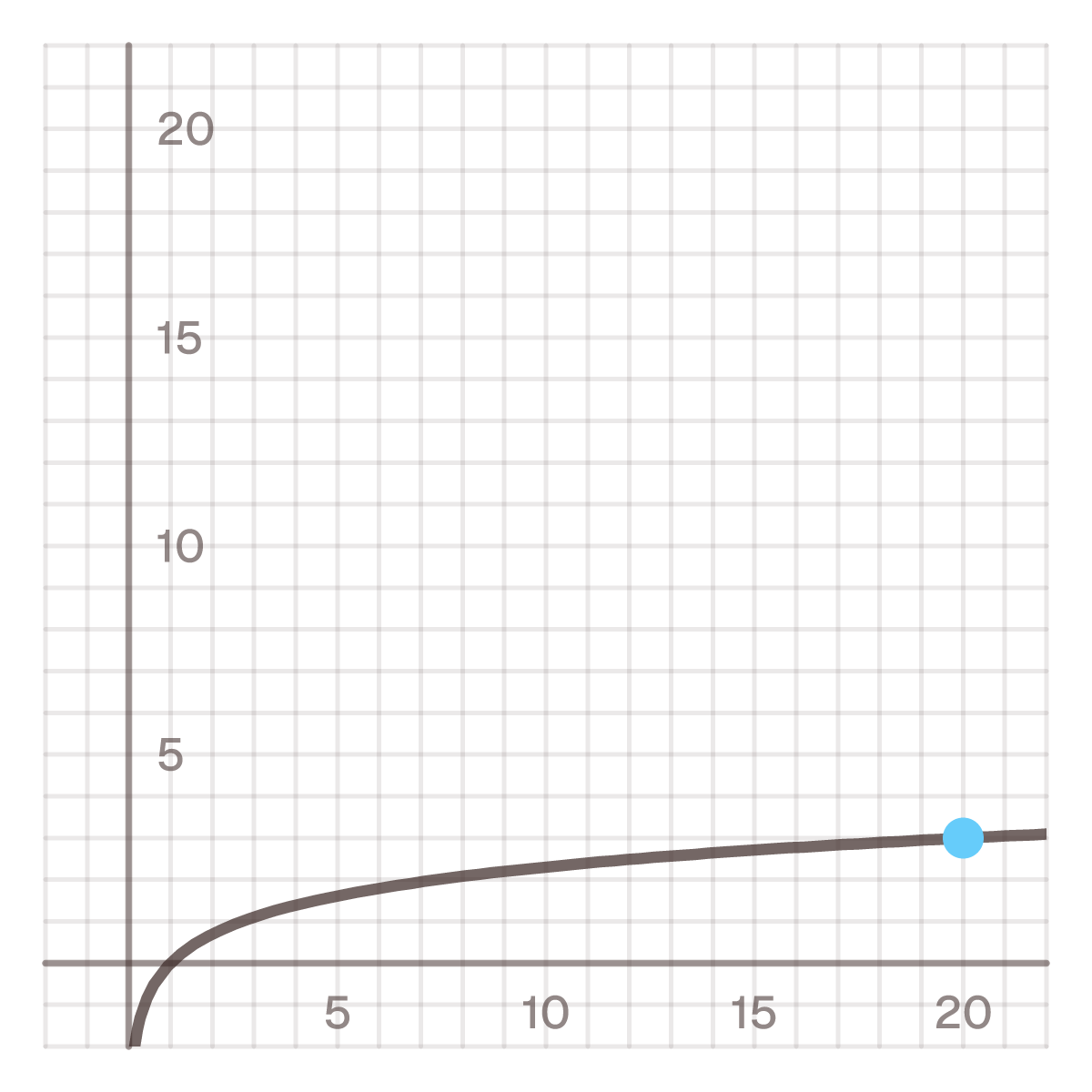
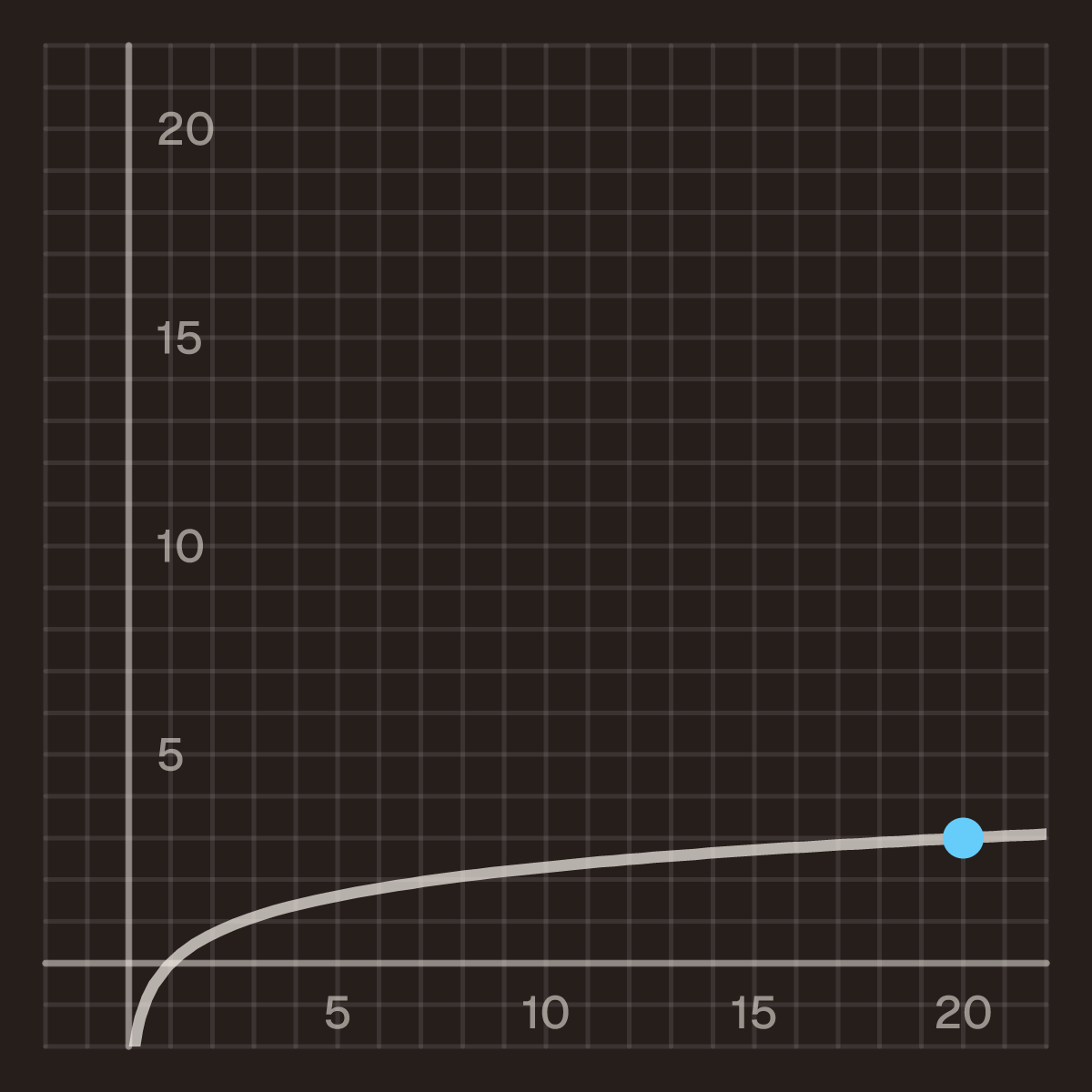
ln 20 ≈ 2.9957. Check it: 2.718³ ≈ 20.08, so the answer sits just under 3. Reasonable.
Solve eˣ = 50: take the logarithm of both sides and x = ln 50 ≈ 3.912. Check: e³·⁹¹² ≈ 50. ✓
Solve ln x = 4: rewrite as a power and x = e⁴ ≈ 54.6.
ln(−5) and ln 0 do not exist. No exponent makes e
negative or zero — eˣ stays above the axis however far down the exponent goes.log has base 10, ln has base e. They give different numbers for the same
x — log 20 ≈ 1.301 against ln 20 ≈ 2.996 — but the same answer when used in a quotient.When should I use ln rather than log?
For the answer it makes no difference, as long as you use the same logarithm throughout the same
calculation — see change of base.
In practice ln is used when e appears in the problem, and log when ten does.
Why is it written ln and not log_e?
Because it is used often enough to have earned an abbreviation. ln is short for logarithmus
naturalis, the natural choice of base in anything about continuous change. Swedish books write lg as
the same kind of shorthand for base 10.
Can ln x be negative?
Yes, for every x between 0 and 1. ln 0.5 ≈ −0.693, because e raised to something negative gives a
number below one. It is x itself that may never be negative — the answer may.
| Solve for | Rearranged | With the numbers | Comes to |
|---|---|---|---|
| x | ey | e2.9957 | 20 |
| y | ln(x) | ln(20) | 2.9957 |
Last reviewed October 6, 2026 ·How pages are reviewed
Exponential changeAll formulas
Copy the code into your page where the formula card should appear. It loads from lovetocalc.com, so it stays current on its own — all we ask is that the credit line comes with it.