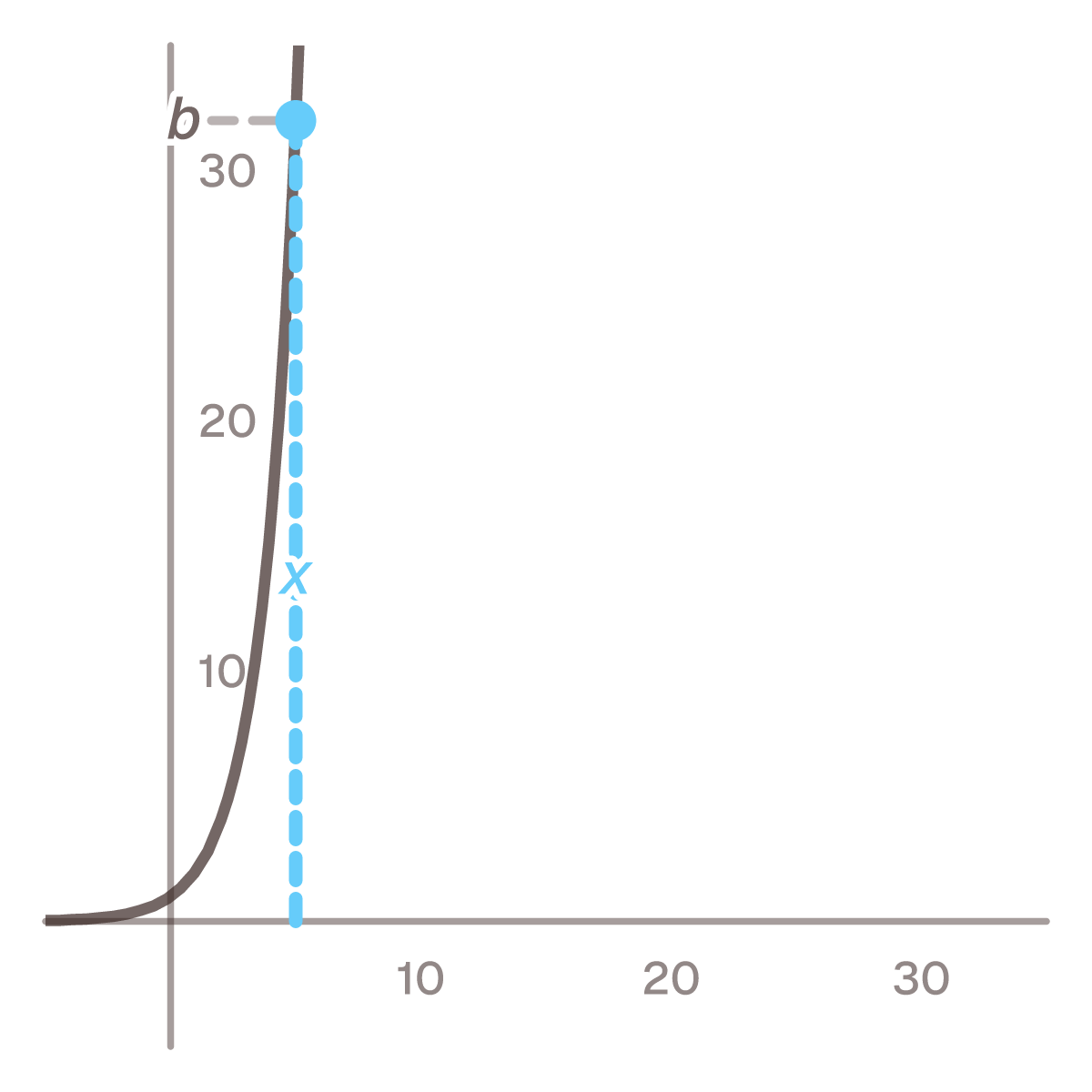
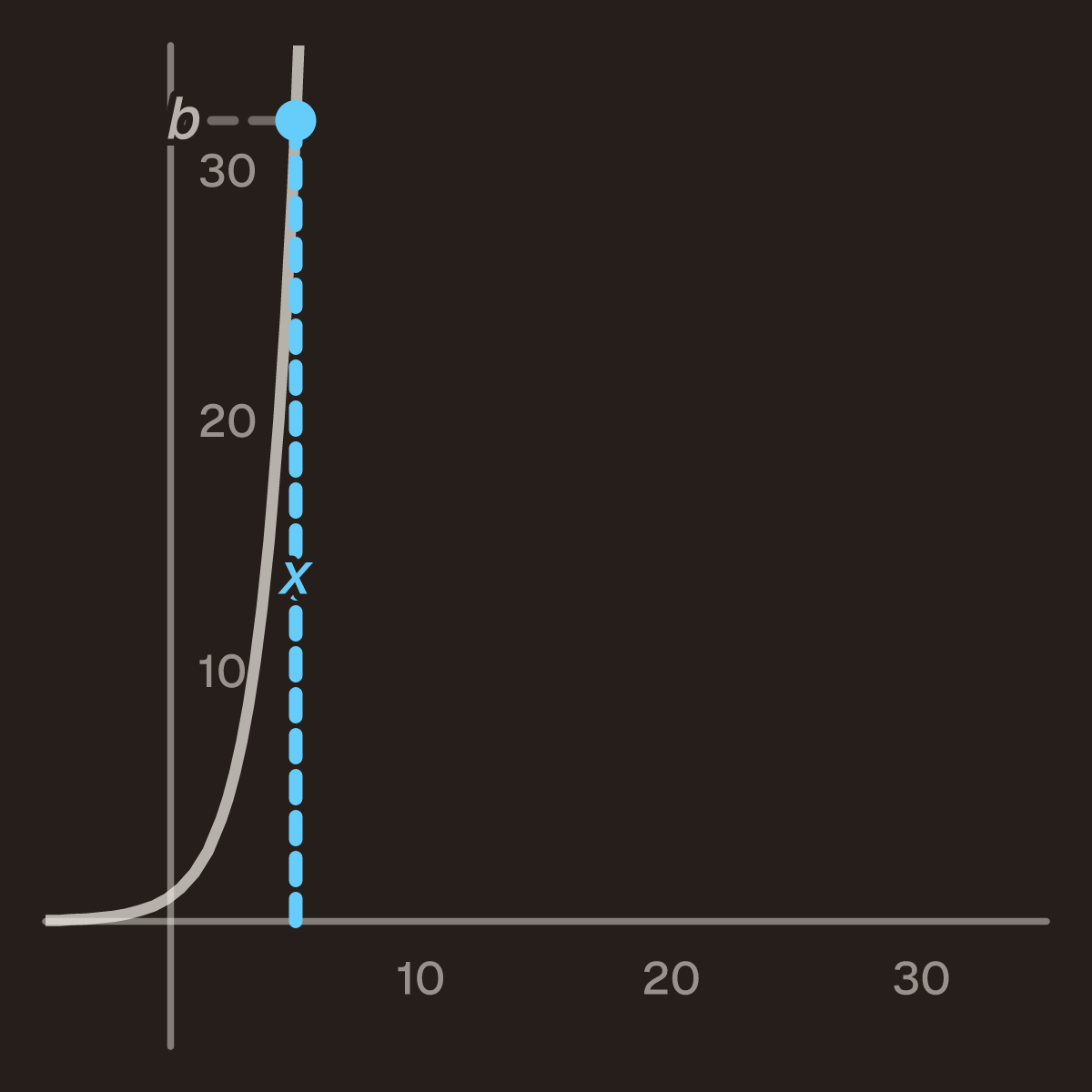
The equation and its solution
- aˣ = b ⟹ x = log b / log a
Holds when a > 0, a ≠ 1 and b > 0.
The unknown sits in the exponent, and the four operations cannot get it out of there. Dividing by a
does not help; taking a root does not help. The logarithm does it: it turns a power
into a product, so the exponent comes down as a factor.
Solve 3ˣ = 81: log 81 / log 3 = 4. Check it: 3⁴ = 3 · 3 · 3 · 3 = 81. ✓
The method in two steps:
- 3ˣ = 81
- x · log 3 = log 81 (take the logarithm of both sides)
- x = log 81 / log 3 = 4 (divide by log 3)
The base of the logarithm makes no difference
log (base 10) and ln (base e) give the same answer, and that is not a coincidence. The answer is a
quotient of two logarithms, and changing base multiplies both of them by the same number, which then
cancels.
| Worked with |
Arithmetic |
Answer |
| log |
1.9085 / 0.4771 |
4 |
| ln |
4.3944 / 1.0986 |
4 |
Use whichever key your calculator has. The only rule is to use the same logarithm top and bottom.
When there is a coefficient in front
C · aˣ = b takes two steps: divide the C away first, then solve what is left.
Solve 500 · 1.05ˣ = 1,000: divide by 500 and you have 1.05ˣ = 2, so x = log 2 / log 1.05 ≈ 14.2.
That is the same arithmetic as exponential growth solved for the
number of steps, and the same as doubling time when the right-hand side is
twice the starting value.
Sometimes no logarithm is needed
If both sides can be written as powers of the same base, compare the exponents directly:
- 2ˣ = 32 is 2ˣ = 2⁵, so x = 5.
- 9ˣ = 27 is 3²ˣ = 3³, so 2x = 3 and x = 1.5.
That is quicker, exact, and usually what an exam expects. The logarithm is needed when the right-hand
side cannot be written as a power of the same base.
Common mistakes
- Dividing by the base. 2ˣ = 32 does not give x = 16. Dividing away a base that is raised to a power
is not an operation that exists.
- Writing log(b/a) instead of log b / log a. The logarithm of a quotient is the difference of the
logarithms, not the quotient of them. The two expressions are different numbers.
- Forgetting the coefficient. In 500 · 1.05ˣ = 1,000 the 500 has to go first. Taking logarithms
straight away gives log 500 + x · log 1.05 = log 1,000, which is solvable but needlessly awkward.
- Accepting an answer without checking it. Substitute it back. It takes five seconds and catches
sign errors.
Common questions
What happens if the base is 1?
1ˣ is 1 for every x, so 1ˣ = b has either infinitely many solutions (if b = 1) or none at all. That is
why the formula requires a base other than 1: log 1 is 0, and dividing by zero is not allowed.
Can the right-hand side be negative?
Not with a positive base. aˣ is always positive when a is positive, however large or small the
exponent. 2ˣ = −8 has no solution — 2⁻³ is 1/8, not −8.
What is x when the right-hand side is 1?
Zero, whatever the base. log 1 is 0, and 0 divided by log a is 0. That agrees with any positive base to
the power of 0 being 1.