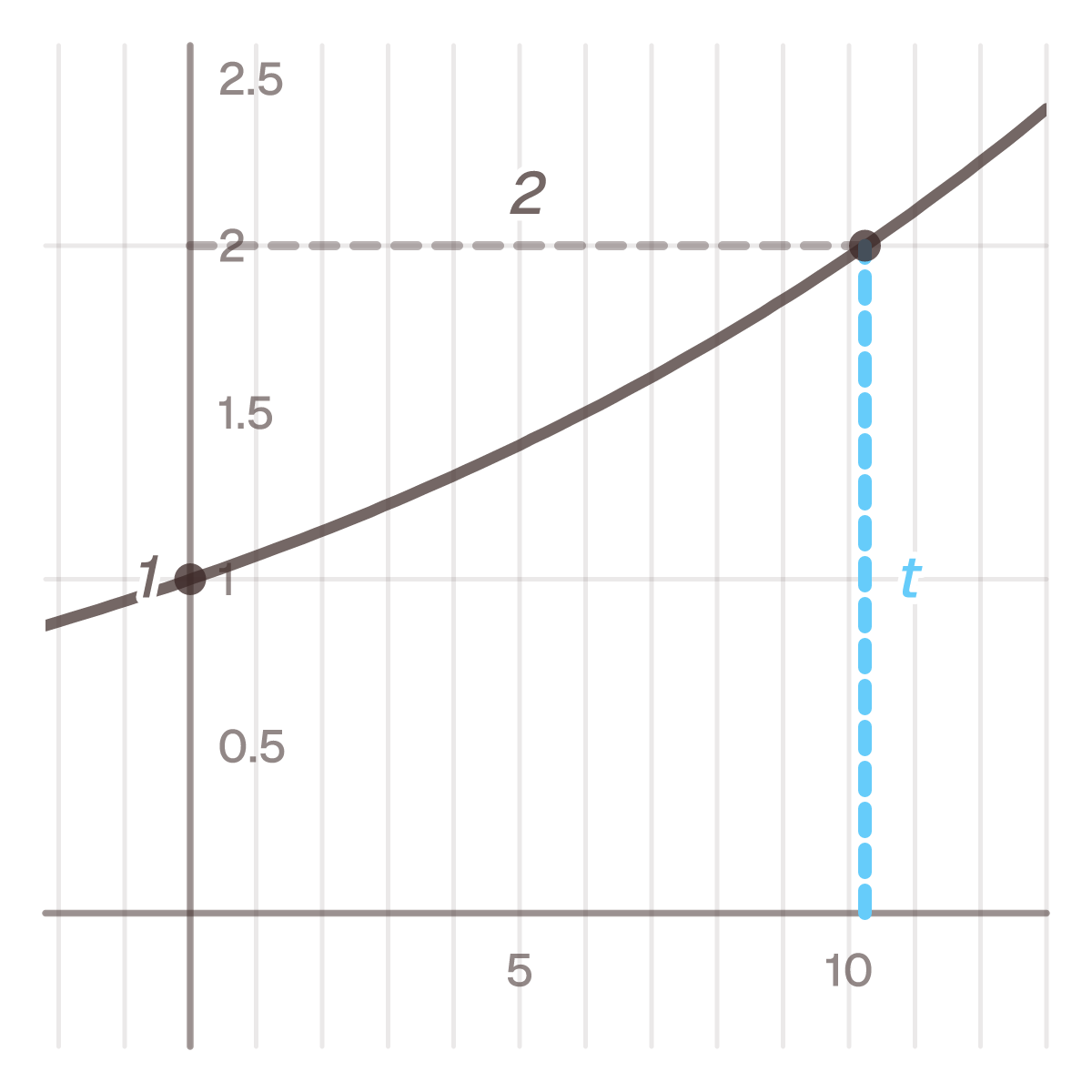
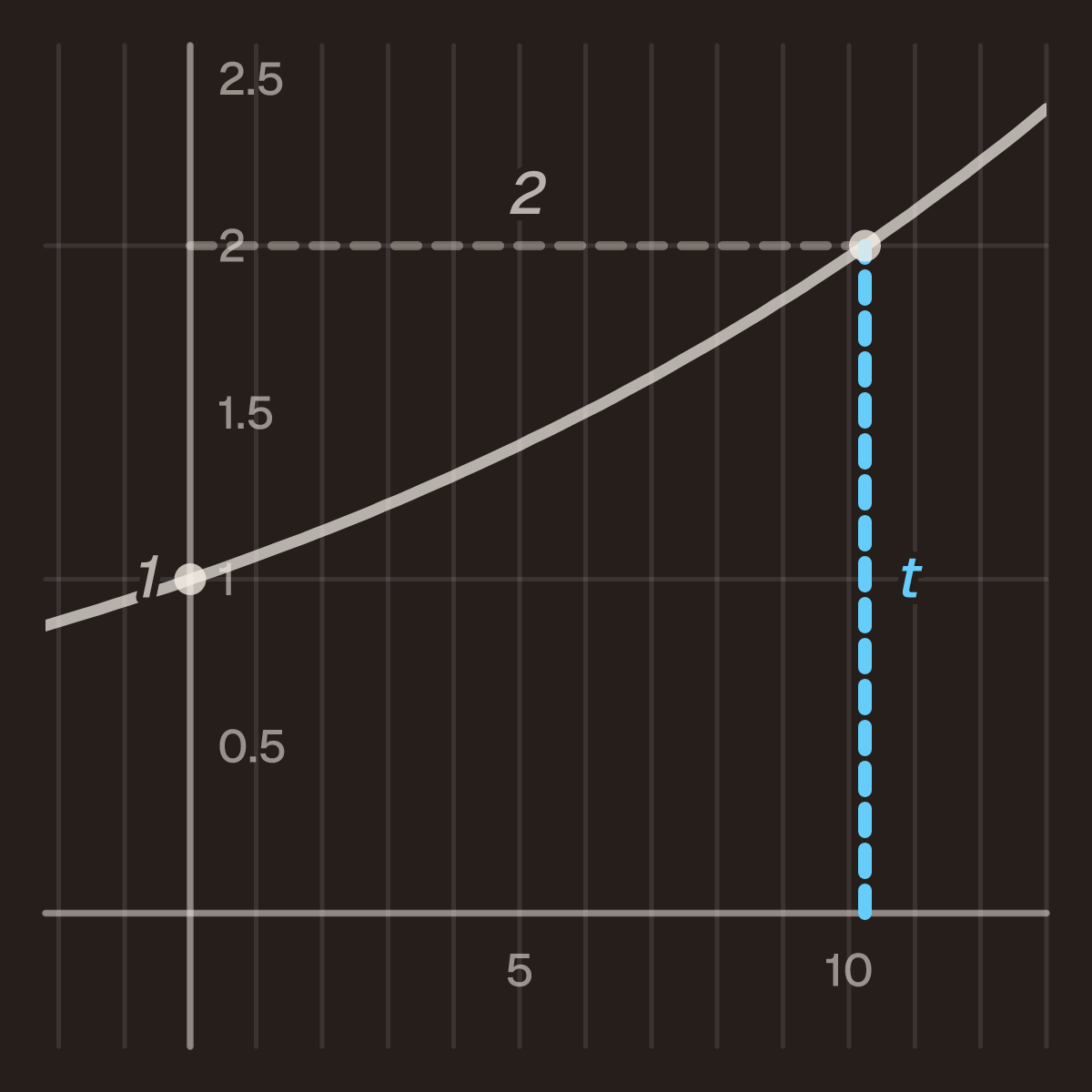
At 7%: ln 2 / ln 1.07 = 0.6931 / 0.06766 ≈ 10.2 years.
The base of the logarithm makes no difference. The two logarithms divide and the base cancels, so
log 2 / log 1.07 gives exactly the same answer. ln is written here only because it is the usual one.
Derivation: where the amount goes
Start from compound interest and set the final amount to twice the
starting one:
- 2P = P · (1 + r/100)^t
- 2 = (1 + r/100)^t — the capital
P is on both sides and cancels
- ln 2 = t · ln(1 + r/100) — the logarithm brings the exponent down
- t = ln 2 / ln(1 + r/100)
The capital is already gone at step 2, and that is the point: how long a doubling takes does not
depend on how much you have. A thousand and a million double in exactly the same number of years at the
same rate. It is also why doubling time works on things that are not money — a population, an electricity
bill, a subscriber count.
Compared with the rule of 72
The rule of thumb says the doubling time is roughly 72 divided by the rate. It is not the formula, but it
goes a long way in your head:
| Rate |
Exact |
Rule of 72 |
| 2% |
35.0 years |
36 years |
| 3% |
23.4 years |
24 years |
| 5% |
14.2 years |
14.4 years |
| 7% |
10.2 years |
10.3 years |
| 10% |
7.3 years |
7.2 years |
| 24% |
3.2 years |
3.0 years |
Around 8% the rule is almost exact, and it drifts in both directions from there. 72 is chosen over 70
because it divides by 2, 3, 4, 6, 8, 9 and 12 — a rule built for mental arithmetic, not for precision.
The other way round
If you know the doubling time and want the rate, the formula turns around:
Something that doubles in ten years is therefore growing at 100 · (2^0.1 − 1) ≈ 7.2% a year.
Frequently asked questions
Does it only apply to money?
No. The formula contains nothing but a percentage change per period. The same arithmetic gives the
doubling time of a population, a dataset or a user count — and the period need not be a year, as long
as the rate is for the same period.
What about halving time?
Replace 2 with 0.5 in the numerator and use a negative change: t = ln 0.5 / ln(1 − r/100). At −10% a
year a halving takes about 6.6 years.