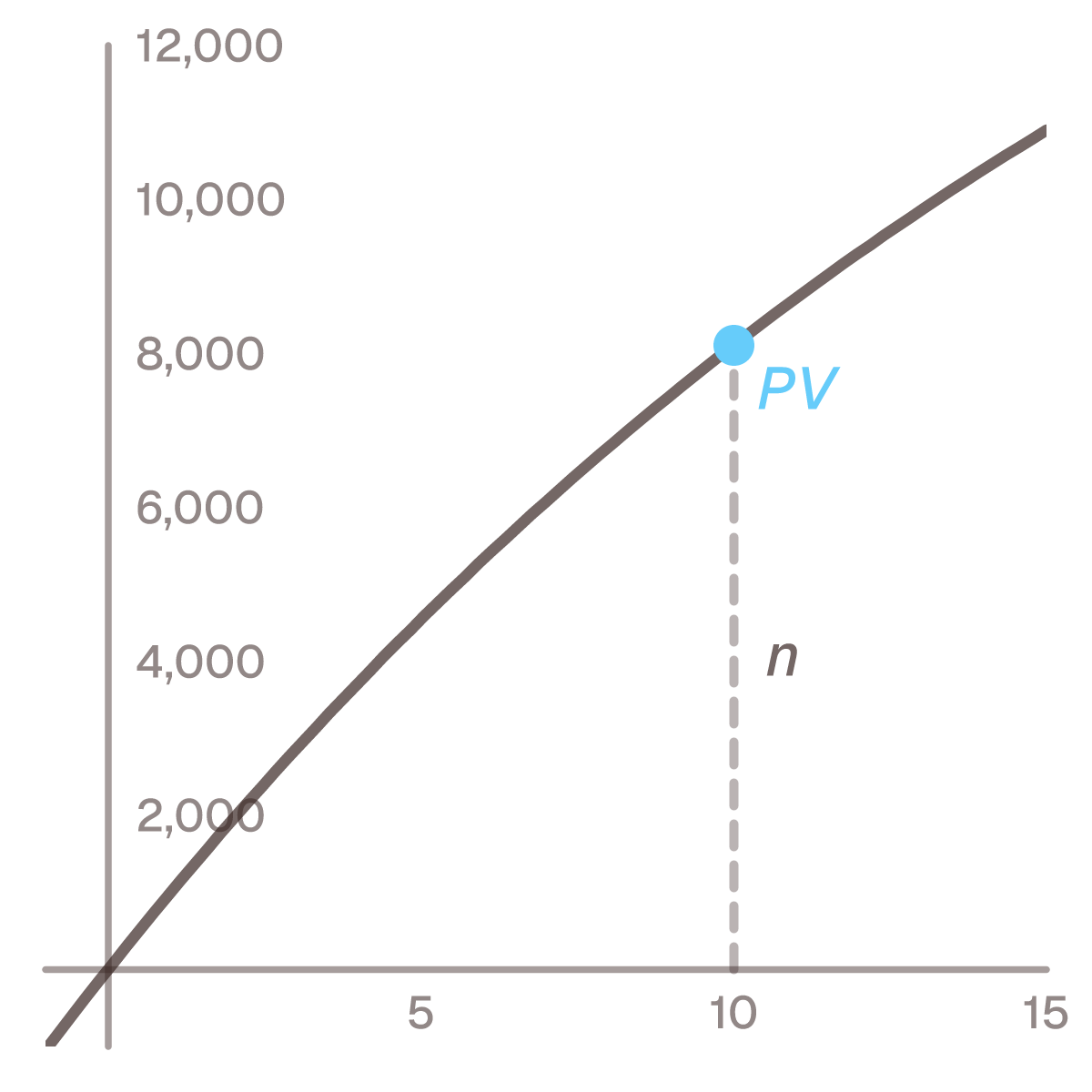
- PV = PMT · (1 − (1 + r/100)⁻ⁿ) / (r/100) · (1 + r/100)
where PMT is the payment per period, r the interest rate per period in per cent, n the number of
payments and PV the present value, measured at the first payment. The payments come at the start of
each period, which makes them an annuity due.
Holds when the payments are equal, the rate is the same every period, and the rate’s period is the same
as the period between payments.
Everything up to the last · (1 + r/100) is the present value of an ordinary annuity, with each payment
at the end of its period — what an amortizing loan is built on (the
annuity formula writes the rate as a decimal,
r/100). When each payment comes one period earlier it is discounted one period less, and the whole
present value is (1 + r/100) times larger. The first payment is not discounted at all: it is paid today.
Worked examples
Ten periods. 1,000 at the start of each period for ten periods at 5% per period:
- PV = 1,000 · (1 − 1.05⁻¹⁰)/0.05 · 1.05 ≈ 8,107.82
The same payments at the end of each period are worth 7,721.73. The ratio is 1.05.
Two other routes to the same number. Add up the ten payments, each discounted by the number of periods it
lies ahead: 1,000 + 1,000/1.05 + 1,000/1.05² + … + 1,000/1.05⁹ ≈ 8,107.82. Or take the
future value of the same payments,
13,206.79, and discount it ten periods: 13,206.79 / 1.05¹⁰ ≈ 8,107.82.
A three-year lease. 50,000 at the start of each year for three years, at a 6% discount rate:
- PV = 50,000 + 50,000/1.06 + 50,000/1.06² ≈ 141,669.63
The formula gives the same number. With the payments at the end of each year the present value would be
133,650.60 — just over 8,000 less for the same three payments.
Start or end of the period
That is the only difference from the ordinary present-value formula. Rent paid in advance and a lease
whose first payment is due when it starts belong here; a loan payment is paid in arrears, a month after
the money was lent.
| Periods |
End of period |
Start of period |
| 1 |
952.38 |
1,000.00 |
| 5 |
4,329.48 |
4,545.95 |
| 10 |
7,721.73 |
8,107.82 |
| 20 |
12,462.21 |
13,085.32 |
| 30 |
15,372.45 |
16,141.07 |
1,000 per period at 5% per period. At one period the present value is the payment itself.
The other unknowns
The card at the top of the page solves for any of the four. The payment is a division. The number of
periods takes a logarithm:
- n = −ln(1 − PV · (r/100) / (PMT · (1 + r/100))) / ln(1 + r/100)
The expression inside the logarithm has to be above 0. If it is not, the present value is more than
payments for ever are worth, PMT · (100 + r)/r, and no number of periods reaches it. The rate has no
rearrangement; the card searches for it, as it does for the
net present value.
Common mistakes
- Discounting the first payment. It arrives today and is worth its full amount. The last one is
discounted
n − 1 periods, not n.
- Using the end-of-period formula for rent paid in advance. The present value comes out one period’s
interest short. Multiply by
(1 + r/100).
- Mixing an annual rate with months. For monthly payments,
r has to be the rate per month and n
the number of months.
- Typing the rate as a decimal. The formula has
r/100 in it. Typing 0.05 where it expects 5 makes the
rate a hundred times too small and the present value close to PMT · n.
Questions people ask
Why is the present value larger when the payments come earlier?
Money that arrives earlier can earn interest for longer. Each payment is one period closer, so it is
divided by (1 + r/100) one time fewer.
What does a spreadsheet’s PV function use?
PV(rate, nper, pmt, fv, type) in Excel, LibreOffice and Google Sheets takes a last argument for the
timing: 0 or left out for the end of the period, 1 for the start. The rate is a decimal there, and the
result comes back negative when the payment is typed as a positive amount.
What if the payments never stop?
Then (1 + r/100)⁻ⁿ goes to 0 and the present value becomes PMT · (1 + r/100)/(r/100). That is the
present value of a perpetuity with the
first payment today rather than one period from now.