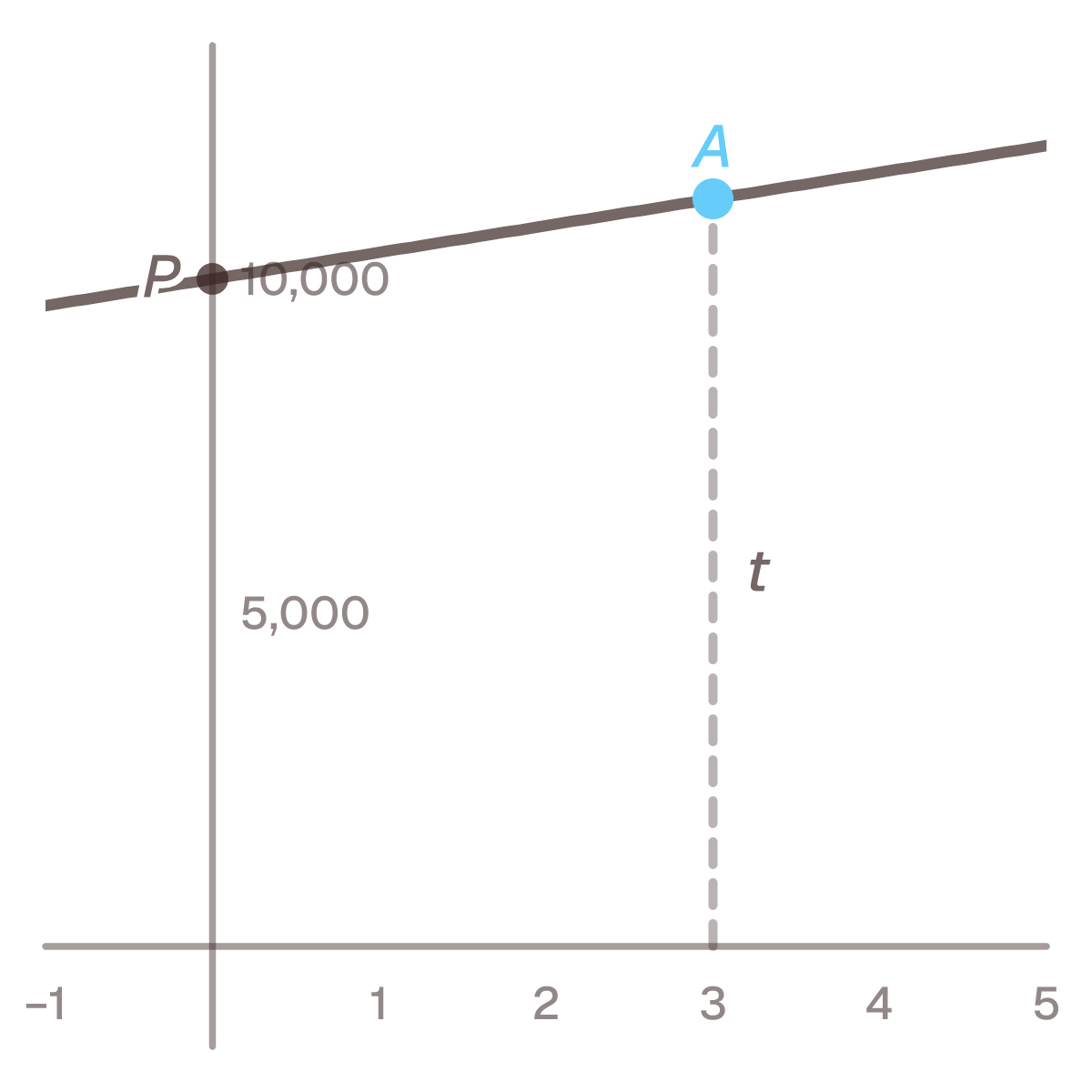
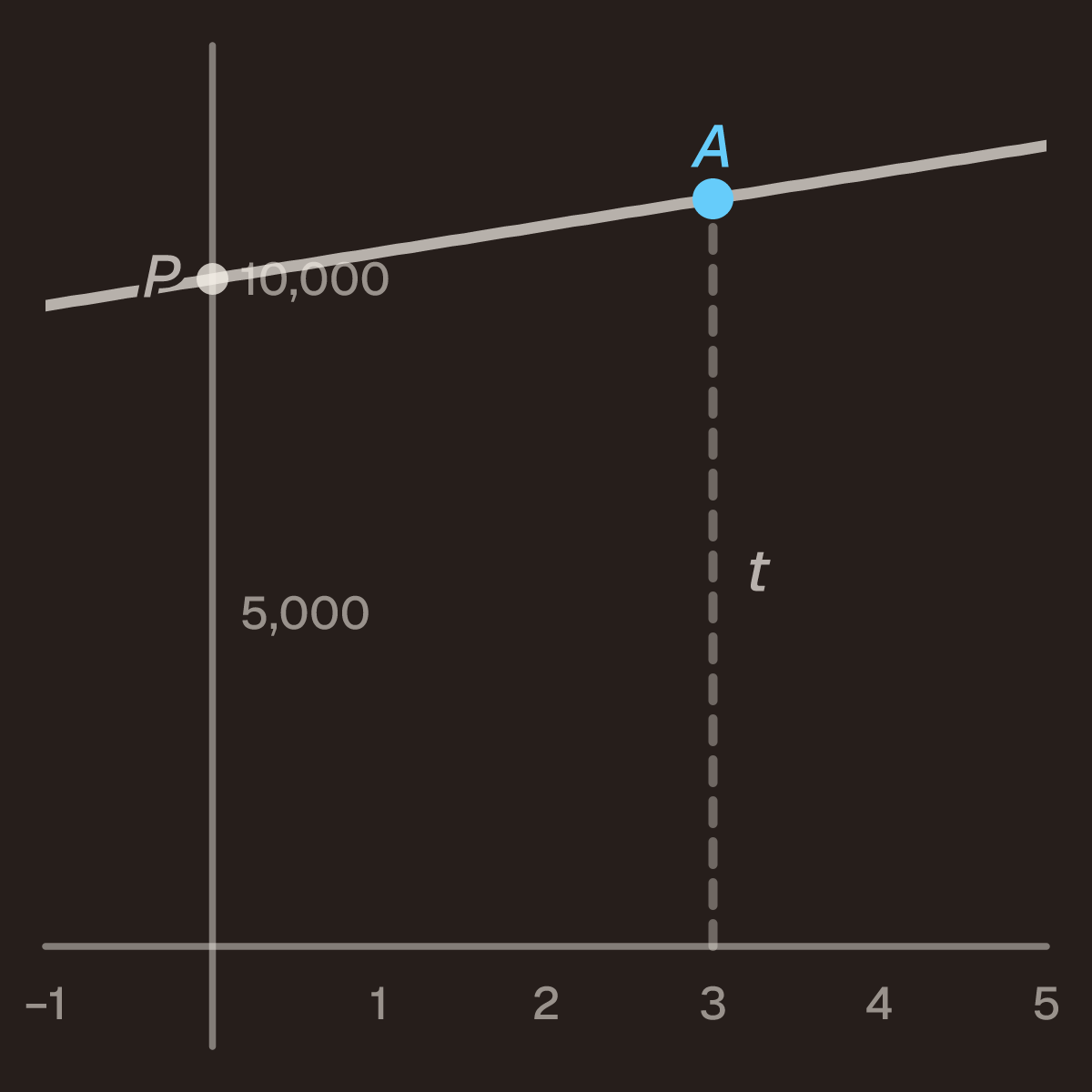
A equals 10,000 plus (((10,000 times 4) times 3) divided by 100), equals 10,000 plus ((40,000 times 3) divided by 100), equals 10,000 plus (120,000 divided by 100), equals 10,000 plus 1,200, equals 11,200
Working5 steps
A
=
10,000+10,000·4·3100
=
10,000+40,000·3100
=
10,000+120,000100
=
10,000+1,200
=
11,200
Practice questions
You are given
A=8160
r=4
t=9
Questions in several steps
Questions that start in another formula and end in this one.
Interest → Total
A loan runs at simple interest. How much is the interest, and how much is repaid in total?
You are given
Principal (P)=19000
Interest rate (r)=3
Years (t)=5
Carry a rounded answer into the next step if you like. That is marked right too.
Step 1
Step 2
Opens when step 1 is answered.
The formula
Simple interest gives the interest. The total is the
principal plus that interest:
A = P + P · r · t / 100
The same thing can be written A = P · (1 + r · t / 100), but the first form says what happens: what you
borrowed, and on top of it what the loan cost.
Worked examples
The total to repay. You borrow $10,000 at 4% simple interest for three years. The interest is
10,000 · 4 · 3 / 100 = $1,200, and the total is 10,000 + 1,200 = $11,200.
The principal, backwards. You owe $11,200 after three years at 4%. The principal is
100 · 11,200 / (100 + 4 · 3) = 1,120,000 / 112 = $10,000.
The rate. You borrowed $10,000 and paid back $11,200 after three years. The rate is
100 · (11,200 − 10,000) / (10,000 · 3) = 4%.
The interest or the total
“How much do I pay back” and “how much does the loan cost” have different answers:
Question
Answer
What does the loan cost?
$1,200 (the interest)
What do I pay back?
$11,200 (the total)
Common mistakes
Stopping at the interest. $1,200 is what the loan costs, not what is repaid. The principal goes
back too.
Working backwards from the total without taking the principal off. To get the rate out of the
total, subtract the principal first so that only the interest is left.
Compounding by mistake. With simple interest the debt grows by the same amount every year. If the
interest is added to the principal, compound interest
applies instead.
Questions people ask
Why do some books write A = P(1 + rt)?
They write the rate as a decimal, 0.04 rather than 4%, so there is no division by 100. The result is
the same.
Does the same formula work for savings?
Yes, as long as the interest is not added to the balance along the way. A is then what is in the
account at the end. Most savings accounts compound, though.
Copy the code into your page where the formula card should appear. It loads from lovetocalc.com, so it stays current on its own — all we ask is that the credit line comes with it.