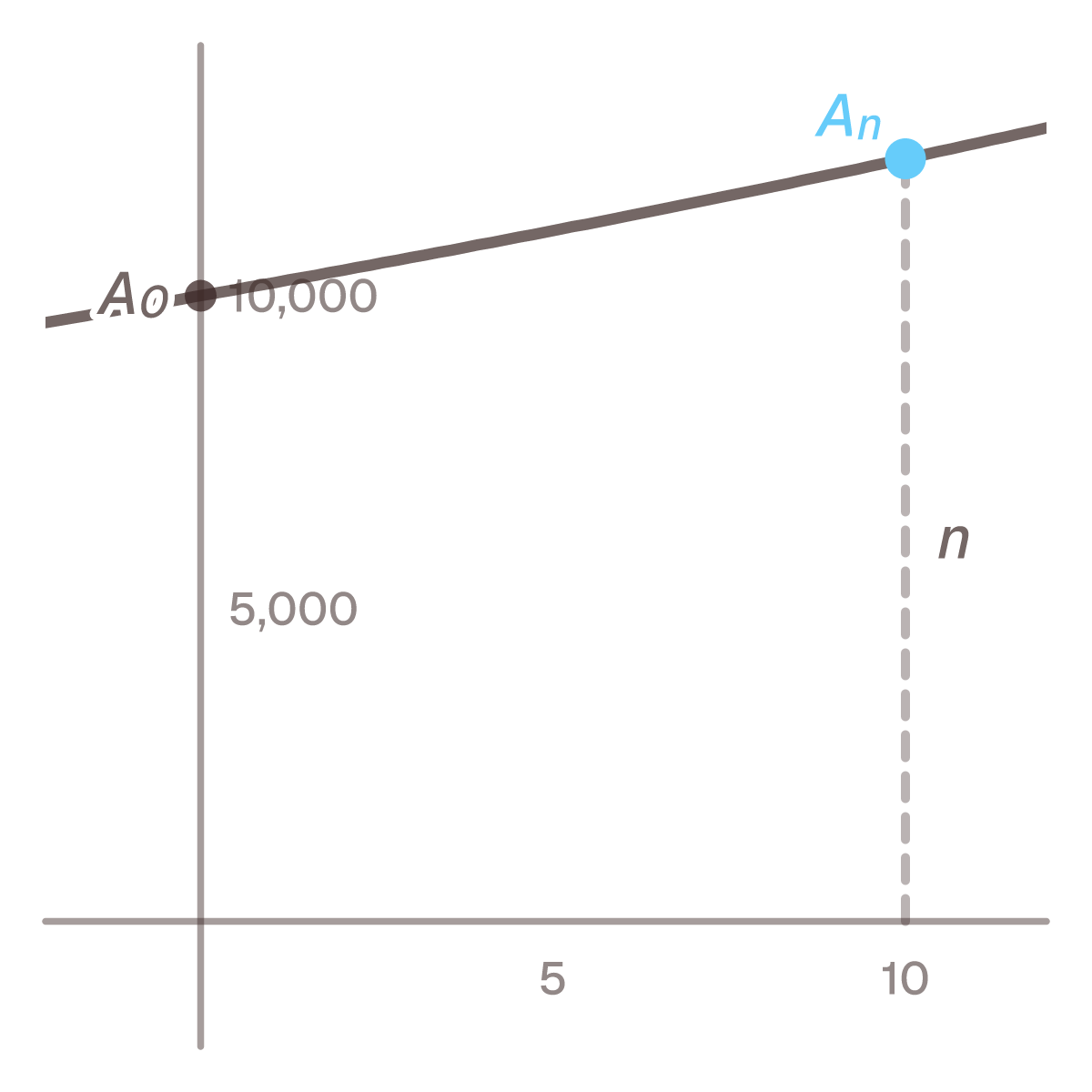
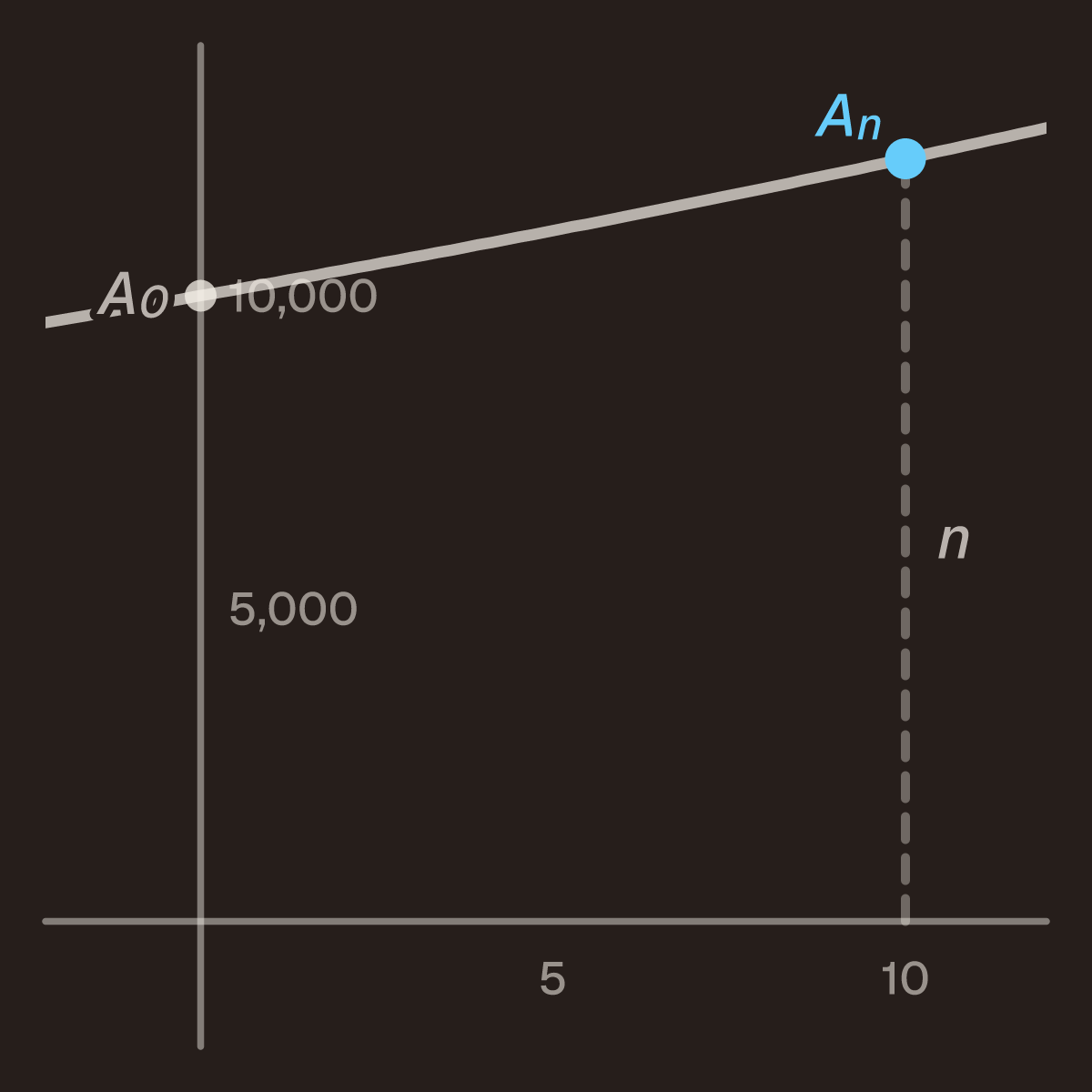
A₀ is the amount you start from, i the inflation per year written as a decimal, n the number of
years and Aₙ the amount expressed in the later year’s money. With inflation as a percentage the factor
is (1 + i/100), which is the form the card works in.
It is exactly the formula for
compound interest. The difference is not in the
mathematics but in what grows: there a deposit becomes worth more, here prices rise while the amount
stands still. Money under a mattress loses value in every year of positive inflation, for precisely
that reason.
Which way round?
The formula is used in both directions, and mixing them up is a common mistake.
| The question |
The arithmetic |
| What would a 1990 item cost today? |
Multiply: A₀ · (1 + i)ⁿ |
| What was today’s amount worth in 1990? |
Divide: Aₙ / (1 + i)ⁿ |
The check is simple. Prices have risen, so the older amount has to come out larger when it is
restated in today’s money. A smaller number means you divided where you should have multiplied.
Worked examples
Fifteen years at 2%. Something that cost 500 costs 500 · 1.02¹⁵ = 500 · 1.345868 ≈ 672.93. The
item is no dearer — the currency is smaller.
The salary that stood still. 30,000 a month through one year at 8% and one at 4% is worth
30,000 / (1.08 · 1.04) = 26,709 in the first year’s money. An unchanged salary is a cut.
What inflation has there been? An amount that went from 10,000 to 12,100 in two years gives
i = (12,100/10,000)^(1/2) − 1 = 10% a year. That is the same calculation as
compound annual growth rate.
Common mistakes
- Adding the inflation up year by year. Two years at 5% is not 10% but 1.05² − 1 = 10.25%. The gap
widens fast: ten years at 5% is 62.9%, not 50%.
- Dividing where you should multiply. See the table above. Older money is scaled up to today’s
value.
- Using an average over an uneven period. 8% one year and 2% the next is not the same as 5% twice,
even though it is close. Multiply the factors separately when you have them.
- Taking the inflation figure from memory. The number has to be read off the statistics office for
the years in question. This page stores none, precisely because a stored one is wrong within a year.
Common questions
Where do I find the inflation for a given year?
From the national statistics office, which publishes a consumer price index monthly and yearly. Over
longer periods it is easier to take the ratio of two index numbers directly than to multiply the
yearly rates together.
Is this the same as the real interest rate?
No, but they belong together. This formula restates an amount; the
real interest rate restates a rate. If you
have both a return and an inflation figure, the real rate is what you want.
Does it work for deflation?
Yes. A negative i gives a factor below 1 and the amount shrinks. The only value the formula cannot
take is i = −100%, where everything is gone in a year and there is no way back.